
 By
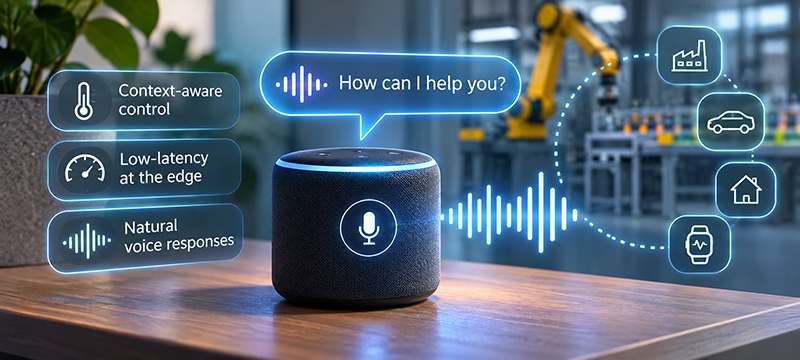
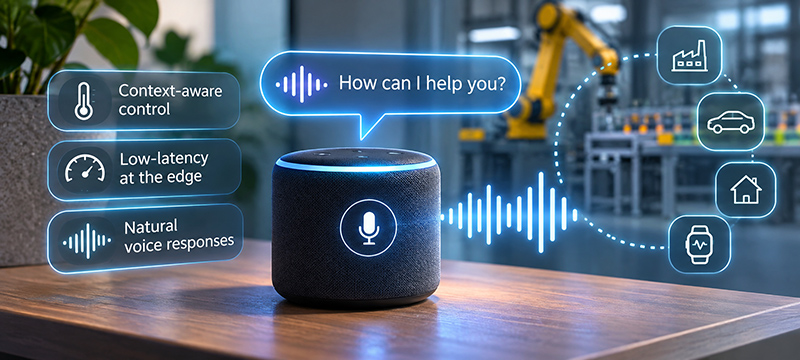
Voice command is currently the hottest technology. From smart speakers and smart wearables, through to smart home equipment and even industrial control panels, it seems as if every other connected device out there today is now ‘voice enabled’.
If you are a developer that wants to include voice command within your latest device design, then a technology such as ElevenLabs AI personal assistant could be just the thing to help you on your way. Offering the tools to make it possible to add ‘converse with the device’ capabilities to your product or service is the name of its game, giving you the possibility to talk and then receive responses that are both conversational and natural.
Why context is king in an embedded voice interface
Any smart assistant built into a connected device needs to be smart enough to interpret not only what the person using it actually says out loud, but also contextual information from things such as the status and settings of the connected device itself, as well as the user’s intention.
For example, a connected thermostat could be given a command such as ‘Make it warmer’ and depending on a wide range of factors, such as the current temperature, its operating mode and even occupancy status, it could react and adjust temperature in any number of ways.
‘What’s the operating temperature for this machine?’, ‘Show me a maintenance checklist’: These are the kinds of commands that might be spoken by a factory worker wearing a connected headset. An integrated smart assistant could then use a combination of sensor readings and technical documentation within the connected device itself to provide the answers to those commands, along with providing information, meaning that the factory worker does not even need to walk across to an external terminal to do his or her job.
How to manage latency on edge devices?
Nobody really likes latency. When speaking to a device there is a noticeable pause before an answer comes back, it’s pretty off-putting to most people. It can be especially off-putting in the case of a conversational interface, when users typically expect that response times will be fast.
The whole idea behind edge computing is to move a certain amount of the functionality involved with compute out to the actual ‘edge’ where the data itself exists. Or in this case, where the smart speaker or smart device might be. In doing so, operations such as the device’s wake word detection, removing any background noise and basic recognition of commands, happen directly on the device itself. This in turn reduces the amount of data that needs to go across any network. Of course, where more advanced natural language processing is required, or the smart assistant needs to generate expressive speech for instance, tapping into extra compute resources is often required.
When developing the solution, a developer must consider what can actually be done locally, at the edge, and what might require cloud services to process. Also, when thinking along these lines, it’s worth keeping in mind that each device that is used is going to have its own constraints, in terms of processing costs, battery life and even the level of network connectivity that it provides. The processing power and battery life that a smart assistant built into a wearable device might have, for example, is far less than a home hub that is always on and connected.
How to design natural audio responses?
Getting responses from your smart device or smart assistant is all well and good, but if your response sounds stilted and robotic, or has inconsistent or even unnatural sounding pronunciation, strange pauses etc., then it’s going to be difficult for your end user to understand it, and more to the point, follow the instructions that it’s trying to give them.
Today, thanks to the advances of text-to-speech technologies, creating voice responses that sound natural and conversational is actually quite straightforward. If you require more natural voices for your app, ElevenLabs provides a Text to Speech, and ElevenAgents, a conversational agent platform, might be just the solution you need.
This means that in the case of a smart device, for example, it could actually provide clear instructions on how to cook while you’re busy making dinner. Alternatively, in the case of a smart assistant inside your car, it might actually provide navigational information while you can keep your eyes firmly on the road in front of you.
ElevenLabs agents can also support over 90 languages and the ability to switch language mid-conversation, making the perfect solution for manufacturers selling products into different markets. If you’d like the same voice for your product that you’re using with your license, you could even consider the possibility of voice cloning, provided you have express permission from the source.
Protecting privacy and ensuring device reliability
Contextually aware personal assistants, by their very nature, need to be able to interact with sensitive and personal data, such as your household schedules, your location and even data concerning your use of a connected device. Therefore, trying to limit how much personal data you actually require to perform each action that you want it to complete, as well as putting in place policies that govern how that data is actually stored and who gets to see it, is key. By keeping data processing local, where possible, it also means that you are limiting how much of your personal data is actually making its way out into the wider world. That said, just because you’re doing things locally, it doesn’t mean that you are off the hook where things like secure updates, authentication and data encryption are concerned, either.
A smart assistant being unable to quite grasp your instruction and turning the lights on a few minutes late, might not be the end of the world. A smart assistant controlling equipment in an industrial environment where it doesn’t quite manage to understand an instruction, however, could be. By asking for confirmations before completing any important actions and also by ensuring that you provide important controls that can still be performed using trusted and well established manual methods, you can help mitigate many of these potential issues.
How to actually make it work?
A key to the success of any voice project developed to work within embedded devices is having an actual objective to aim for. A good way to do that is to actually analyze what are the most popular commands that your end users are actually likely to be using. This in turn gives you an excellent starting point to test your hardware capabilities and begin performance measurements, based on real-world conditions like noisy environments and iffy connections.
At that point you’re then going to want to actually test a range of things such as battery usage, latencies, the accuracy of the speech recognition and quality of the voice etc. After all, what might work perfectly well when it’s tested in a quiet lab isn’t necessarily going to behave in the same way when you get out onto a noisy factory shop floor, or inside a moving vehicle, for example.
The post Embedded Voice Interfaces: Bringing Context-Aware AI Assistants to Edge Devices appeared first on IoT Business News.