

 By

Smart home adoption is expected to reach 200.7 million households across Europe and North America by 2030, according to Berg Insight. The market is increasingly shifting toward integrated solutions that deliver measurable benefits in security, energy management and home automation.
As connected thermostats, security cameras, lighting systems and appliances become increasingly common, the focus is shifting toward making these products work together and deliver practical value beyond remote control.
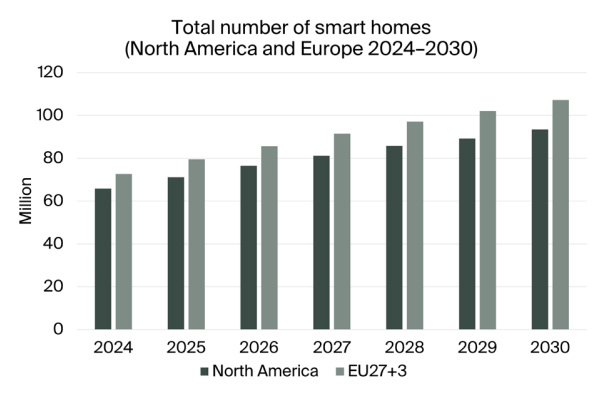
This transition is taking place as smart home adoption continues to expand. According to the latest research from Berg Insight, 150.6 million households in Europe and North America had at least one smart home system at the end of 2025. That figure is forecast to reach 200.7 million by 2030, representing approximately 50 million additional connected households over five years.
Europe Leads in Smart Home Numbers, North America in Penetration
North America remains the more mature smart home market, with 71.1 million connected households at the end of 2025, representing 47.2 percent of all households in the region. Berg Insight expects this figure to increase to 93.5 million by 2030, corresponding to a compound annual growth rate (CAGR) of 5.6 percent.
Europe, defined in the report as the EU27+3 countries, has a larger absolute number of smart homes but lower market penetration. The region counted 79.5 million connected households in 2025, equivalent to 33.3 percent of households. With an expected CAGR of 6.2 percent, the European installed base is projected to reach 107.2 million smart homes by 2030.
The difference reflects distinct market structures. Interactive home security services have become an important gateway to smart home adoption in North America, where companies such as ADT, Vivint, SimpliSafe, Comcast and Telus combine security monitoring with connected home functionality.
In Europe, traditional home automation platforms and do-it-yourself solutions play a more prominent role. Companies including Shelly, eQ-3, Somfy, Loxone and Verisure are among the leading providers of whole-home systems.
More Than 567 Million Smart Home Systems Already Installed
One important distinction in Berg Insight’s research is the difference between connected households and the number of systems installed within them. A single household may operate several independent smart home solutions, making the installed base of systems substantially larger than the number of smart homes.
At the end of 2025, North America had 314.6 million smart home systems in use, including 243.7 million single-purpose solutions and 70.9 million multifunction or whole-home systems.
Europe accounted for another 253.2 million installed systems, comprising 202.2 million point solutions and 51.0 million whole-home systems.
Combined, the two regions therefore represented approximately 567.8 million installed smart home systems.
These figures highlight an important opportunity for IoT platform providers and device manufacturers. The market is not simply expanding through the addition of new connected households. Existing smart homes already contain multiple systems, creating opportunities to integrate previously separate applications into more coordinated environments.
Smart Home Revenues Could Reach €153.7 Billion by 2030
The financial outlook also points to continued expansion. Berg Insight estimates that smart home revenues in North America reached US$57.4 billion (€50.8 billion) in 2025 and will increase to US$88.0 billion (€77.9 billion) by 2030, representing an 8.9 percent CAGR.
Europe is expected to grow faster, with revenues rising from €44.5 billion in 2025 to €75.9 billion in 2030, corresponding to an 11.3 percent CAGR.
Across both regions, the research firm forecasts combined annual revenues from home automation system shipments and service fees of €153.7 billion by 2030, compared with €85.6 billion in 2025.
Revenue growth exceeding household adoption growth suggests that market expansion will increasingly depend on the value of connected products, additional functionality and associated services, rather than simply bringing new households online.
Interoperability and AI Shape the Next Phase
The smart home ecosystem remains fragmented across communication technologies, device manufacturers and software platforms. Wi-Fi, Bluetooth, Zigbee, Z-Wave, Thread and other technologies coexist, while interoperability initiatives such as Matter aim to simplify integration between products from different vendors.
Berg Insight identifies interoperability, embedded smart home hub functionality and artificial intelligence among the important developments shaping the market through 2030. The report also highlights energy efficiency, product discontinuations and consumer trust as issues influencing adoption.
For IoT manufacturers and system integrators, this creates a practical challenge: supporting connectivity alone is insufficient when consumers expect devices to operate as part of a broader home environment. Compatibility, long-term software support and integration with established platforms are becoming important considerations in product development.
AI could further change how these systems operate, enabling more automated coordination between security, heating, lighting and other connected functions. However, delivering this functionality requires reliable access to data and consistent interaction between devices that may come from different manufacturers.
Security, climate control and service robotics are particularly relevant categories because their benefits are readily identifiable. Connected security systems address protection and monitoring needs, while smart thermostats and energy management solutions can help households optimize consumption and costs.
The findings suggest that the next competitive phase of the smart home market will be defined less by the number of devices a manufacturer can connect and more by how effectively those devices contribute to an integrated, dependable and useful home automation experience.
The post Smart Homes in Europe and North America to Exceed 200 Million by 2030 appeared first on IoT Business News.