
 By
There are more connected devices on our planet than there are people. No longer an emerging technology, the Internet of Things (IoT) has become the critical infrastructure on which we are dependent for everything from reliable water supply and electricity smart metering to motorway monitoring systems and wearable fitness trackers.
As the IoT moves away from isolated connected devices to large-scale, always-on and increasingly industrial infrastructure, it generates huge volumes of data for processing, analysing and ultimately to trigger automated actions or inform decision-making. The question for businesses today is how quickly this data needs to be processed and what storage architecture can support its use most efficiently?
IoT Layers
Most modern IoT systems feature five architectural layers through which data flows in a continuous cycle. The device layer captures data in the real world, primarily from sensors; the edge layer processes the data close to where it has been generated, perhaps from the device itself, or on an edge server nearby; the connectivity layer allows data to be transmitted between systems and connects devices, edge systems and cloud platforms so data is always flowing; the cloud layer, which has the compute power and capacity, stores data at scale; while finally, the application layer is user-facing and can be presented in dashboards, monitoring tools and business applications.
Ensuring that the IoT system delivers maximum value means distributing workloads across the layers in such a way that performance, cost efficiency, scalability and reliability are balanced. Rather than choosing between cloud and edge, most organisations will opt for a hybrid approach where time-sensitive tasks are handled at the edge, while the cloud layer is used for analysis, historical data storage or centralised management.
Strategic Data Storage
How best to store data in IoT environments is an important and strategic consideration. Today, that means not just accommodating more of it but storing the right data in the right place, at the right performance level and for the right length of time.
In businesses where urgent decisions are required, sending data to a centralised cloud and waiting for a response is likely to result in delays, whereas processing it locally, either at device level or on edge servers helps to reduce latency, and delivers a faster response.
High-performance storage is essential for maintaining system responsiveness at scale, but organisations should avoid a single storage strategy for all their IoT data. If the primary data requirement is for immediate operational decision-making, for example, local or edge processing and fast storage, is ideal, but if it is for historical analysis, cloud storage would be better. Frequent operational analysis will require high-performance edge or server storage, but for organisations with large volumes of lower-value data, a better option is high-capacity, cost-efficient storage.
Our recommendation for industrial automation, medical and real-time monitoring applications is to use device-level or edge storage, which allows filtering of data to be carried out rapidly, enabling immediate actions to be triggered.
In terms of the storage hardware, enterprise SSDs will help to reduce corporate bottlenecks by delivering low latency and high throughput, which allows data to be written and accessed quickly even under sustained workloads. These devices also support encryption, secure erase and power-loss protection, which helps to safeguard sensitive IoT data from unauthorised access, loss and corruption.
Many IoT deployments now rely on specially designed industrial or embedded storage within edge devices to capture and process data closer to the source. These systems provide an important role for applications that need low latency, local decision-making or operation in environments with poor connectivity.
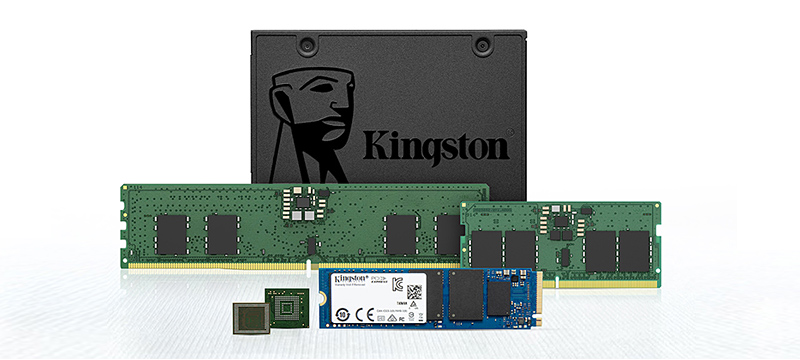
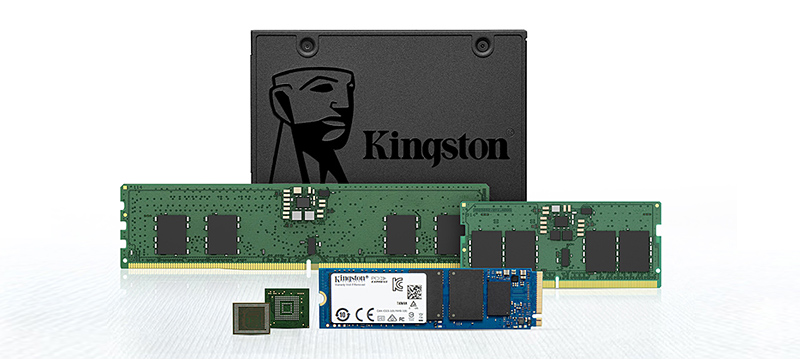
Kingston Technology differentiates its embedded and industrial solutions through a broad product portfolio, lifecycle management, and customer-focused technical support. Our offering includes industrial DRAM, industrial SATA and NVMe SSDs, alongside embedded solutions such as eMMC, UFS and discrete DRAM, providing organisations with options to suit different system architectures and application requirements.
IoT devices are increasingly used in constrained conditions where there is unreliable power, restricted physical space or extreme temperatures, and which requires industrial-grade embedded data storage built to withstand these environments. Not only are they robust, but protecting the data is essential for maintaining compliance and operational resilience.
Cost Considerations
When it comes to budgeting for IoT data storage, capacity, performance, power, maintenance, replacement, scalability and data movement all contribute to the total cost. Organisations must consider how much data is generated and how long it must be retained, as well as where it should be stored. Over-provisioning creates unnecessary expense, but insufficient capacity can affect performance and availability. Storage selection should aim to balance all of these considerations with the total cost of ownership while allowing for future growth.
Expert guidance can also make a significant difference. Through programmes such as Kingston’s Ask an Expert, our team works directly with organisations to assess their existing environments and recommend memory and storage configurations based on their measured requirements.
As connected deployments continue to expand, the importance of data storage will increase. By aligning storage infrastructure with workload requirements and planned scaling of the business, organisations can contain costs and ensure their IoT data remains available, useful and actionable as it is needed.
The post The Hidden Challenge of IoT Adoption: Why Reliable Memory and Storage Matter appeared first on IoT Business News.