

 By

The global installed base of active telematics systems in motorcycles, scooters and mopeds is forecast to exceed 85 million units by 2030, according to Berg Insight, with factory-installed connectivity significantly outpacing aftermarket solutions.
Connected vehicle technology is extending beyond passenger cars and commercial fleets, with motorcycles, scooters and mopeds emerging as an increasingly important market for embedded IoT connectivity. The expansion of electric two-wheelers, combined with growing demand for security, safety and digital services, is accelerating the integration of telematics directly into vehicles.
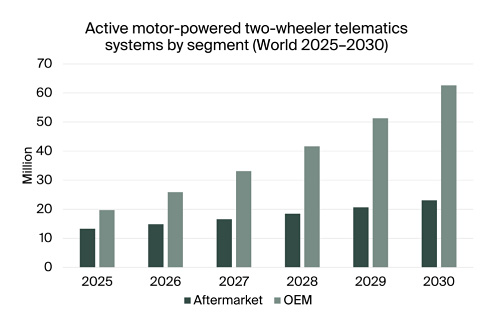
According to a new report from Berg Insight, the global installed base of active OEM telematics systems in motor-powered two-wheelers is expected to grow from 19.7 million units at the end of 2025 to 62.6 million by 2030, representing a compound annual growth rate (CAGR) of 26.0%.
Including aftermarket solutions, the total number of active connected two-wheeler telematics systems reached 32.8 million in 2025 and is projected to rise to 85.7 million by 2030.
Factory-installed telematics takes the lead
One of the report’s most significant findings is the widening gap between embedded OEM connectivity and aftermarket telematics.
While the aftermarket installed base is forecast to increase from 13.3 million systems in 2025 to 23.1 million in 2030, corresponding to an 11.7% CAGR, OEM systems are expected to expand considerably faster.
As a result, factory-installed solutions would account for approximately 73% of active two-wheeler telematics systems by 2030, compared with around 60% in 2025.
The shift is also reflected in annual shipments. Berg Insight expects shipments of OEM telematics systems to increase from 8.6 million units in 2025 to 21.6 million in 2030, while aftermarket shipments are forecast to grow from 5.3 million to 9.1 million over the same period.
This evolution has important implications for the IoT supply chain. As connectivity becomes integrated into vehicle designs rather than added after purchase, telematics providers must increasingly address OEM requirements for hardware integration, software management and long-term connectivity services.
Electric two-wheelers and Asian manufacturers drive adoption
India and China are playing a central role in the expansion of connected two-wheelers, with manufacturers increasingly using digital services to differentiate their products.
In India, companies including Ather Energy, Hero MotoCorp, TVS Motor, Bajaj Auto’s Chetak brand and Royal Enfield offer connected services. Chinese manufacturers such as NIU Technologies, Yadea, Segway-Ninebot, AIMA Technology and Sunra are also active in the market.
Electrification represents a particularly important catalyst. Beyond traditional vehicle tracking and theft protection, connected electric two-wheelers create opportunities for battery-related services, remote diagnostics and software updates.
Berg Insight’s report also identifies battery swapping, vehicle financing and leasing as application areas supported by telematics. These use cases illustrate how embedded connectivity can become part of the operational infrastructure supporting electric mobility services, rather than simply an optional feature for riders.
In Europe, BMW Motorrad has been an early adopter, introducing emergency call services in 2017 and expanding its connected offerings since then. However, the strongest momentum in OEM telematics deployment is currently coming from Asian manufacturers.
Automotive suppliers and IoT specialists compete for OEM programs
The growing adoption of embedded connectivity is attracting suppliers from both the automotive industry and the specialised IoT telematics ecosystem.
Established automotive technology companies including Bosch, Harman International, LG Electronics, Panasonic, Visteon, Actia and Aumovio are extending their capabilities into the two-wheeler segment.
At the same time, specialised providers such as Ajjas, iTriangle Infotech, Nexular, Trak N Tell and Vecmocon Technologies are supplying hardware and software solutions to manufacturers, particularly in India.
JioThings illustrates another approach, combining telematics capabilities with access to cellular connectivity services through its sister company Reliance Jio Infocomm.
For connectivity providers and system integrators, this increasingly diverse supplier landscape creates opportunities extending beyond cellular access to include device management, vehicle data integration and connected service platforms.
However, OEMs are also retaining direct control over parts of their telematics ecosystems, particularly customer-facing applications and connected services. This suggests that technology suppliers will need to support different integration and commercial models rather than relying exclusively on complete end-to-end offerings.
Aftermarket solutions retain a significant role
Despite the rapid expansion of embedded connectivity, aftermarket telematics remains a substantial market, particularly for stolen vehicle tracking and theft prevention.
India and China account for large installed bases, while additional opportunities exist across Southeast Asia, Africa, the Middle East and Latin America.
Specialised providers such as Monimoto, GeoRide, Mapit IoT, Ituran and Tracker Connect serve this market, alongside hardware manufacturers including Queclink, Teltonika, Jimi IoT and Ruptela.
The continued growth of aftermarket systems indicates that embedded connectivity will not eliminate demand for independently installed tracking solutions, especially across existing vehicle populations without factory-fitted telematics.
Looking ahead, Berg Insight also identifies deeper vehicle integration, digital instrument clusters, 5G RedCap and vehicle-to-everything (V2X) communications among the technology developments relevant to the sector.
The broader transition is therefore not simply about connecting more motorcycles and scooters. It reflects a shift towards software-enabled two-wheelers in which connectivity increasingly supports vehicle functionality, ownership services and new mobility business models.
The post Connected Two-Wheeler Telematics Market Set to Exceed 85 Million Systems by 2030 appeared first on IoT Business News.