
 By
New research from Berg Insight identifies the leading suppliers across the automotive connectivity hardware market, with LG Electronics, Quectel and Qualcomm topping their respective segments. The study also highlights the growing role of 5G RedCap and integrated vehicle architectures.
With connectivity now standard in most new vehicles, the automotive telematics market is increasingly focused on reducing costs, improving performance and integrating connectivity more efficiently into vehicle architectures. The transition to 5G, the emergence of software-defined vehicles and growing requirements for cybersecurity are reshaping the hardware decisions facing automakers and their suppliers.
Against this backdrop, a new report from Berg Insight provides a detailed picture of the automotive connectivity hardware ecosystem, revealing a market dominated by a handful of suppliers and facing significant technological change.
Automotive connectivity hardware market approaches 95 million units
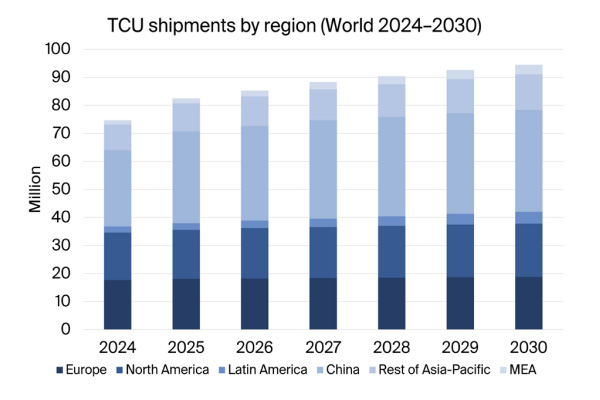
According to Berg Insight, global shipments of telematics control units (TCUs) reached 82.5 million units in 2025 and are projected to increase to 94.5 million by 2030, representing a compound annual growth rate of 2.8%.
The corresponding market value is expected to rise from €9.0 billion to €11.8 billion over the same period, indicating that revenue growth will outpace shipment growth.
The research also reveals how extensively connectivity has penetrated the automotive industry. In 2025, approximately 83% of new passenger cars and commercial vehicles sold worldwide were equipped with a TCU, compared with 78% in 2024.
With factory-installed connectivity already approaching market saturation, future opportunities will increasingly depend on technology upgrades, more sophisticated vehicle connectivity architectures and higher-value hardware rather than simply expanding the number of connected vehicles.
Three suppliers dominate different layers of the value chain
One of the most significant findings concerns the different levels of concentration across the automotive connectivity supply chain. Berg Insight distinguishes three main hardware segments: complete telematics control units, network access device (NAD) modules and cellular connectivity systems-on-chip (SoCs).
LG Electronics leads the global TCU market with a 27% share, followed by Aumovio and Harman. Other significant suppliers include Denso, Valeo, Neusoft, Huawei, Marelli, Actia, Bosch, Desay SV, Gosuncn WeLink and Lan-You.
In the NAD module segment, Quectel holds the leading position with a 25% market share, benefiting from its established presence in both China and international cellular IoT markets. Rolling Wireless, Kontron, Fibocom, MeiG and Compal are among the other important suppliers. LG Electronics and Aumovio also develop NAD modules internally for their own telematics products.
The strongest concentration is found at the semiconductor level, where Qualcomm accounts for 83% of automotive connectivity SoC shipments. Its competitors include MediaTek, UNISOC, ASR Microelectronics, Huawei’s HiSilicon and Samsung Electronics.
This disparity in market concentration has important consequences for the industry. While automotive manufacturers retain considerable negotiating power over TCU suppliers, semiconductor providers occupy an equally influential position upstream. NAD and TCU manufacturers must therefore balance vehicle manufacturers’ requirements against their dependence on a relatively limited choice of connectivity chipsets.
For automotive OEMs, this concentration also makes chipset selection a strategic consideration extending beyond immediate hardware cost, particularly when vehicle platforms must remain operational over long production and service lifecycles.
5G RedCap emerges as a potential alternative to conventional 5G
Although 4G LTE continues to account for most TCU shipments, Berg Insight expects a rapid transition toward 5G technologies. By 2030, approximately 82% of shipped TCUs are forecast to support either conventional 5G enhanced Mobile Broadband (eMBB) or 5G Reduced Capability (RedCap).
RedCap could play a particularly important role in this transition. Unlike conventional 5G implementations, which are designed to support demanding broadband applications, RedCap provides a more economical connectivity option for applications that do not require the full capabilities of 5G.
For vehicle manufacturers, the distinction matters because many telematics functions, including remote diagnostics, vehicle status monitoring and certain over-the-air communications, do not necessarily require high-throughput cellular connectivity.
RedCap therefore offers a potential route to longer-term 5G network compatibility without imposing the hardware costs associated with full-featured 5G modems. However, the appropriate technology choice will still depend on the vehicle’s intended services, bandwidth requirements and lifecycle considerations.
Integrated architectures are changing TCU design
Beyond cellular technology, Berg Insight identifies hardware integration as another important development. In China, integrated TCU and smart cockpit architectures are gaining traction, while several suppliers are introducing solutions that combine TCUs with antennas.
These approaches reflect a broader shift toward more consolidated vehicle electronics, where connectivity must increasingly coexist with infotainment, advanced driver assistance systems and software-defined vehicle architectures.
Such integration can potentially reduce hardware duplication and system costs, but it also introduces additional design considerations. Combining connectivity with other electronic functions makes coordination between hardware suppliers, software developers and vehicle manufacturers increasingly important.
The report also identifies cybersecurity, including evolving AI-driven threats, as an emerging competitive differentiator. Increasingly sophisticated ADAS functions, zonal electronic architectures and satellite connectivity are among the other developments expected to influence future TCU designs.
For connectivity module suppliers and automotive system integrators, the implications extend beyond delivering cellular connectivity. Competitive differentiation will increasingly involve supporting complex vehicle architectures, maintaining security throughout extended product lifecycles and accommodating evolving network technologies.
The broader message from Berg Insight’s research is that automotive connectivity hardware is entering a more mature phase. With connected vehicles already representing the overwhelming majority of new vehicle sales, the competitive focus is shifting toward semiconductor dependencies, system integration and selecting the most appropriate connectivity technologies for the next generation of vehicles.
The post Automotive TCU Market to Reach 94.5 Million Units by 2030, with Qualcomm Dominating Connectivity Chips appeared first on IoT Business News.