
 By
By 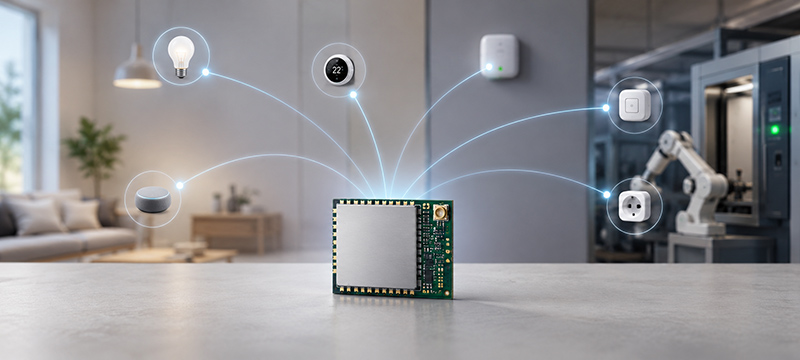
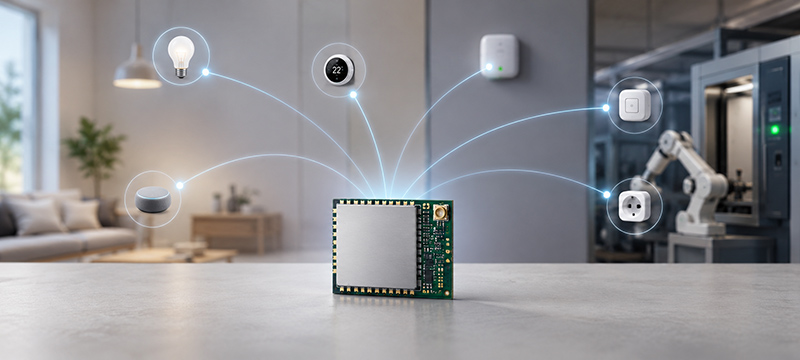
Quectel has introduced the FCM365X, a compact wireless module based on NXP’s RW612 MCU that combines dual-band Wi-Fi 6, Bluetooth LE 5.4, Zigbee and Thread support for smart home and industrial IoT designs.
Short-range IoT design is becoming less about choosing a single radio and more about managing coexistence between several of them. A connected appliance, sensor hub or industrial control device may need Wi-Fi for IP connectivity, Bluetooth LE for commissioning, and a mesh protocol such as Thread or Zigbee for low-power local networking. That combination can complicate board design, software integration and product variants.
Quectel’s latest module, the FCM365X, addresses that convergence point by packaging several short-range connectivity options into a single device. The module is built around NXP Semiconductors’ RW612 wireless MCU and supports dual-band Wi-Fi 6, Bluetooth Low Energy 5.4, Zigbee and Thread. For OEMs designing products that must operate across smart home and industrial environments, the significance is not simply another Wi-Fi module, but the combination of IP networking, BLE provisioning and mesh protocol support in one compact hardware footprint.
The FCM365X uses an Arm Cortex-M33 processor with TrustZone technology running at up to 260MHz. Quectel states that the module integrates 1.2MB of SRAM and 8MB of Flash, with optional PSRAM expansion. It also supports several low-power modes and keep-alive mechanisms, positioning it for power-constrained devices rather than only mains-powered gateways.
What makes this announcement distinct is the protocol mix and the silicon architecture behind it
Many embedded wireless modules focus on Wi-Fi and Bluetooth, leaving Zigbee or Thread to a separate radio. Here, Quectel is using NXP’s RW612 platform to support Wi-Fi 6, BLE 5.4, Zigbee and Thread in the same module. That matters in designs where a manufacturer wants one hardware base that can serve different ecosystem requirements, such as a product family that may need Wi-Fi connectivity in one configuration and mesh networking in another.
The Thread element is particularly relevant because Thread has become closely associated with Matter-enabled smart home architectures, while Zigbee remains widely used in smart home and building automation deployments. Quectel does not state that the FCM365X is Matter-certified, and that distinction is important. The module can support the underlying Thread protocol, but device makers would still need to handle the broader software, certification and ecosystem requirements associated with a finished Matter product.
For industrial IoT, the attraction is slightly different. Factories and commercial buildings often contain a mix of legacy and newer short-range networks. A module that supports both Zigbee and Thread alongside Wi-Fi and BLE may help equipment vendors avoid locking a device design too tightly to one local networking approach. The practical benefit is design flexibility; the trade-off is that system integrators still need to manage protocol selection, network planning and application-layer interoperability.
Quectel has also disclosed a broad set of interfaces. The FCM365X supports GPIO, SDIO, UART, USB and JTAG as standard, while I2C, I2S, ADC, LCD and PWM are supported in the company’s QuecOpen solution. For embedded developers, that interface set is relevant because these modules are not only radio add-ons; they often sit close to sensors, displays, control circuitry or host processors. The inclusion of JTAG also reflects the debugging needs of more complex embedded applications.
Security support includes WPA-PSK, WPA2-PSK and WPA3-SAE, along with AES-128 encryption. Combined with the Cortex-M33 TrustZone capability of the underlying processor, the module is aimed at connected devices where secure connectivity is part of the baseline design requirement. As always, module-level features do not replace secure product architecture, but they can give OEMs a stronger starting point than a basic radio implementation.
Physically, the FCM365X measures 25.5mm x 18.0mm x 3.16mm and weighs 1.51g. It supports 2.4GHz and 5GHz Wi-Fi through a 1×1 antenna configuration, includes an RF coaxial connector and offers a PCB antenna option. Quectel specifies an operating temperature range from -40 °C to +85 °C, which makes the module relevant beyond consumer devices and into harsher industrial or building environments.
The broader industry context is that short-range IoT is fragmenting at the application layer even as module vendors try to consolidate radio hardware. Wi-Fi, BLE, Thread and Zigbee each solve different problems, and none is disappearing from real-world deployments. Modules such as the FCM365X reflect a pragmatic direction for the ecosystem: not betting on one protocol winning, but giving device makers a way to support several without redesigning the wireless subsystem for every product line.
For connectivity providers and platform vendors, this type of module may increase demand for tools that can manage heterogeneous local networks alongside cloud connectivity. For OEMs and industrial players, the immediate implication is more optionality at the device design stage, especially where product lifecycles are longer than wireless protocol trends.
The post Quectel Adds Multi-Protocol NXP-Based Module for Wi-Fi 6, Thread and Zigbee IoT Devices appeared first on IoT Business News.