
 By
The Vanguard S&P 500 ETF (VOO) has been stuck in a narrow range in the past few months, even as investors have continued investing in it. The fund was trading at $698, a few points above this month’s low of $673. It faces some major risks as concerns about the AI industry and interest rates remain.
VOO ETF inflows are soaring
The Vanguard S&P 500 ETF (VOO) has performed well this year, driven by the growing popularity of “VOO and Chill.” The concept is simple: investors put their money into the fund and hold it for the long term, aiming for strong returns over time.
ETF DB data shows that VOO has attracted more than $32 billion in inflows over the last 30 days, bringing its year-to-date inflows to more than $132 billion.
In contrast, the SPDR S&P 500 ETF (SPY) has seen outflows of more than $2.9 billion over the same period, bringing its year-to-date flows to $7.04 billion. The iShares Core S&P 500 ETF (IVV) has taken in more than $7.63 billion over the last 30 days, lifting its year-to-date inflows to $34.6 billion.
VOO has emerged as the favorite S&P 500 ETF, with its assets under management (AUM) rising to over $1.03 trillion. One of the reasons for this is its lower fees, which stands at 0.03%, much lower than SPY’s 0.09%.
S&P 500 Index is facing some major risks
The ongoing consolidation is happening as the S&P 500 Index faces some major risks ahead. One of the risks is in the artificial intelligence industry, which some analysts believe is in a bubble. In recent statements, experts like Ray Dalio and Ken Griffin have warned that the industry was in a bubble that could burst soon as interest rates rise.
The bursting of an AI bubble would have a major impact on the S&P 500 Index and on ETFs that track it, such as SPY and VOO, because AI-related companies make up a large share of its composition. Technology companies alone account for about 40% of the index.
Further, energy companies face the risk of continued declines as crude oil prices remain under pressure. Brent and West Texas Intermediate (WTI) have both fallen by more than 10% from their October highs. As a result, energy majors such as Chevron, Exxon Mobil, Marathon Petroleum, and ConocoPhillips have pulled back sharply over the past few weeks.
There is also a risk from the Federal Reserve, which is expected to hike interest rates in the December meeting. US bond yields have continued rising, with the ten-year rising to 5.025% and the five-year hitting 4.83%. Odds of the Federal Reserve hiking interest rates have jumped to 99% on Polymarket.
In a statement earlier this week, Christopher Waller, a top Federal Reserve Governor, warned that he will support hiking interest rates by 0.50% in the next meeting. That was a big statement since Waller is one of the most dovish Fed official, such that Donald Trump considered hiring him to replace Jerome Powell. Other officials like Austan Goolsbee, John Williams, and Susan Collins have considered hiking rates.
Further, there are signs that earnings growth is slowing. FactSet data shows that the earnings growth in the third quarter was 31.4%, much lower than the 51.4% experienced in the second quarter. Some top companies like Alphabet and Amazon published relatively weak results as AI tools started cannibalizing their earnings.
On the positive side, the S&P 500 Index and its ETFs are relatively cheaper, with the forward price-to-earnings ratio being 18.
VOO ETF technical analysis
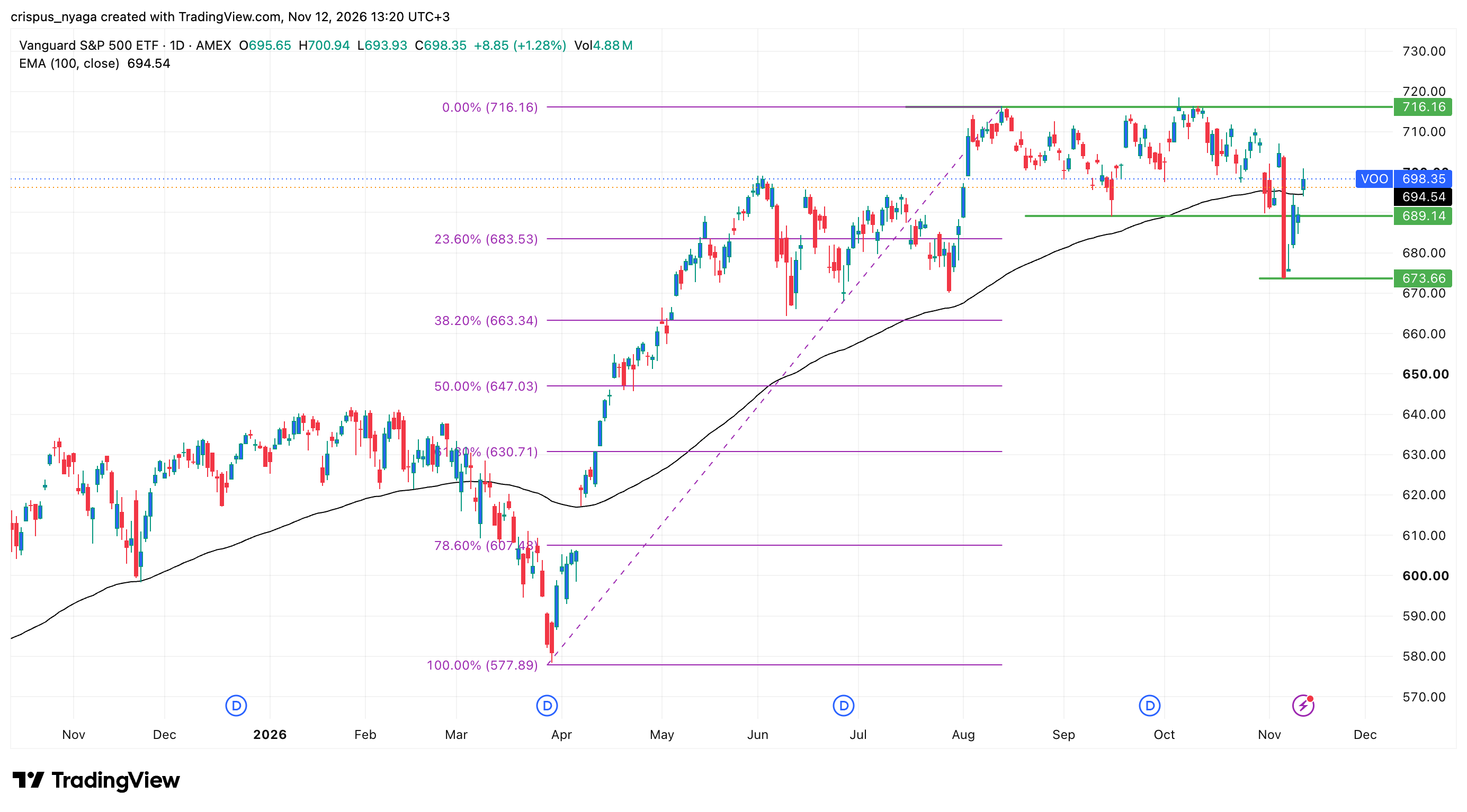
VOO ETF chart | Source: TradingView
The daily chart shows that the VOO ETF has done well has rebounded in the past few days, moving from a low of $673 to a high of $698. Looking back, the fund made a double-top pattern at $716 and a neckline at $689. This pattern normally leads to more downside over time.
Therefore, the fund will likely retreat, potentially to the support level of $673. A move above the resistance at $716 will point to more gains.
The post VOO & Chill is gaining momentum: What comes next for the S&P 500? appeared first on Invezz