
 By
As nights lengthen and the autumn air cools, those of us who remember the golden age of trick-or-treating can recall the sound of packaged candy falling into a plastic, pumpkin-shaped pail on Halloween night.
The candy was freely given. But it wasn’t a free lunch. Whether homemade or store-bought, treats only exist when someone fashions scarce resources into a finished good.
Entrepreneurs do this for a living. They take a leap of faith that consumers will value a product and offer something of value in return. Shouldering uncertainty is part of the deal.
Few lives demonstrate this better than that of Harry Burnett Reese, the inventor of the now iconic Reese’s Peanut Butter Cup. His story is one of persistence amid difficulty, resilience in the face of failure, and grace in success.
From Factory Worker to Entrepreneur
Reese was born on a farm in York County, Pennsylvania, in 1879. He was an only child and demonstrated an entrepreneurial mindset at an early age by raising frogs to sell to restaurants. As a teen, he played French horn in local bands.
Some think of frequent job changes as a twenty-first-century phenomenon, but a glance at Reese’s career proves otherwise. He married in 1900. His wife, Blanche, came from a prosperous family. By 1903, Reese was managing fishing operations in Virginia for her father’s cannery business.
Eventually, he returned to Pennsylvania to work on a dairy farm and then in a factory. But in 1917, he took a job managing a dairy farm for The Hershey Company. He did well and was promoted to manage Hershey’s “Round Barn” the following year. This was an experimental farm for improving milk production. But it was so expensive that Hershey decided to close it in 1919, leaving Reese out of work.
Once World War I ended, sugar rationing had slowly eased. Domestic demand for confectionery was spiking. The Hershey Company, still led by its founder, Milton Hershey, dominated the market with chocolate bars and signature Kisses.
But entrepreneurs vied to create the next big candy, much as they try to develop a hit smartphone app today. With ten kids (and counting) to feed, Reese began making candy to sell to area stores. He often covered things with chocolate, such as almonds and raisins. He even raised money through a stock offering for the Superior Chocolate and Confectionery Company, but the venture failed to support his growing family. By 1921, he was back at The Hershey Company, working in the shipping department.
But he kept his hands in the confectionery game, literally, experimenting in his basement in his spare time. While working out candy recipes, he was also working out the recipe for entrepreneurial success, which requires energy and tenacity. Reese created the Lizzie Bar and the Johnny Bar, named after two of his kids, and began to find some success.
In 1923, he incorporated as H.B. Reese Candy Company. Two years later, he borrowed money to build a factory. He was selling everything from butterscotch to raisin clusters, once even coating honeydew melon with chocolate. But in 1928, he released the product that would change his life.
A Bold Move
In the 1920s, peanut butter was something of a novelty, a health food created as a cheap source of protein. Combining it with chocolate was a bold move. Once Reese hit on the idea, he approached it like a scientist. He experimented with recipes and proportions, struggling to get the chocolate to coat the peanut butter evenly. Accidentally over-roasting a batch of peanuts produced a taste he liked, so he made that part of the recipe.
A 1928 family photo used in advertising shows Reese and his wife on a sofa, each holding a baby. Reese’s hair has thinned and silvered since his horn-playing days. Blanche looks a bit tired. Twelve children, apart from the two babies, surround them. The couple had 16 children in total, 13 of whom lived to adulthood.
It’s a picture of abundance, but harder times were coming. The Great Depression began in 1929 and hit the candy industry hard. Even giants like Hershey had to tighten their belts. Many small firms went under. Reese kept his company alive through a side hustle: canning and selling vegetables.
Milton Hershey, who had supplied Reese with chocolate from the beginning, now extended him badly needed credit. Reese also pivoted to producing the perfect product for tough economic times: a smaller, one-cent peanut butter cup.
By 1935, Reese’s business was booming. He would never again have to worry about side hustles. Known for his generosity, Reese built a fishing lodge in Maryland where his employees and their families could vacation for a dollar a day, meals included. It’s now a dormitory for marine science students.
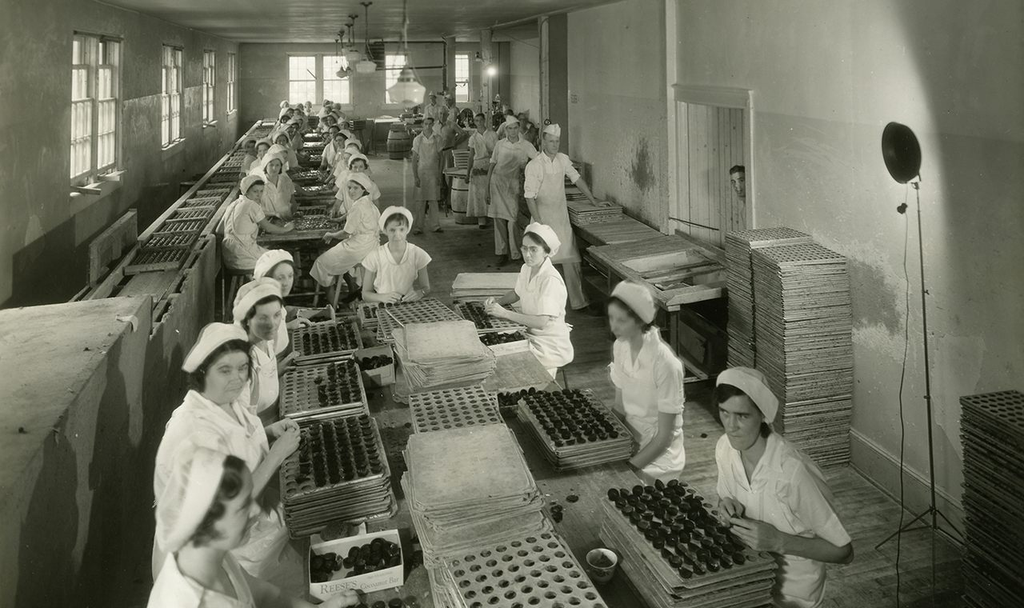
During World War II, with sugar once again rationed, Reese discontinued all products except his cash cow: the peanut butter cup. Amid America’s postwar prosperity, the product continued to grow in popularity. In 1957, the Reese Company opened a new 100,000-square-foot factory. A later photograph shows rows of peanut butter cups in their iconic paper liners, moving like soldiers down a conveyor belt, passing under metallic nozzles that apply chocolate to a layer of peanut butter.
A Lesson in Perseverance and Capitalism
Unfortunately, Reese didn’t live to see this. He had died the year before of a heart attack. In 1963, with annual sales having reached $12 million to $14 million, the family sold the firm to The Hershey Company in a stock deal. Blanche Reese died in 1968.
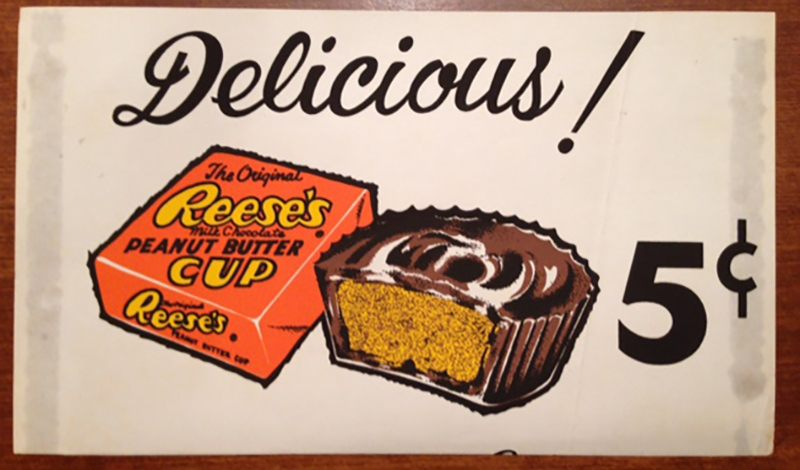
Reese’s Peanut Butter Cups outlived them both. The circular treat in the corrugated paper made frequent appearances in my childhood in the 1970s and ’80s, including on Halloween nights. Classic commercials from the era show people stumbling into each other in public — one while eating peanut butter, the other while eating chocolate — and realizing that the combination was even better.
H.B. Reese’s now-classic creation from 1928 still reverberates through American culture today. The brand has expanded into multiple products, from dipped pretzels to breakfast cereal. As of 2023, Reese’s was Hershey’s best-selling brand, with $3.1 billion in annual sales.
“If you push through that feeling of being scared, that feeling of taking risk,” said former Yahoo CEO Marissa Mayer, “really amazing things can happen.”
H.B. Reese embodied the entrepreneurial spirit. He took risks, did the work, paid his dues, and reaped the rewards. He never let failure become more than a speed bump on the road to success. Though success may take time, a capitalist economy generally rewards this approach to life. When taught to young people, these values can make society not just wealthier, but more resilient in the face of difficulties — and sweeter, too, by bringing once-unaffordable treats within reach of ordinary Americans.