
 By
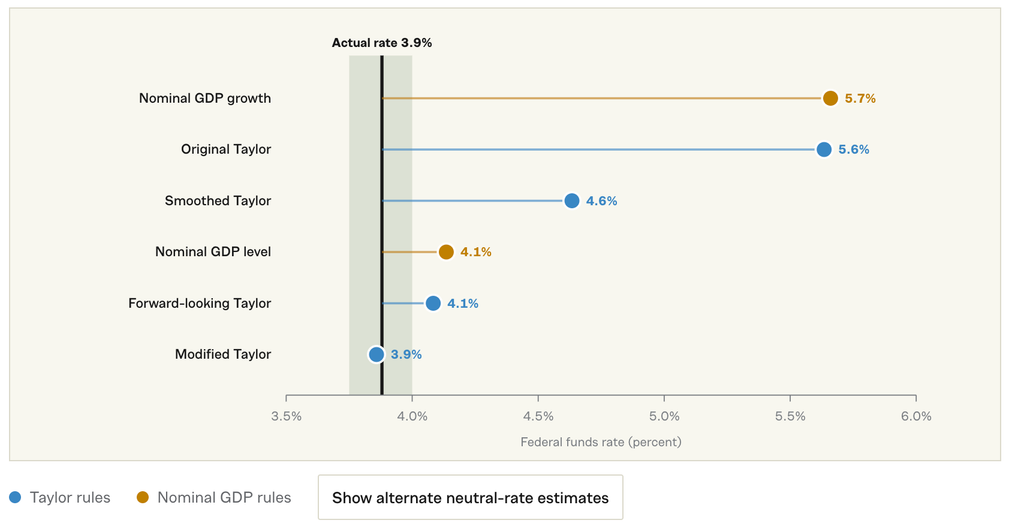
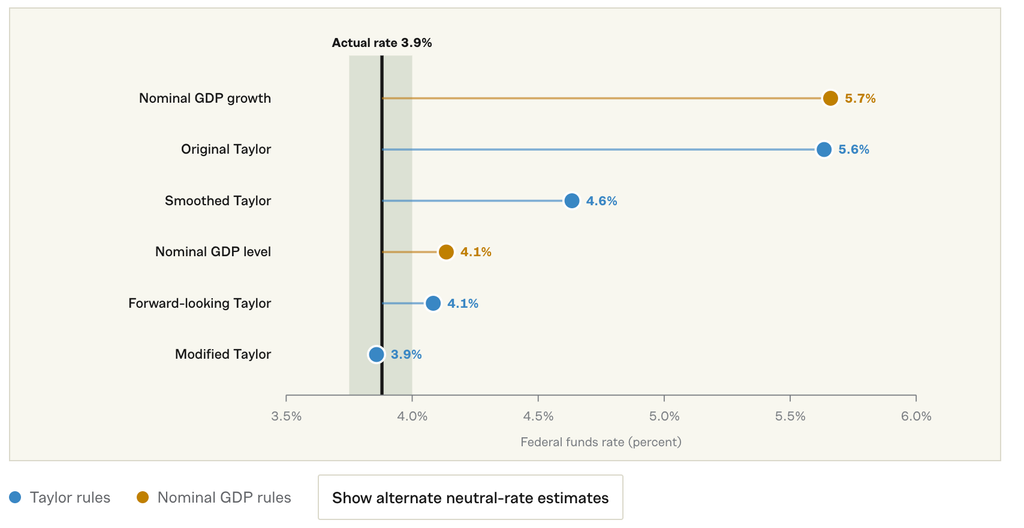
The Federal Open Market Committee (FOMC) is widely expected to leave its federal funds rate target unchanged when it meets on October 27–28. Fed officials have signaled that there is little urgency to raise rates again after September’s quarter-point increase. New York Fed President John Williams has said that the Fed has time to gather more information, while San Francisco Fed President Mary Daly has similarly argued that additional tightening will likely be needed but not necessarily right away. The leading monetary rules leave room for that approach, as they prescribe a policy rate ranging from about 3.8 percent to 5.7 percent.
While the lower end of those estimates is consistent with holding steady at the Fed’s current 3.75–4.00 percent target range, nine out of 12 favor tighter policy. A pause at the October meeting is therefore likely to be temporary. Inflation is still on the rise, unemployment remains low, and overall spending in the economy is strong. If those trends persist, further tightening will be needed.
What the Rules Say
The AIER Monetary Rules Dashboard (beta version) shows that a modified Taylor Rule and a nominal GDP level rule prescribe rates between roughly 3.8 and 4.1 percent. Those estimates are broadly consistent with current policy. An original Taylor Rule and an NGDP growth rule, however, point to rates well above 5 percent. Taken together, the rules suggest that September’s rate hike brought policy back into a defensible range, but there is likely more work to be done.
Taylor Rules: Inflation Is Still Too High
Taylor-type rules adjust Fed policy based on changes in inflation and economic activity. When inflation rises above the Fed’s 2-percent target, they call for a higher federal funds rate. When unemployment rises or economic activity weakens, they pull in the opposite direction.
The Fed defines its 2 percent inflation goal using the personal consumption expenditures (PCE) price index. The latest PCE data, for August, showed headline inflation at 3.4 percent and core PCE inflation at 3.0 percent, both still above target. September PCE will not be released until after the Fed’s October meeting, so the September consumer price index (CPI) provides the most up-to-date broad inflation reading, even though PCE data are used in constructing the Taylor rule estimates.
The September CPI data show the inflation side of the Taylor rule calculation pushing toward higher rates. Overall inflation rose 0.6 percent from August to September and 3.7 percent over the previous year. This is up from 3.4 percent in August and well above the Fed’s 2 percent goal. Core inflation, which excludes food and energy prices, was also 2.6 percent higher than last year. While energy accounted for a notable portion of the overall monthly increase, the recent inflation story is not confined to gasoline and other obvious supply-side pressures.
Prices tied to the ongoing AI investment boom offer one example. Prices for computers, peripherals, and smart-home assistants in September were 9.7 percent higher than a year earlier. Computer software and accessories were up 28.4 percent. Those categories are relatively small parts of the overall CPI, but their price increases illustrate how strong demand associated with AI investment is driving prices higher outside the energy sector.
Accelerating inflation in the service sector is even more concerning. Prices for all services, excluding energy services, were 3.1 percent higher than a year earlier in September. Hospital services were up 5.6 percent, motor vehicle maintenance and repair 5.8 percent, and food away from home 3.5 percent. The breadth of these increases makes it harder to explain current inflation as the sole result of energy disruptions or other isolated supply shocks.
The other side of the Taylor rule, related to economic activity and the labor market, is on sounder footing, with the unemployment rate remaining at a relatively low 4.2 percent. Some policymakers have expressed caution, however. Job growth has slowed considerably, with payroll employment increasing by only 29,000 in September. Long-term unemployment has also been creeping higher for the last few years. While potential stress in the labor market is worth monitoring, these developments do not represent the kind of labor market deterioration that would call for easier monetary policy. Slow job growth may be the new normal with low net migration and an aging population entering retirement. And long-term unemployment is often due to structural problems, like skill mismatch, that monetary policy is ill-equipped to address.
In short, inflation is still too high while the labor market remains reasonably stable. That combination explains why many variations of the Taylor rule continue to point toward tighter policy, even before incorporating the more recent inflation pressures visible in the CPI data.
NGDP Rules: Spending Is Still (Too) Strong
Rules based on nominal GDP tell a similar story. Nominal GDP measures total dollar spending in the economy. An NGDP growth rule implies that the Fed should raise the federal funds rate when nominal spending grows faster than 4 percent, and lower it when spending grows slower than 4 percent. That 4 percent benchmark is based on an inflation rate of 2 percent plus average output growth of around 2 percent, which is consistent with historical pre-pandemic trends. An NGDP level rule, similarly, calls for raising rates when total spending moves above its longer-run trend, and lowering rates when spending falls below trend.
The latest GDP revisions reinforce the concern that nominal spending is growing too quickly. The Bureau of Economic Analysis initially estimated second-quarter nominal GDP growth at 7.9 percent. That estimate was revised to 8.0 percent in the second release and then up to 8.5 percent in the third. Real GDP growth was also revised substantially higher, from 1.5 percent to 2.2 percent.
The third quarter does not look weak either. The Atlanta Fed’s GDPNow model currently estimates real GDP growth at 3.6 percent. If inflation remains anywhere near current levels, nominal spending growth will once again be well above 4 percent. The Bureau of Economic Analysis (BEA) will release third-quarter GDP data on October 29, the day after the FOMC meeting.
The AI buildout is undoubtedly part of the NGDP story too. The same boom that is putting upward pressure on consumer prices for computers and software is also supporting investment and overall economic activity. But AI is not the only source of demand pressure. Consumer spending remained strong through August, and Cleveland Fed President Beth Hammack recently described business activity as generally “strong to booming” when arguing that a more restrictive policy stance is needed to return inflation to 2 percent.
More Tightening Ahead
Fed officials seem to recognize that a hold in October is likely to be temporary. New York Fed President John Williams stated that, if the data continue to evolve as expected, an additional rate hike may be appropriate before the end of the year. More hawkish officials, like Hammack and Dallas Fed President Lorie Logan, have argued for tighter policy immediately.
The consensus among FOMC members appears similar to the policy path suggested by the monetary rules: holding in October is defensible, but additional rate hikes are likely needed.
The Fed’s own projections tell a similar story. In September, the median FOMC participant projected that the unemployment rate will remain near 4.1 percent through the end of 2026 and that PCE inflation will end the year at 3.7 percent. The projections indicated one more quarter-point hike in the federal funds rate, bringing the projected rate to approximately 4.1 percent. Interestingly, core PCE inflation is projected to reach 3.4 percent. This implies that officials anticipate year-over-year inflation to continue rising through the end of 2026, even after excluding food and energy, the categories most directly exposed to recent geopolitical disturbances.
With inflation remaining substantially above the Fed’s 2 percent target for well into the fifth year, the lack of urgency to continue tightening in October – while defensible from the perspective of the rules – is difficult to square with the Fed’s own outlook.
Market participants anticipate more tightening as well. The Atlanta Fed’s market-probability tracker currently assigns roughly a 94 percent chance of at least one additional hike by the end of the year. CME FedWatch data also indicate an 80 percent probability of a quarter-point rate increase at the December meeting.
Fed officials and investor sentiment appear to be aligned around a pause in October, with additional tightening to come in December. The monetary rules agree that the Fed has some leeway to be patient. Without significant improvement in the inflation data, clear signs of a deteriorating labor market, or a meaningful slowdown in overheated nominal spending, the Fed should proceed with another rate hike in December.