
 By
By 
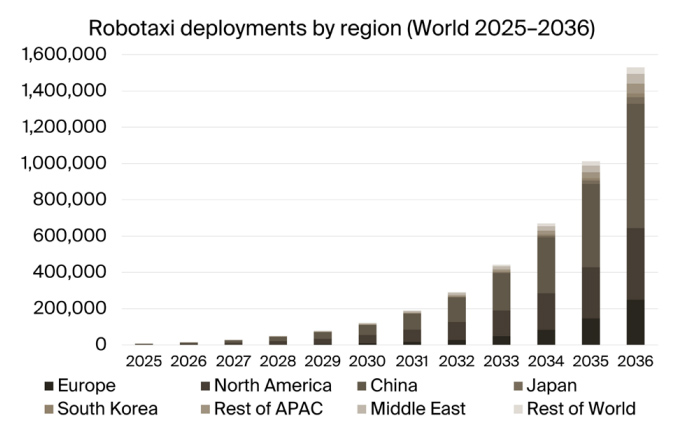
Berg Insight forecasts that the global robotaxi fleet will expand from around 6,500 vehicles at the end of 2025 to 1.53 million by 2036, as Level 4 autonomous driving platforms move from limited deployments toward larger commercial fleets.
Scaling autonomous driving is becoming less a question of whether a vehicle can navigate without a human driver and more a question of whether the entire system around that vehicle can be replicated economically across cities. Robotaxis bring together sensors, onboard computing, vehicle-control systems, connectivity, mapping, fleet infrastructure and remote operations, making commercial expansion significantly more complex than simply deploying additional vehicles.
Against that backdrop, Berg Insight expects the global robotaxi fleet to reach 1.53 million vehicles in 2036, compared with approximately 6,500 operating worldwide at the end of 2025. The research firm also forecasts passenger fare revenues from commercial robotaxi services to rise from US$260 million in 2025 to US$158.7 billion in 2036, representing a compound annual growth rate of 79.2 percent.
Driverless robotaxi services are currently concentrated primarily in the United States, China and the Middle East, although services have recently appeared in Europe, South Korea and Singapore. Further geographic expansion is expected as technology providers, mobility platforms and fleet operators attempt to reproduce working service models in additional markets.
The technology provider is the integration layer
One aspect that distinguishes the robotaxi market from more conventional connected-vehicle businesses is the unusually large amount of technology integration concentrated in the automated-driving provider. These companies are not simply supplying one subsystem. They develop the Level 4 automated driving system and determine how perception software, sensors, compute hardware and vehicle controls operate together.
Berg Insight identifies Avride, Baidu through Apollo Go, May Mobility, Mobileye, Momenta, Motional, Pony.ai, Tesla, Waymo, Wayve, WeRide and Zoox among the leading robotaxi technology providers. Some of these companies also control supporting functions including mapping, simulation, validation, fleet-data infrastructure and remote assistance.
Martin Cederqvist, Senior Analyst at Berg Insight, said:
“The automated driving system and the data used to train and validate the system are the main proprietary assets.”
This structure has an important operational implication. As fleets grow, the vehicle becomes only one component of a much broader distributed computing system. Data generated in the field must support validation and improvement of the driving system, while fleet operations may also depend on remote assistance and centralized infrastructure. For technology suppliers serving the connected-vehicle market, robotaxis therefore combine onboard intelligence with continuous fleet-level data operations rather than treating connectivity as an isolated vehicle feature.
Commercial scale depends on more than autonomous driving
Mobility platforms form another important layer of the emerging ecosystem. Companies including Uber, Lyft, Bolt, DiDi, CaoCao Mobility and T3 Mobility can provide passenger-facing applications, booking, payments, pricing and customer support while connecting autonomous vehicles with existing pools of demand.
The distinction matters because technically capable vehicles do not automatically create commercially viable services. Robotaxi economics depend on keeping vehicles sufficiently utilized while covering vehicle, technology and operational costs. Established mobility platforms can contribute existing customer bases and data on travel patterns, potentially helping operators match autonomous fleet capacity with demand.
The more difficult issue is replicating deployments across locations. Different traffic environments, regulations and operating conditions can create additional engineering and data requirements whenever a service enters a new city. Berg Insight points to end-to-end AI and large driving models as technologies that could reduce dependence on manually specified driving rules and improve generalisation between driving environments.
That is potentially one of the most consequential shifts in the robotaxi architecture. If driving systems can reuse more of their learned behavior across markets, expansion becomes less dependent on extensive city-specific engineering. However, Berg Insight notes that the amount of additional local data collection still varies between markets and systems, meaning geographic scalability will continue to depend on both the underlying automated-driving approach and the deployment environment.
Vehicle design will also influence the economics
Factory-integrated and purpose-built robotaxis could further change the cost structure once production volumes become sufficiently large. Integrating autonomous-driving hardware and vehicle systems during manufacturing can potentially reduce some of the complexity associated with adapting conventional vehicles for driverless operation.
For OEMs, system integrators and connectivity providers, the forecast therefore points toward a market in which differentiation will increasingly come from the ability to operate complete vehicle fleets rather than from individual components alone. Autonomous-driving software, vehicle architecture, fleet-data systems, remote operations and passenger platforms all have to work as a coordinated service.
Berg Insight’s forecast of more than 1.5 million robotaxis by 2036 consequently represents more than expected growth in autonomous vehicle numbers. Reaching that scale will require the industry to turn highly integrated, location-specific deployments into repeatable operational platforms — while satisfying safety requirements, local regulation and the economics of commercial mobility services.
The post Robotaxi Fleets Could Scale to 1.5 Million Vehicles Worldwide by 2036 appeared first on IoT Business News.