

 By
By 
The artificial intelligence industry could need to generate nearly $6 trillion in annual revenue by 2031 to sustain the unprecedented infrastructure buildout underway across chips, data centres, networks and power systems, according to Bain & Company.
The warning comes as the world’s largest technology companies dramatically increase spending on the computing capacity needed to develop and run AI models.
Microsoft, Google, Amazon, Meta and Oracle could collectively spend as much as $780 billion on capital expenditure in 2026, nearly five times their combined level three years earlier, Bain estimates.
But the consultancy says the bigger challenge is no longer simply building enough infrastructure.
It is creating enough economic value to pay for it.
“Enterprise productivity is the tip of the spear, the first gains we’re seeing from AI deployment, but it won’t be nearly enough,” Bain said in its research report, authored by David Crawford, Kristie Tagawa, Cory Boles and Tatum Quinn.
AI infrastructure spending could hit $1.5 trillion
The scale of the buildout is already visible in the size of leading AI data centres.
Facilities that are approaching 1 gigawatt of power capacity today could reach about 2 GW by 2027, while 9 GW campuses could emerge by the end of the decade, according to Bain.
Annual spending on AI infrastructure could reach $1.5 trillion by 2031.
The estimate includes new data centre infrastructure and computing capacity as well as upgrades to the installed base of GPUs, memory and networking equipment.
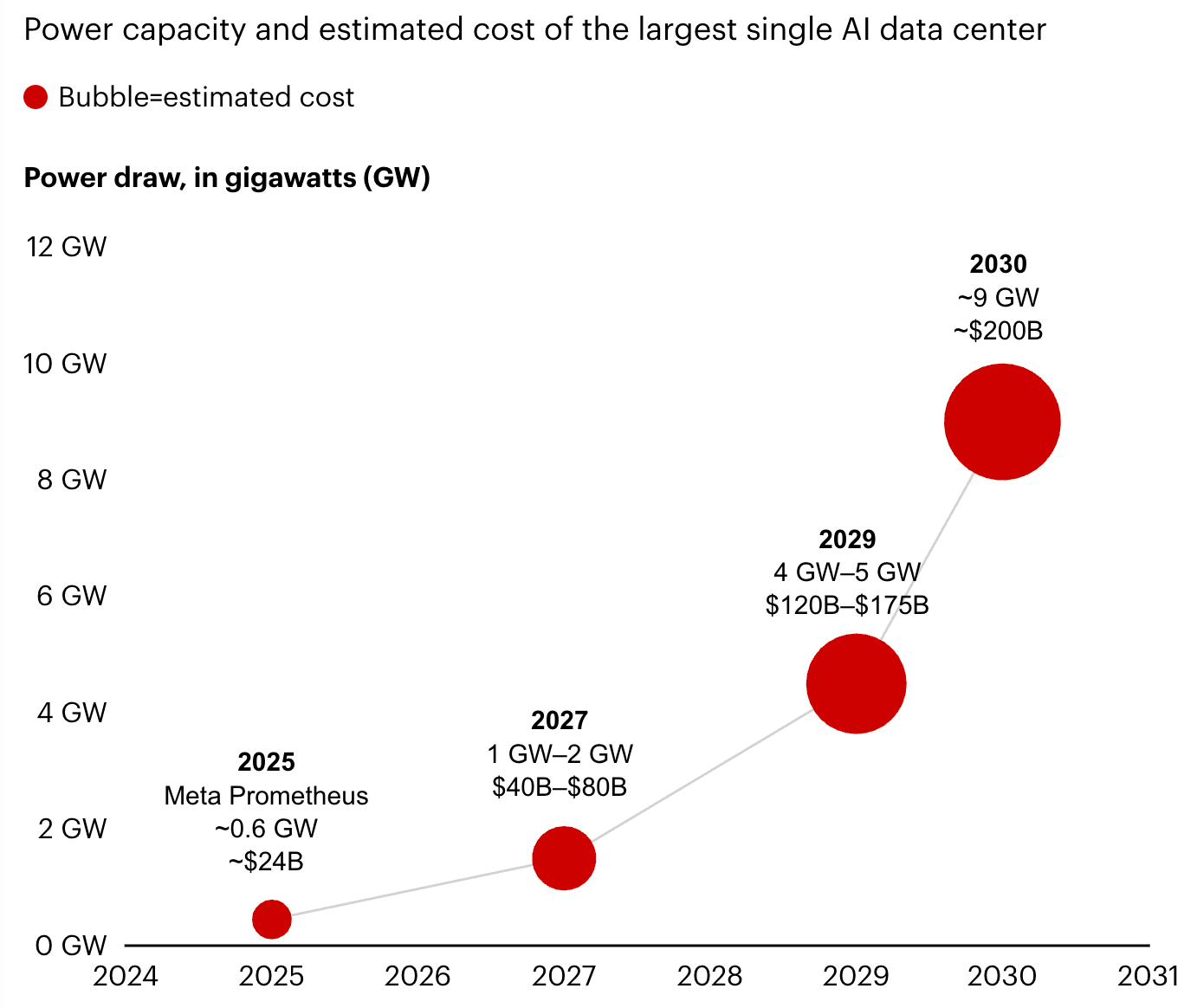
Source: Bain & Company
Bain’s calculation assumes capital expenditure will represent roughly 25% of industry revenue, a level the consultancy considers ambitious but reasonable based on trends among cloud providers.
At that level, sustaining $1.5 trillion in annual infrastructure spending would require an AI market approaching $6 trillion in annual revenue.
The figure highlights the potential mismatch between the money being committed to AI infrastructure and the revenue currently generated by AI applications.
Existing AI markets leave a $4.2 trillion gap
Some of the revenue required to support the infrastructure buildout is already taking shape.
Consumer AI products, through subscriptions and advertising, could generate between $200 billion and $400 billion annually by 2031, Bain estimates.
Enterprise adoption could contribute another $1 trillion to $1.4 trillion in gains to AI providers as companies deploy the technology across software development, sales, marketing, customer service and IT operations.
Together, consumer and enterprise AI could represent between $1.2 trillion and $1.8 trillion in annual revenue.
Even at the upper end of that range, however, the industry would still face a roughly $4.2 trillion shortfall relative to the nearly $6 trillion market Bain estimates would be required to fund the infrastructure investment.
“That revenue must come from new sources of economic value,” Bain said.
The consultancy argues that productivity improvements in existing business processes therefore cannot be the sole economic justification for the AI infrastructure boom.
Search and autonomy could create new markets
Bain identifies several areas that could help close the revenue gap, beginning with search and advertising.
AI model providers could generate between $100 billion and $200 billion or more by incorporating advertising into chatbot products as consumers increasingly use AI tools in place of traditional internet search.
Another potential $400 billion opportunity could come from autonomous vehicles and industrial automation.
AI could be used to operate cars, trucks and drones with limited human intervention while increasing equipment uptime and reducing training and operating costs.
The opportunity could span consumer vehicles, robotaxis and automated logistics.
The consultancy describes this as “autonomous everything” and argues that the economic opportunity extends beyond transportation into a broader automation of physical tasks.
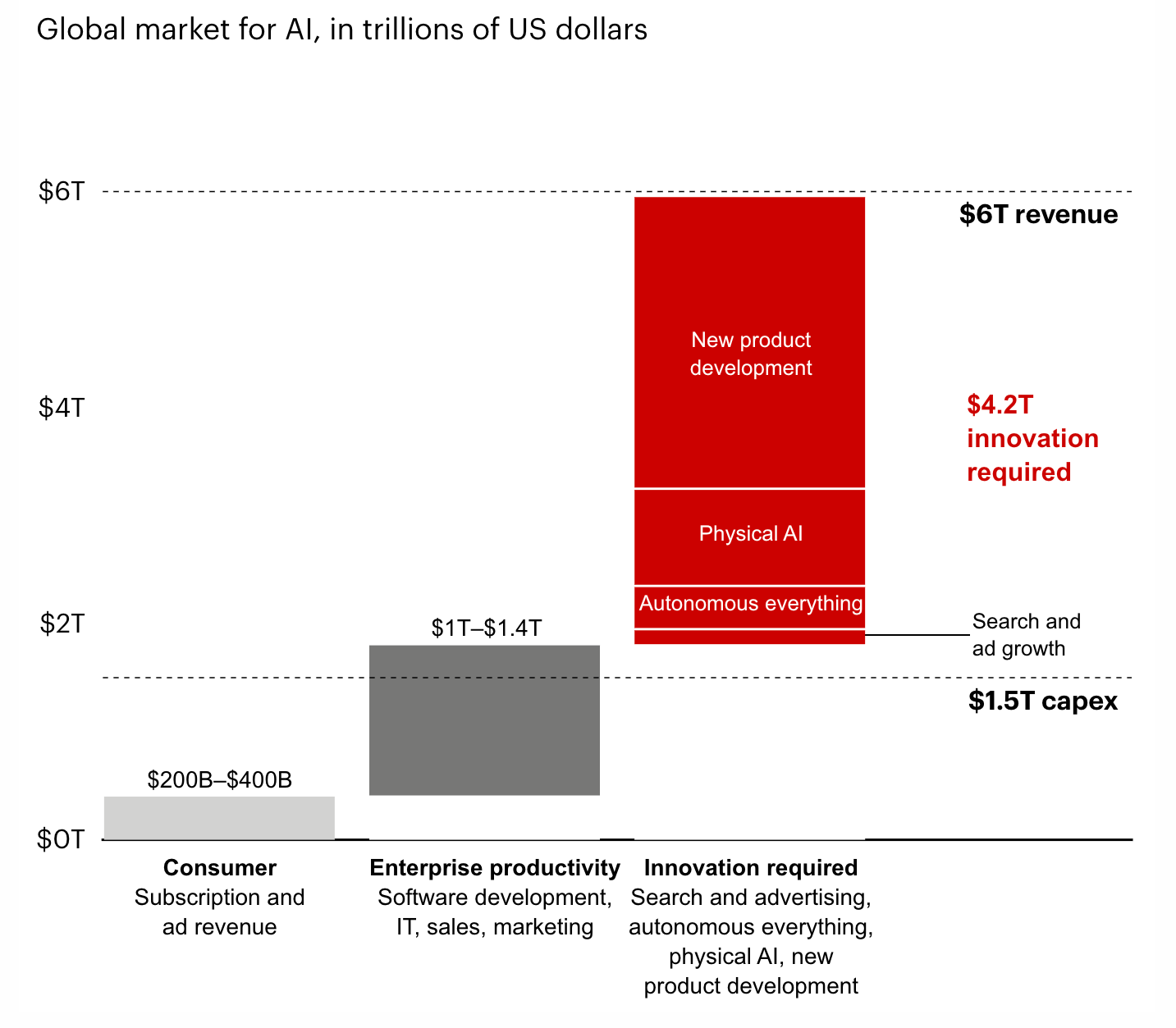
Four categories could supply revenue to fund AI’s global market by 2031, Source: Bain & Company
Physical AI could be a $900 billion opportunity
Bain sees an even larger opportunity in what it calls physical AI.
Advanced AI models can be used to create realistic simulations and digital twins of physical processes, allowing companies to test changes, improve productivity, and accelerate the deployment of autonomous systems.
AI-powered robots, including humanoid machines, could also operate in less structured environments, opening applications across manufacturing and other parts of the physical economy.
Bain estimates that the physical economy could represent a $900 billion opportunity across sectors including automotive, electronics, semiconductors and aerospace and defense.
The estimate assumes a 10% reduction in research, development and manufacturing costs resulting from higher yields and faster factory ramps.
New products may hold the biggest opportunity
The fourth category is less defined but potentially broader: entirely new products and services enabled by increasingly capable AI.
Bain points to AI-driven drug discovery as one example.
Faster and cheaper research could potentially make treatments for rare diseases economically viable.
Other opportunities include always-available mental health support, materials science breakthroughs that could enable new batteries and semiconductors, and autonomous scientific research that accelerates progress in areas ranging from neuroscience to fusion energy.
These applications would represent a shift away from using AI primarily to perform existing tasks more efficiently toward creating economic activity that was previously difficult or impossible.
“The industry needs a wave of application innovation comparable with what mobile and cloud unlocked, not just productivity gains on existing workflows,” Bain said.
Infrastructure is moving ahead of demand
The central risk, according to Bain, is that infrastructure investment may run ahead of the applications needed to consume it profitably.
“The infrastructure is being built ahead of the demand curve,” the consultancy said.
Bain estimates that sustainably funding the AI infrastructure expansion could require adding approximately 1% to annual global GDP growth.
That puts the burden on AI developers, technology companies and businesses to create new applications capable of generating trillions of dollars in incremental economic value.
“The economics required to generate ROI from AI infrastructure are demanding trillions in new revenue, not just cost savings,” Bain said.
The next phase of the AI boom may therefore depend less on how quickly companies can build data centres and more on how quickly developers can turn that capacity into products, services and industries capable of generating the revenue needed to support it.
“The question is whether the applications arrive in time to pay for it,” Bain said.
The post AI must generate $6T in annual revenue by 2031 to justify infrastructure boom: Bain appeared first on Invezz