

 By
By 
Global cellular IoT module shipments grew 15% year over year in the first half of 2026, with LTE Cat 1 bis emerging as the main volume driver while component costs and longer lead times began putting renewed pressure on the supply chain.
The cellular IoT module market is entering a new phase in which shipment growth is no longer being shaped primarily by the transition away from legacy 2G and 3G networks. Technology mix, component availability and supplier concentration are becoming equally important factors for device makers planning their next generation of connected products.
New data from IoT Analytics shows that global cellular IoT module shipments increased 15% year over year during the first half of 2026. Growth accelerated sharply in the second quarter, when shipments rose 20.9% from a year earlier and 15% compared with Q1.
Cat 1 bis is becoming the volume technology of choice
The most significant change is the growing weight of LTE Cat 1 bis. Shipments of Cat 1 bis modules increased by approximately 34% year over year during H1 2026 and accounted for 56% of the market’s incremental shipment growth.
The shift became even more pronounced during the second quarter. Cat 1 bis shipments rose 45.3% sequentially between Q1 and Q2 and represented about three quarters of the overall increase in cellular module shipments during the period.
IoT Analytics points to tracking devices, POS terminals, IP cameras and smart metering as important sources of demand. The research firm expects Cat 1 bis to account for roughly 43% of cellular IoT module shipments by 2030.
That trajectory makes Cat 1 bis more than another step in the LTE product roadmap. For many applications that require cellular connectivity without the capabilities or cost structure of full 4G or 5G modules, it is increasingly becoming the practical replacement path for legacy cellular technologies. At the same time, NB-IoT’s share has eased from its earlier peak, while RedCap and eRedCap remain at an earlier stage of commercialization.
Supply-chain pressure is returning
The market expansion is taking place against a less favorable component environment. IoT Analytics reports that the blended average selling price of cellular IoT modules increased by around 2.5% year over year in H1 2026, reversing four consecutive quarters of annual declines.
Memory is emerging as a particular constraint for modules with higher component requirements. Vendors interviewed by IoT Analytics reported longer lead times across several module categories, alongside pressure from memory, resistors, capacitors, PCBs and other components.
This creates an important practical implication for OEMs and system integrators. Module selection can no longer be evaluated purely on connectivity features and unit pricing: component exposure and supply availability may increasingly influence design and procurement decisions. Low-cost Cat 1 bis products are helping contain the increase in blended module prices, but they are not isolated from broader semiconductor and component supply dynamics.
Chinese vendors extend their position beyond China
The competitive landscape is also shifting. IoT Analytics says the five largest cellular IoT module suppliers by shipment volume in H1 2026 were all Chinese companies: Quectel, China Mobile, Lierda, Fibocom and Sunsea AIoT.
More importantly, the trend is no longer confined to China’s domestic IoT market. Chinese vendors accounted for approximately 59% of cellular IoT module shipments outside China in H1 2026, compared with about 35% in 2018. Quectel alone represented roughly 38% of shipments outside China, while Fibocom approached 10%.
The automotive market remains more diversified, although that position is also changing. Shipments from Chinese module suppliers into embedded automotive applications grew around 33% year over year in H1 2026, compared with approximately 12% growth for the segment overall.
A more complex cellular IoT market
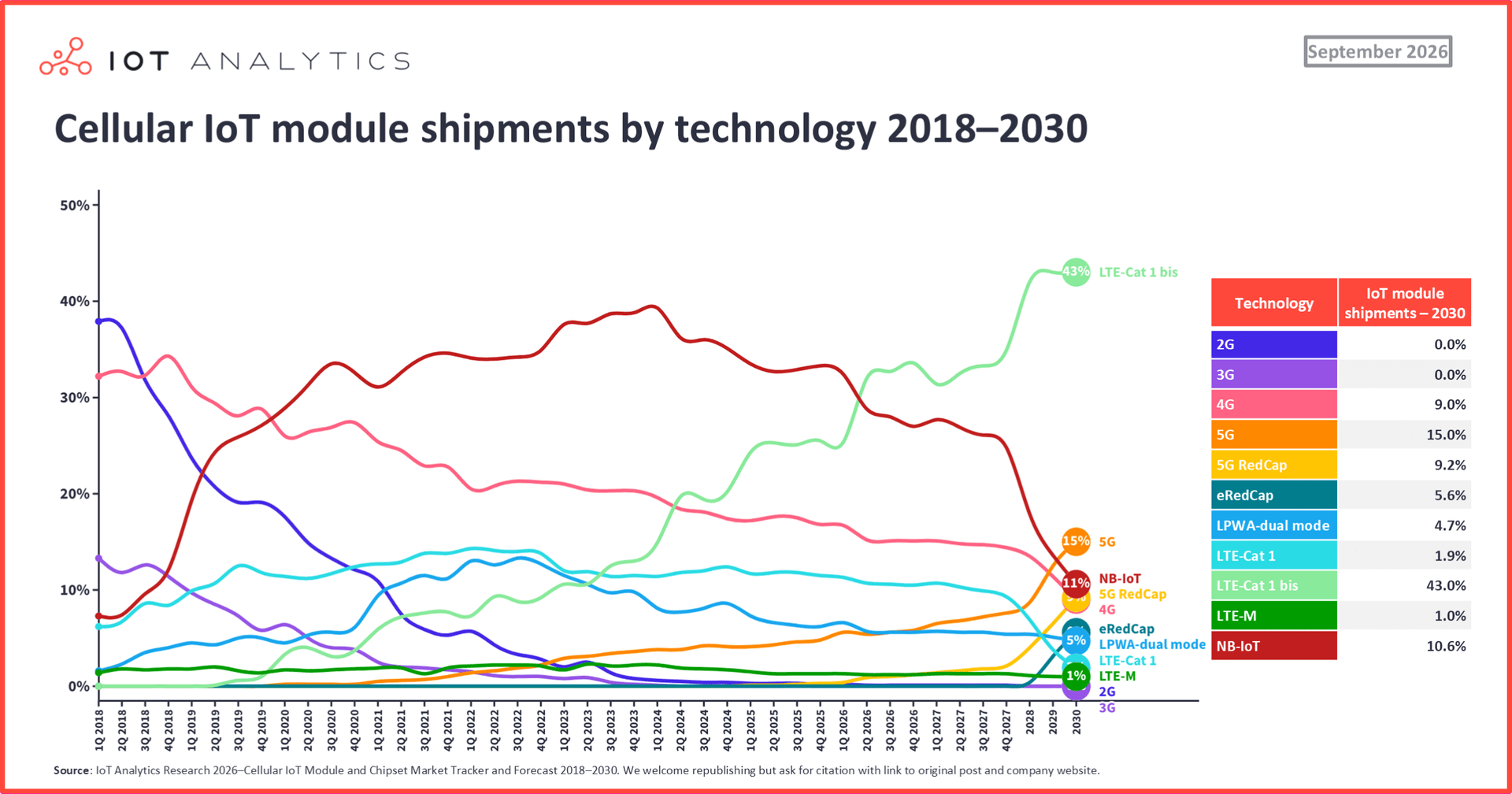
The H1 figures therefore point to more than a cyclical rebound in module demand. Cat 1 bis is consolidating its role in high-volume IoT applications, Chinese suppliers are strengthening their international presence, and component constraints are beginning to affect pricing and sourcing decisions again.
For connectivity providers, OEMs and industrial IoT developers, the resulting technology landscape is becoming more segmented rather than converging around a single cellular standard. Cat 1 bis is absorbing much of today’s volume growth, full 5G remains concentrated in higher-value applications, and RedCap is developing as an intermediate option whose adoption will also depend on the availability of 5G standalone networks.
That combination means shipment volumes alone will provide an increasingly incomplete picture of the cellular IoT market. Technology mix, supply-chain exposure and the changing structure of the module supplier base are likely to matter just as much as headline growth as the market moves through the second half of 2026 and into 2027.
The post Cellular IoT Module Shipments Rise 15% as Cat 1 bis Takes the Lead appeared first on IoT Business News.