

 By
By 
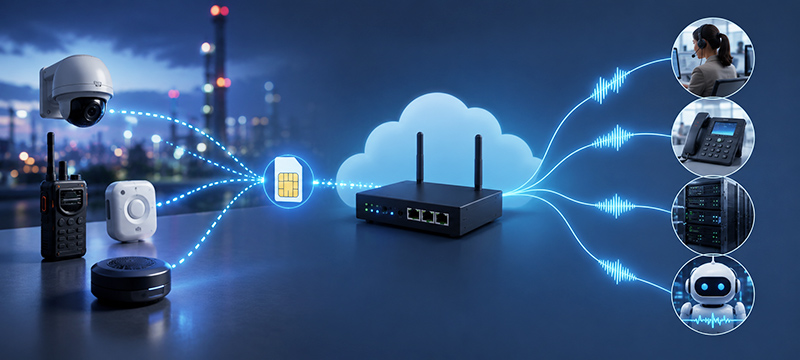
Soracom has introduced Air RTC Gateway, a service designed to route voice from IoT devices using SIM identity to contact centers, VoIP providers and AI agents. The announcement points to a narrower but important challenge in cellular IoT: how to connect field devices to voice workflows without relying only on conventional phone-number-based logic.
Voice is not usually the first capability associated with IoT deployments, yet it remains relevant in categories where a connected device may need to initiate or support a real-time interaction. Emergency devices, field equipment, assisted-service terminals and certain telematics applications can all require more than data telemetry. The operational question is how that voice session is identified, routed and handled once it leaves the device.
Soracom’s new Air RTC Gateway addresses that problem by tying the routing of IoT device voice to SIM identity. Based on the company’s announcement title, the service is intended to connect device-originated voice to contact centers, VoIP providers and AI agents, rather than treating the device simply as another conventional handset on a mobile network.
That distinction matters. Many IoT systems already use the SIM as a trusted anchor for connectivity management, policy control and device identity. Extending that identity model into voice routing creates a more IoT-specific architecture than approaches that depend primarily on telephone numbers, manual provisioning records or application-side mapping. For operators of large device fleets, this can reduce the gap between cellular connectivity management and downstream voice workflows.
Why SIM-based voice routing is different
The announcement is not simply another VoIP integration. Its notable element is the use of SIM identity as the routing key for voice from IoT devices. In practical terms, that places the connectivity layer closer to the service logic used by contact centers or automated agents. For IoT professionals, this is significant because SIM identity is already part of the device lifecycle: it is assigned, activated, suspended, monitored and managed as part of the deployment.
A logical implication is that enterprises using this kind of model may be able to align voice handling with the same device inventory and connectivity controls used for data services. That does not remove the need for integration with contact center platforms or VoIP environments, but it changes where device recognition can begin. Instead of asking the voice application to infer which asset is calling, the network-connected identity of the device becomes part of the routing decision.
This is particularly relevant as AI agents begin to appear in customer service and operational support workflows. Routing a call from a device to an AI agent is only useful if the system can reliably understand which device is initiating the session and what context should accompany it. Soracom’s positioning suggests a bridge between cellular IoT identity and these voice-handling environments, although the available announcement does not provide technical specifications, supported protocols or deployment details.
Implications for IoT deployments
For OEMs, the service could influence how voice-enabled connected products are designed. A device that uses cellular connectivity for both telemetry and voice may benefit from having identity and routing handled at the SIM level, provided the rest of the application stack is built to use that context.
For system integrators, the value is likely to depend on how Air RTC Gateway fits into existing enterprise voice infrastructure. Contact centers and VoIP providers are rarely greenfield environments. Any real deployment would need to consider call flows, authentication, operational records and escalation logic. The announcement’s emphasis on routing by SIM identity gives integrators a specific architectural point to evaluate rather than a generic communications feature.
Connectivity providers and enterprises should also note the broader direction. Cellular IoT platforms are moving beyond basic data access and SIM management toward services that expose device identity into adjacent business systems. Voice routing is a less common example of that trend, but it fits the same pattern: the connectivity layer becomes more directly involved in application workflows.
The unanswered details remain important. Soracom’s announcement, as available, does not state performance characteristics, supported geographies, certifications, commercial terms or the exact integration model with contact centers, VoIP providers or AI agents. Those factors will determine how broadly the service can be applied. Still, the core idea is clear enough: Air RTC Gateway is positioned around making the SIM identity of an IoT device actionable in real-time voice routing, a specific problem that conventional IoT data connectivity services do not normally address.
The post Soracom Air RTC Gateway Links SIM Identity to Voice Routing for IoT Devices appeared first on IoT Business News.