
 By
By 
The Hang Seng Index retreated to 24,011 on Thursday, paring back some of the gains made a day earlier. This drop mirrored developments in key markets like in the United States and South Korea. Still, the potential rotation to Hong Kong stocks may push it higher, potentially to 25,000.
Rotation to Chinese equities possible
The Hang Seng Index retreated slightly on Thursday as investors started to book some of the profits they made a day earlier. This decline aligned with what happened in the United States, where the Dow Jones dropped by over 600 points.
Other Asian indices like the Kospi and Nikkei 225 are falling. There are jitters about the technology sector and the resumption of kinetic action between Iran and the United States. Benjamin Netanyahu will likely make the case for more fighting when he visits Washington soon.
In a statement on Wednesday, President Donald Trump argued that, in his view, the ceasefire was over. The US then launched more strikes against Iran overnight, pushing crude oil prices higher. Brent jumped to $79, while the West Texas Intermediate (WTI) soared to $75.
Broadly, however, there are signs that investors are starting to pay attention to Chinese stocks, which have been left behind in the global rally. With indices in the US, South Korea, and Japan hitting their record highs, the Hang Seng has remained in a prolonged bear market.
This performance has made it quite cheap, with its price-to-earnings ratio being at around 11. In contrast, the FTSE 100 Index’s multiple is around 17, while the S&P 500 Index is at 22.
Some Chinese technology companies have become outright bargains. For example, Alibaba has a PE ratio of less than 20, while Tencent has 16. Xiaomi, which is normally seen as China’s Apple, has a multiple of 14, while Trip.com has 6.
To be fair, these multiples can be justified by the challenges the companies are going through. Xiaomi has seen its profit plunge because of the rising memory prices, while its electric vehicle business is contending with rising competition.
Alibaba, on the other hand, is facing challenges as AI investment costs rose. Its profits dropped by over 80% in the first quarter. Trip.com’s business has slowed, while Tencent’s AI costs have risen.
Still, despite these challenges, a general rotation to China cannot be ruled out. This also aligns with a recent prediction by Morgan Stanley’s Mike Wilson, who predicted a sector rotation from semiconductor stocks to companies that were left behind in the rally.
Hang Seng Index technical analysis
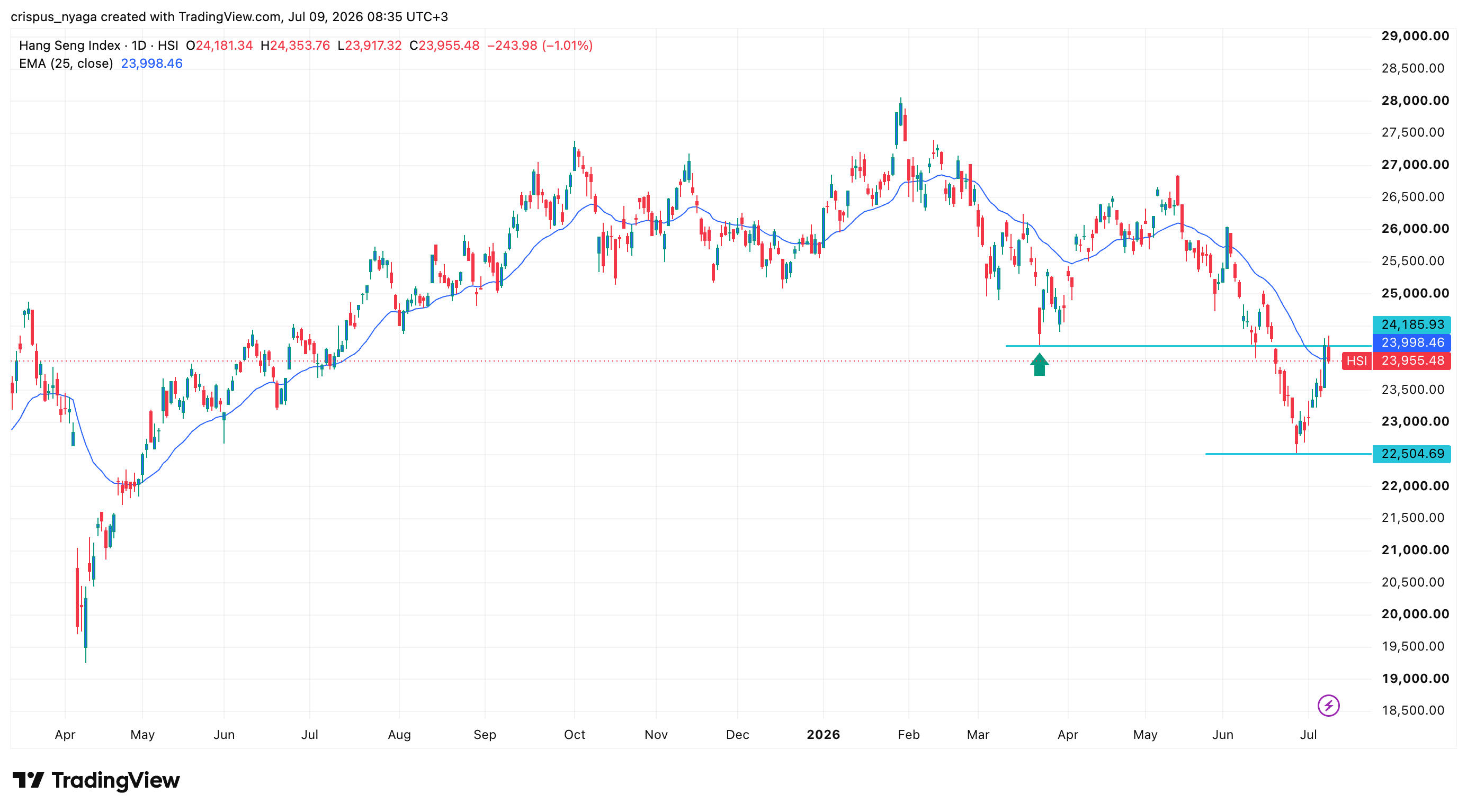
HSI Index chart | Source: TradingView
The daily chart shows that the Hang Seng Index has rebounded from a low of 22,504 to 23,980 today. It retested the crucial resistance level of 24,000, its lowest swing on March 23rd.
The index has moved slightly above the 25-day Exponential Moving Average (EMA), a sign that bulls have prevailed for now. It, however, remains below the 50-day and 100-day EMAs.
Therefore, the most likely scenario is where it resumes rising as bulls target the key resistance of 25,000. A drop below the support level of 23,500 will invalidate the bullish outlook.
The post Hang Seng Index rally has stalled: what next for Hong Kong stocks? appeared first on Invezz