
 By
By Introduction
This explainer expands upon the earlier AIER explainer “A Brief History of Federal Transfers” by examining the relationship between federal, state, and local governments shaped by transfers and the incentives they create. Transfers enable the federal government to exert influence over state and local policy beyond what direct legislation — or indeed the Constitution — allows.
It outlines the dangers of centralization created by transfers, provides an overview of federal transfers to state and local governments today, and offers solutions for states to minimize their dependence on federal transfers.
Tocqueville’s Evergreen Warning
In his seminal book Democracy in America, Alexis de Tocqueville distinguishes between two types of state centralization. The first type, governmental centralization, occurs when a national government creates “general laws” and deals with foreign affairs. This form reflects a minimal state, protecting person, property, and promises as well as national security. The second type, administrative centralization, occurs when the national government gains power to “regulate the ordinary affairs of society, to rule the diverse parts of the State in the direction of their special affairs, and to be in charge of the daily details of their existence.”
Administrative centralization always fails, Tocqueville argued, because the task “exceeds human power.” No single person has the necessary knowledge to properly manage these affairs, which leads to “incomplete result or exhausts itself in useless efforts.” Furthermore, while it might produce some “great men of history,” administrative centralization is incapable of securing “the lasting prosperity of a people.” Tocqueville writes that in such planning we see “an element of despotism, but not of lasting national strength.” This unique despotism, which he calls “democratic despotism,” destroys a nation’s character by leaving its citizens “irrevocably in childhood; it likes the citizens to enjoy themselves, provided that they think only about enjoying themselves.”
Nearly two centuries later, his warnings are as salient as ever. The federal government involves itself in myriad state affairs and local minutiae, thanks largely to the growing number of federal grants to state and local governments.
Ideally, the relationship between the federal government and the states would be close to what legal scholar Michael Greve calls “Competitive Federalism.” Greve summarizes Stanford Economist Barry R. Weingast’s parameters of “competitive, ‘market preserving’ federalism,” which emphasize:
- State governments underneath a central government have sufficient authority and independence to compete with other states over “some range” of political and economic policies.
- States control what happens within their borders, but the central government ensures people and goods can move freely between states to avoid “excessive externalities.”
- Transfer payments from the central government to the states are extremely limited.
Today, the US falls short of this model. It suffers from what Greve calls “cartel federalism,” in which the federal and state governments act as “partners in a collective enterprise.” This partnership gives the federal government influence over state and local affairs by using “the production and distribution of rents among politicians, bureaucrats, and concentrated industry sectors.” In return, it softens state and local budget constraints with infusions of federal funds. The result is more centralization and less accountability. Additionally, Greve warns that some forms of decentralization could be pernicious. One such example is the Supreme Court upholding state government interference in national commerce, such as in South Dakota v. Wayfair, Inc. (2018), which permits states to require e-commerce sellers to collect sales tax even if these sellers do not have a physical presence in the state.
In all such cases, the focus is on spending and regulations, rather than solving the problems for which these grants are created in the first place. Despite the clear failings of federal aid, federal policymakers are eager to dole it out and state and local policymakers are eager to accept. The feedback loop reinforces administrative centralization and detracts from individual liberty.
The Constitutional Issues at Stake
The debate over federal transfers reflects a deeper constitutional debate going back to the founding era over the meaning of “promoting the general welfare.” James Madison argued that the meaning of “general welfare” in the preamble must be limited to the Constitution’s enumerated powers. Alexander Hamilton, by contrast, argued for a broader interpretation, claiming that “power ought to be coextensive with all the possible combinations of [the infinite circumstances that endanger the safety of nations].” These two perspectives inevitably carried over into spending and the relationship between federal and state governments.
This same debate entered the discussion of federal transfers in the Supreme Court case South Dakota v. Dole (1987), in which the Supreme Court ruled that Congress may attach conditions to federal funds to influence state policy so long as these conditions promote the “general welfare,” are clearly stated, and are not coercive. In this case, the Court upheld a reduction in highway funding for states that refused to raise the drinking age, calling it “relatively mild encouragement.”
In practice, the Dole framework grants Congress broad latitude to shape state policy indirectly through funding. This issue was revisited in NFIB v. Sebelius (2012), where the Court ruled that threatening states with the loss of all Medicaid funding crossed into coercion. This ruling was narrow and preserved the broader logic of Dole, leaving most conditional funding programs intact.
What appears cooperative is often a system of negotiated dependence, where constitutional doctrine and fiscal incentives work together to shift authority toward the federal government and away from the states.
Why Give Transfers? Why Take Them?
At the federal level, these transfers encourage states to increase spending on issues DC deems important. If state lawmakers were not going to fund something, however, it’s likely because that issue is addressed by the private sector or the costs of such spending exceed any potential benefits.
The “flypaper effect” refers to a phenomenon of states using federal aid for its targeted purpose (i.e., education), only partially reallocating funds to tax cuts or other spending. Evidence is mixed, but the flypaper effect appears strongest wherever interest groups are highly active at the state level and/or where federal grants require matching state funds.
From a political economy perspective, this outcome is predictable. Policymakers respond to incentives embedded in institutional rules. Conditional funding allows Congress to expand influence without a direct mandate, while states adjust policies to secure federal dollars.
Federal transfers also create a transactional form of governance. “There’s a very great danger,” Philip Hamburger comments, “that all institutions will end up being aligned under centralized control” due to the influence of federal transfers with conditional funding.
When federal aid comes into the picture, decision-making becomes distorted. Federal transfers allow states to export some of their burden of funding their own budgets to taxpayers across the country. The cost of spending a dollar is now much less than a dollar for state taxpayers. As a result, states will overspend on federally subsidized activities (especially those that support interest groups) and underspend on other budget priorities, regardless of how state residents value that spending.
The goal of increasing spending to maximize federal dollars also invites a lapse in program security, inviting fraud and abuse. At the beginning of 2026, the federal Department of Health and Human Services froze childcare and family assistance in five states over fraud concerns. Additionally, when federal transfers to the states discourage states from auditing programs for waste, fraud, and abuse, taxpayer dollars get wasted while dependence on the federal government increases. This scenario occurred while the federal COVID-19 stimulus packages were passed, particularly with unemployment insurance and Medicaid. This gave the federal government greater control over these programs and their respective sectors of the economy (i.e., healthcare) while taxpayers must sacrifice additional income to cover the losses these programs incurred.
It also encourages state policymakers to shift costs from their own budgets onto federal balance sheets. This results in many states having the appearance of strong fiscal health while being propped up by federal funds. If federal transfers decrease, many states and cities are likely to experience budget crises.
Jonathan Rodden’s analysis of fiscal federalism finds that this is a predictable outcome of institutional design. Rodden finds that when subnational governments depend on transfers while retaining borrowing and spending autonomy, they can expand programs without fully bearing the cost, also known as a “soft budget constraint.”
Political incentives reinforce this behavior. Policymakers respond to the fiscal rules they operate under as actors that want to maximize resources and avoid hard tradeoffs. When spending decisions are made locally but financed nationally, each state will try to draw as much as possible from federal funds while spreading the costs across the national tax base.
The result is a system that quietly builds fiscal distress beneath a veneer of stability.
The Twenty-First Century: An Era of Federal Dependence
“A Brief History of Federal Transfers to the States” covered the history of federal transfers from the Founding to 1980, but the story continues after the Great Society. A brief respite from ratcheting federal transfers, known as the “Devolution Revolution,” consolidated 77 categorical grants and two block grants into 9 block grants under the Omnibus Budget Reconciliation Act of 1981. Despite this consolidation, federal transfers, particularly for entitlements, continued relatively unabated.
In 1995, the Unfunded Mandate Reform Act brought hope to limiting federal unfunded mandates on state and local governments and the private sector, but its scope was extremely limited, excluding most federal grant conditions and preemptions. By 2000, 653 aid programs to the states existed. Throughout the presidencies of George W. Bush, Barack Obama, and Donald Trump, these programs and their spending steadily increased in the years leading up to the pandemic in 2020.
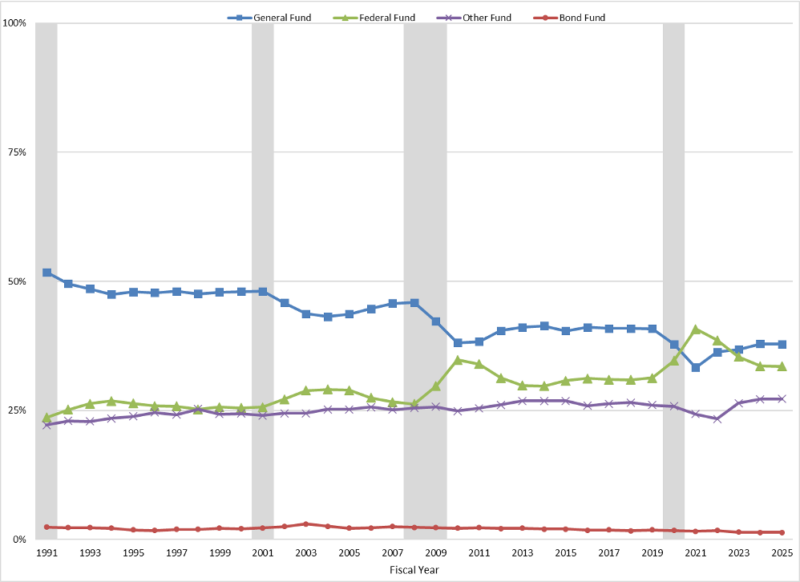
In 2020 and the years following, state dependence on federal funds increased 63 percent from 2019 to 2021 (the peak of federal transfers during the COVID-19 economic contraction). Even after these programs were reduced, federal spending on state and local governments in 2023 is still $200 billion (constant 2017 dollars) greater than in 2019. Projections from the Congressional Budget Office also anticipate federal transfers to state and local governments to resume a steady increase from 2026-2036. Increased strains on the federal budget, however, will inevitably lead to cuts to state transfer payments (as is being heavily debated in discussions of Medicaid reform) resulting in state governments scrambling to cover billion-dollar funding shortfalls. State policymakers will then likely finance those budget shortfalls with debt to avoid political backlash. Figure 1 shows the average state expenditures as a percentage of total spending since Fiscal Year 1991.
Figure 1: State Expenditures by Type as a
Percentage of Total State Expenditures (50 State Average)
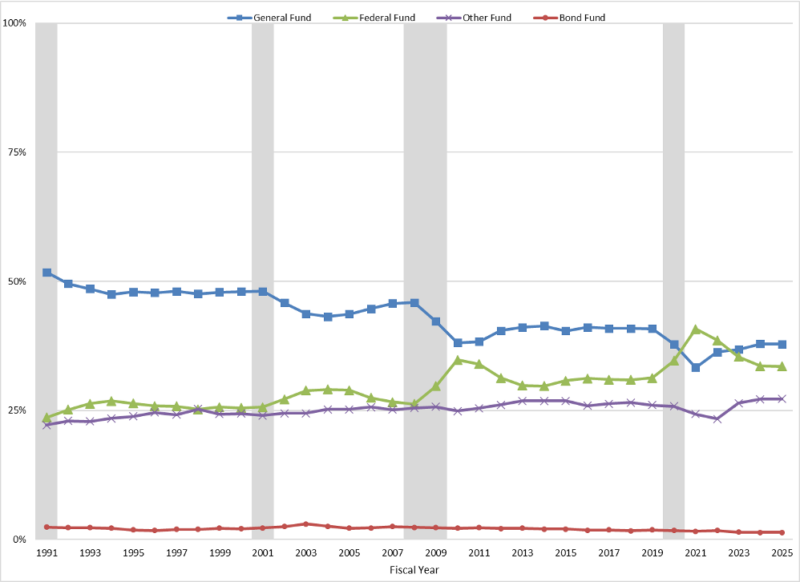
Note: These totals include capital spending. Shaded areas indicate periods of recession.
Source: National Association of State Budget Officers (NASBO) State Expenditure Report Historical Data, FRED Database (for inflation indicator), and Author’s Calculations
Hopes of reducing federal influence over states were dashed as both FY 2023 and 2024 state budgets saw a severe decline in revenues. This has meant prolonged dependency on federal taxpayer dollars, which federal policymakers are happy to provide in exchange for submission. While federal funding returned to second place in 2023, nearly one third of the average state spending comes from federal transfers. This gives the federal government a large influence over state policy and softens budget constraints for state policymakers.
Such demands for state submission may occur at unexpected times. In late 2025, Indiana legislators discussed redistricting efforts, with many rejecting a plan proposed by President Trump. In response, a rumor spread of a federal funding freeze (originating from a non-profit outside of the government) if Indiana failed to pass the redistricting map. The mere rumor of such a threat stoked fierce debate in the Indiana legislature. The redistricting map was rejected, and the rumored threat never materialized. The clear lesson, though, is that states are so dependent on federal funding that they can be scared into compliance.
Breaking the Addiction to Federal Transfers
Fiscal discipline will be the best means for states to prepare for the coming cuts. One successful example is the Financial Ready Utah plan. Implemented in 2013, the plan created the state Federal Funds Commission to monitor the effects of federal grants on the state and required state agencies to develop emergency action plans in anticipation of a 5- to 25-percent cut in federal funding.
Additionally, state policymakers can begin tracking the number and type of federal transfers coming into the state. Recently, Indiana Comptroller Elise Nieshalla began a campaign highlighting how excessive national debt comes from overspending, which has drawn many state legislators and organizations to rally to the cause. Comptroller Nieshalla has also highlighted the dangers in her own state with a data transparency portal, noting that 43.48 percent of Indiana state expenses were paid from federal transfers.
Making the extent of state federal dependence on federal funds clear to the public, and the dangers of such dependence, can help states break free from federal funds.
Conclusion
The growth of federal transfers pushes America further from the ideal federalism rooted in competition and autonomy and emboldens a federalism defined by dependence and centralized control. What began as limited fiscal assistance evolved into a powerful mechanism through which the federal government shapes state and local policy, distorts local priorities, and weakens accountability. As fiscal pressures mount in DC, states face a critical choice: continue down the path of dependency or restore their fiscal independence. Reclaiming autonomy and preserving the decentralized system Tocqueville admired starts with ending the dependence on the federal government.