

 By
By 
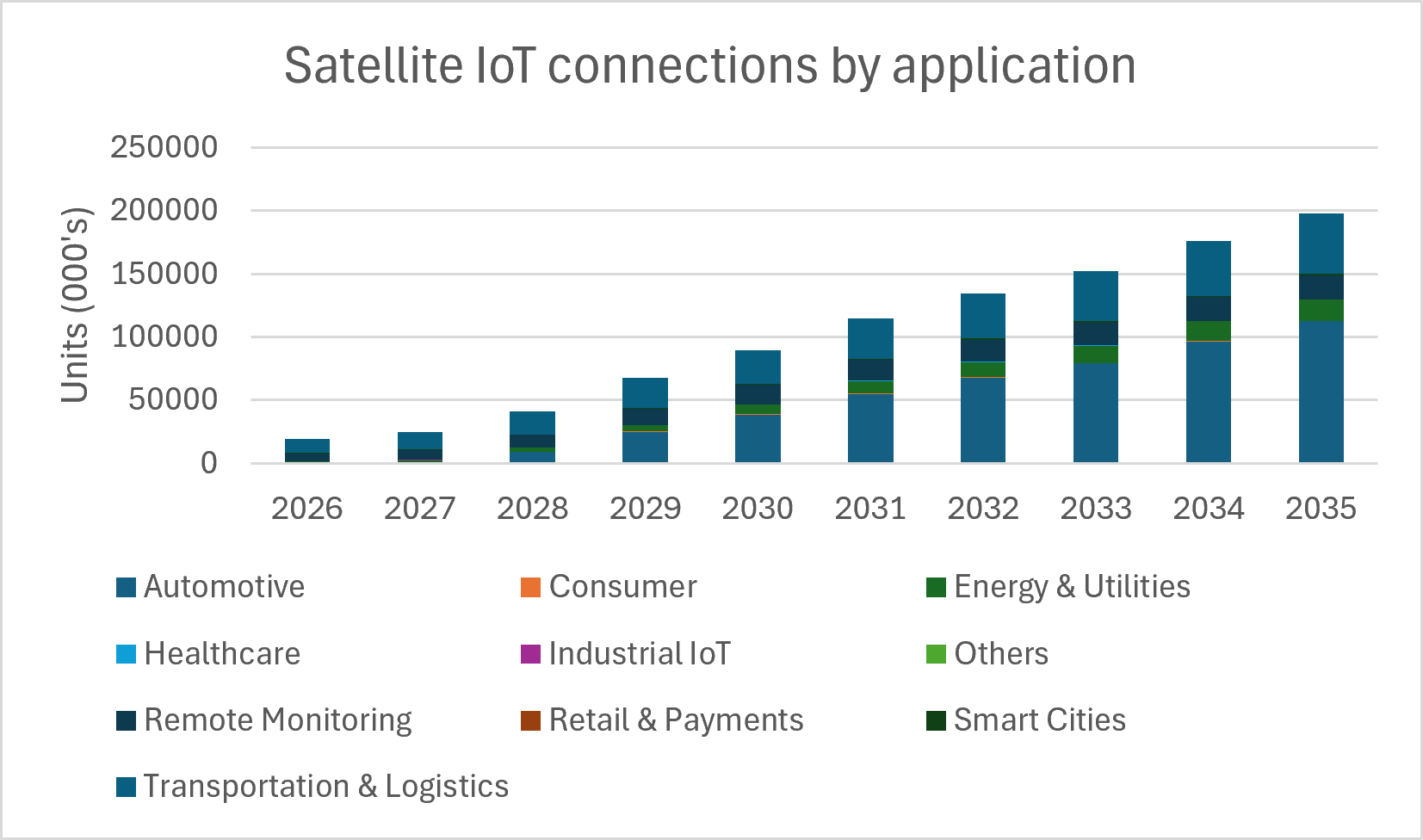
Omdia is forecasting satellite IoT connections to reach 197.6 million by 2035, underscoring the growing role of non-terrestrial connectivity in the wider IoT market.
For many IoT deployments, the hardest connectivity problem is not bandwidth. It is reach. Assets, meters, sensors and industrial equipment often operate beyond the footprint of terrestrial networks, particularly in remote logistics corridors, offshore environments, agricultural areas and sparsely populated regions.
That context gives weight to a new Omdia forecast indicating that satellite IoT connections are expected to reach 197.6 million by 2035. The figure points to a market moving beyond specialist satellite tracking and remote monitoring deployments toward much higher-volume IoT applications, with connected vehicles emerging as a particularly important source of growth.
The composition of that growth is also significant. Omdia’s application forecast shows automotive becoming by far the largest source of satellite IoT connections by 2035, accounting for more than half of the projected total. Transportation and logistics represents another substantial share, while energy and utilities, smart cities and remote monitoring contribute smaller volumes. In other words, the headline growth is not evenly distributed across the IoT market: it is increasingly tied to mobile assets and applications where maintaining connectivity across terrestrial coverage gaps has clear operational value.
The announcement is not a single-vendor product claim. It is a long-range analyst projection, and its relevance lies in what the connection count suggests about the direction of the market: satellite IoT is increasingly being evaluated as part of the mainstream connectivity mix rather than as a last-resort technology for exceptional cases.
Why the forecast matters for IoT decision makers
A projection of almost 200 million connections by 2035 has practical implications. At that scale, satellite IoT cannot be understood only through the lens of high-value terminals or specialist remote monitoring systems. The connection volume implies a need for lower-cost devices, simplified onboarding, manageable service plans and integration models that can fit into existing IoT platforms.
That is an important distinction for OEMs. If satellite connectivity is to support large numbers of IoT endpoints, device makers will need to think about antenna design, power budgets, enclosure constraints and service activation much earlier in the product development cycle. Satellite support is not simply a connectivity add-on; it can influence industrial design, certification planning and lifecycle management.
For connectivity providers, the forecast reinforces the need to package satellite IoT in ways that enterprises can actually procure and operate. Many customers do not want to manage satellite connectivity as a completely separate operational domain. They want coverage extension, roaming logic, device management and billing models that can coexist with cellular, LPWAN or private network deployments.
System integrators may also see a more complex design environment. Satellite IoT can solve coverage gaps, but it introduces trade-offs around message frequency, latency expectations, power consumption and installation quality. The derived insight for integrators is clear: wider adoption will not remove the need for careful application engineering. It will make that engineering more common.
Satellite IoT as a complement, not a replacement
The broader industry relevance is that satellite IoT is increasingly positioned alongside terrestrial IoT rather than against it. Cellular IoT, LoRaWAN and other LPWAN technologies remain well suited to many dense or semi-dense deployments. Satellite becomes particularly relevant when assets move across coverage boundaries or operate in places where building terrestrial infrastructure is commercially difficult.
This complementary role is where the Omdia forecast is most useful. A rising number of satellite IoT connections does not imply that enterprises will abandon terrestrial networks. It suggests that hybrid connectivity strategies are becoming more important, especially for asset tracking, logistics, energy, utilities, agriculture and industrial monitoring scenarios where location and network availability vary over time.
Enterprises considering satellite IoT should therefore focus less on headline coverage claims and more on operational fit. Key questions include whether the application can tolerate intermittent transmissions, how device power consumption will be managed, whether data payloads are suitable for satellite links, and how satellite-connected devices will be monitored within existing IoT operations.
Omdia’s 2035 forecast does not, by itself, define which technologies or providers will capture the opportunity. But it does signal that satellite IoT is becoming large enough to shape product planning, connectivity procurement and integration strategies across the IoT ecosystem. For an industry long focused on connecting everything everywhere, the forecast is a reminder that “everywhere” still requires a different technical and commercial model once terrestrial coverage runs out.
The post Satellite IoT Connections Forecast to Reach Nearly 200 Million by 2035 appeared first on IoT Business News.