

 By
By 
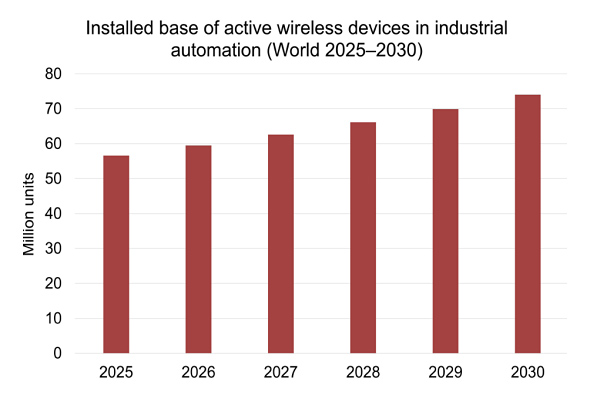
Berg Insight’s latest forecast says shipments of wireless devices used in industrial automation will reach 85 million units by 2030, underscoring the growing role of wireless connectivity inside factories and industrial facilities.
Industrial automation has traditionally been one of the most conservative environments for wireless networking. Deterministic performance, electrical noise, long equipment lifecycles and safety requirements have kept many production systems anchored to wired infrastructure. That is why shipment forecasts for wireless devices in this sector matter: they indicate not only technology adoption, but also a gradual shift in how industrial operators are prepared to instrument, connect and maintain assets.
Berg Insight is now pointing to a market in which shipments of wireless devices for industrial automation reach 85 million units by 2030. The figure, contained in the firm’s latest market communication, frames wireless industrial connectivity as a measurable volume market rather than a niche add-on to automation systems.
A demand signal rather than a product launch
What makes this announcement distinct from the many industrial IoT releases entering the market is that it is not tied to a single module, gateway, cloud platform or connectivity contract. It is a market-level forecast focused on device shipments. For OEMs and industrial technology suppliers, that distinction is important because shipment volume is closer to design-in activity than to marketing interest.
A forecast of 85 million wireless industrial automation devices by 2030 suggests that wireless connectivity is moving deeper into the installed base of sensors, controllers, monitoring devices and automation-adjacent equipment. It does not imply that factories are abandoning wired networks. A more practical reading is that wireless is being used where cabling is costly, inflexible or operationally inconvenient, while wired systems continue to serve applications where latency, power or certification constraints require them.
That coexistence is a key implication for the IoT ecosystem. Industrial players are unlikely to standardize around a single connectivity model. Instead, system integrators and automation vendors will need to manage mixed environments where wireless devices must interoperate with established control architectures, enterprise systems and maintenance workflows. The complexity is less about adding a radio and more about supporting secure onboarding, lifecycle management and reliable data integration over many years.
Why this matters for industrial IoT suppliers
For embedded wireless module vendors, a rising shipment base in industrial automation can translate into broader demand for ruggedized designs, long availability windows and support for industrial certification processes. For connectivity providers, the opportunity is not simply network access; it is the ability to support device fleets that may be deployed across factories, remote industrial sites and brownfield facilities with different operational constraints.
OEMs face a different challenge. Adding wireless connectivity to industrial equipment changes product support expectations. Devices that were once largely standalone may require firmware update processes, security policies, provisioning tools and diagnostics. Even where the wireless link is used only for monitoring, the connected product becomes part of a larger operational technology and IT environment.
System integrators may benefit from this trend, but they will also carry much of the implementation burden. Industrial customers will expect wireless deployments to work around existing assets, legacy protocols and site-specific reliability requirements. The forecast therefore points to services demand as much as hardware demand: assessment, integration, security hardening and long-term fleet management are likely to be central to successful deployments.
The broader industry relevance is that industrial IoT growth is increasingly tied to practical deployment economics. Wireless technologies can reduce installation friction in environments where running cable is expensive or disruptive. At the same time, industrial automation buyers will continue to evaluate connectivity through the lens of uptime, maintainability and risk. The value of the Berg Insight forecast is that it quantifies the direction of travel without suggesting that industrial wireless adoption is uniform or unconstrained.
In that sense, the 85 million-unit figure should be read less as a standalone market milestone and more as evidence of an architectural transition. Industrial automation is becoming more connected at the device layer, but the winning approaches will be those that fit into operational realities rather than those that simply promise wireless replacement of existing infrastructure.
The post Berg Insight Forecast Points to Rising Wireless Adoption in Industrial Automation appeared first on IoT Business News.