
 By
By Ten years ago, Britons voted to leave the European Union, launching three and a half years of tumultuous negotiations and domestic political ructions, only subsiding after the UK’s official withdrawal in January 2020.
It’s tempting to see Brexit as a watershed moment in Britain’s political economy. Britons themselves now tend to regret the choice rather than affirm it, with narrow majorities affirming that Brexit has been “more of a failure” and supporting restoring free movement with the EU in exchange for single-market access.
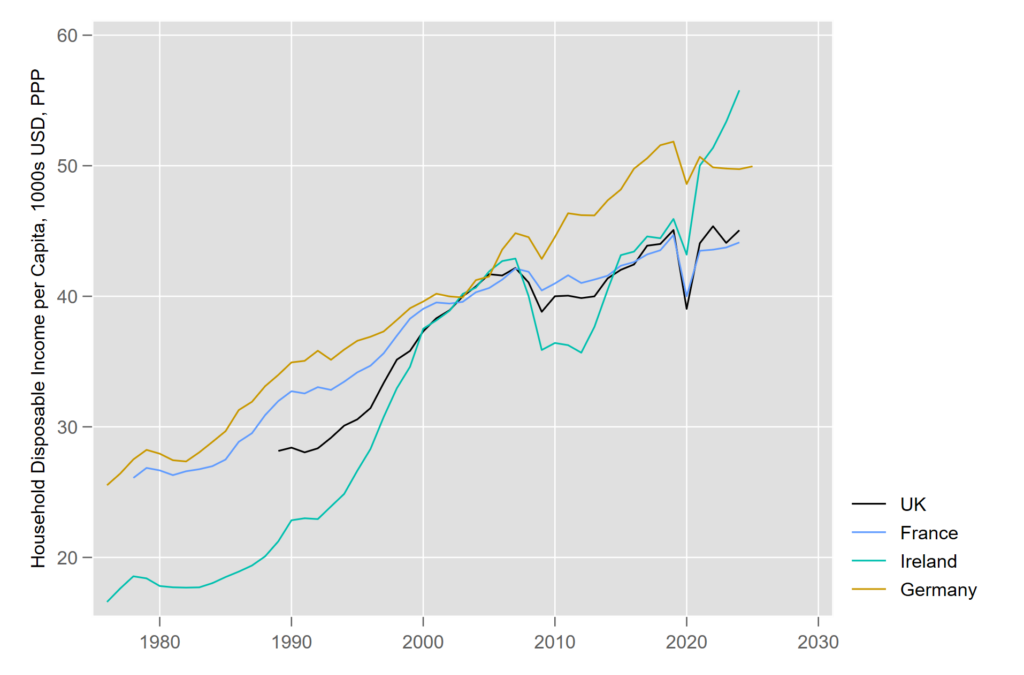
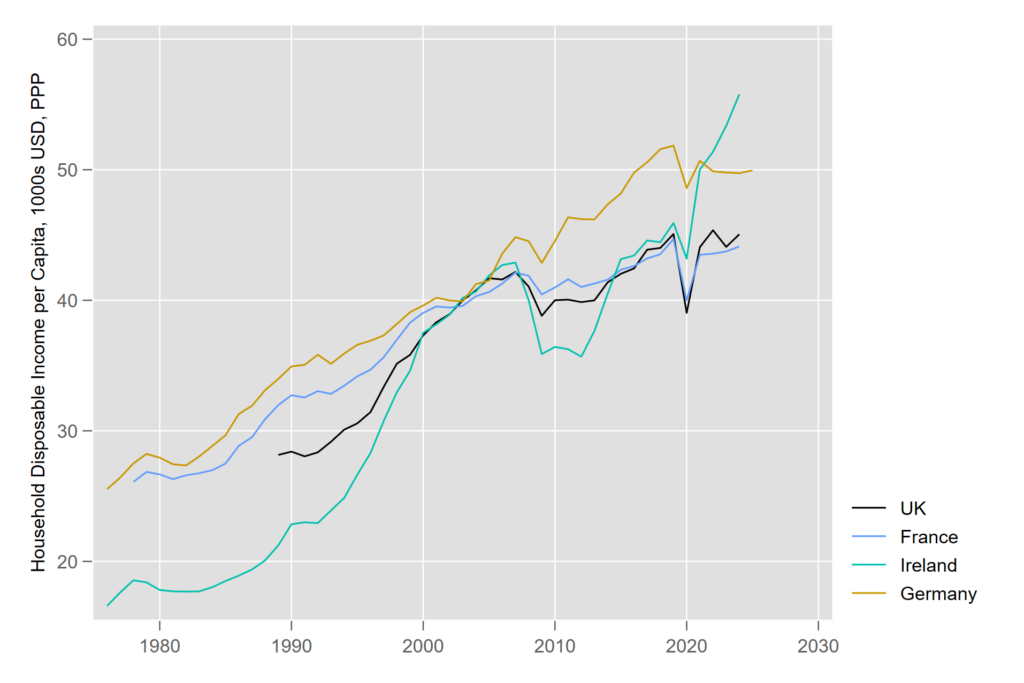
Contrary to some forecasts, Brexit has been closer to an economic blip than a disaster. Figure 1 shows net disposable household income per capita in the UK and comparable countries. While Ireland has rocketed ahead of this whole group, it’s difficult to see any worse economic performance in the UK compared to France and Germany since 2020.
But this low bar — no worse than France or Germany — reflects the deeper ailment in British politics. Brexit was merely one episode in a long series of abdications of responsibility by British leaders.
Free-market Brexiteers like Daniel Hannan assured us that Brexit would allow the UK to deregulate and improve competitiveness: “It’s 24 June 2025… The years that followed the 2016 referendum didn’t just reinvigorate our economy, our democracy and our liberty. They improved relations with our neighbours,” he forecast on June 21, 2016. He went on:
The United Kingdom is now the region’s foremost knowledge-based economy. We lead the world in biotech, law, education, the audio-visual sector, financial services and software. New industries, from 3D printing to driverless cars, have sprung up around the country. Older industries, too, have revived as energy prices have fallen back to global levels: steel, cement, paper, plastics and ceramics producers have become competitive again.
None of that happened. The UK never undertook deregulation commensurate with the new barriers that Brexit imposed, such as new customs paperwork and inspections for goods traveling between the UK and the Continent, and strict limits on Britons and Europeans moving to each other’s countries for work. According to a research briefing from the House of Commons Library, “most regulations made under the [UK law authorizing repeal of EU regulations] have not led to substantive policy changes.”
So much for Brexit’s oversold transformative potential. The real story Britons must grapple with is a nearly 20-year narrative of decline.
Britain had once outperformed its closest Continental peers on the back of a market-friendly economic model created by Thatcher, preserved by Major, and adapted by Blair. Since the disastrous premiership of Labour Prime Minister Gordon Brown, Britain has sickened itself with the same maladies that have since left most of Western Europe stagnating.
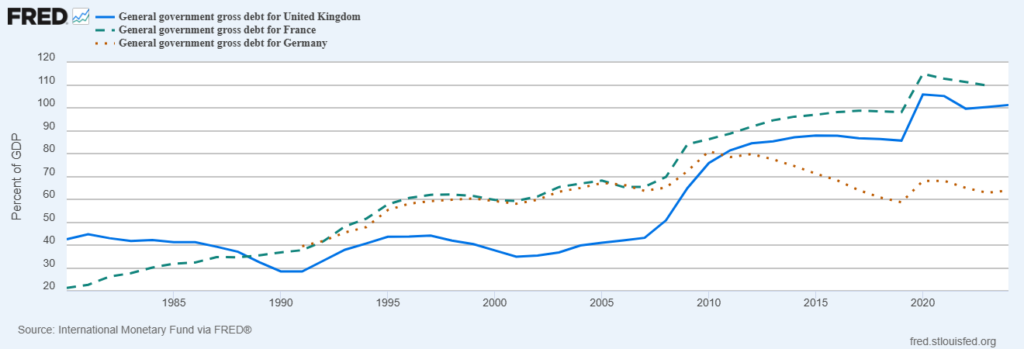
Brown’s premiership, spanning 2007 to 2010, saw the government debt-to-GDP ratio increase 76 percent in just three years. All of that increase came from government spending, not tax cuts (taxes were raised at the high end and on some middle-income households). While the Great Recession caused government spending and debt to rise everywhere, Britain’s increase was much larger than that of France and Germany (Figure 2).
Another long-term legacy of Brown’s premiership has been the Equality Act, which introduced the language of “rights” to economic contracts. It mandates detailed fair employment protections across a broad range of protected categories, including a Marxist-inspired concept of equal pay for equal “demands” or “effort.” It is the legal basis under which some courts are now ruling that it is unlawful to pay men and women different wages in a single company even if they do different jobs.
The Conservatives took power, in coalition with the Liberal Democrats, from Brown’s Labour, but to soothe voters worried about a return of Thatcherism, successive Tory Prime Ministers maintained the high-tax, high-spending, high-regulation equilibrium.
Brown’s tax hikes had increased tax revenues to GDP from 32 to 33 percent. Despite a small top marginal rate cut, Conservative-led governments raised VAT and eventually, under Rishi Sunak, reversed cuts to corporate income taxes. By 2022, tax revenues to GDP stood at 35 percent.
One of the UK’s main economic policy advantages over the Continent has been a flexible labor market, but that is now under threat. The Blair government introduced a largely symbolic minimum wage, but the Tories hiked it to new heights, from £5.52 in 2007 to £11.44 in 2024 when Labour won back power, with inflation-adjusted rates rising inexorably since 2015. The UK minimum wage is now two-thirds of the median wage; that ratio is one of the highest in the OECD.
An example of Britons’ growing obsession with getting free stuff from the government is the explosion of the Motability scheme, which is supposed to give mobility-impaired disabled people the right to allocate some of their disability benefits toward leasing new cars. Eligibility for and participation in the program have exploded, to the point that a fifth of all new cars in the UK — and reportedly a full half of those in Northern Ireland — are leased through Motability. Motability itself is an ostensibly private nonprofit, but its monopoly on managing this welfare scheme has enriched it to the point of dispensing multimillion-pound bonuses to its executives.
The overall disability caseload in the UK has grown by 57 percent since 2005, rising from 7.4 percent of the population in May 2005 to 10.8 percent in May 2025. Most of that growth has been in just the last five years.
Benefits for pensioners have also exploded. In coalition with the Lib Dems, the Tories enacted the “triple lock,” growing social security benefits at the highest of earnings growth, CPI inflation, or 2 percent.
But it is seen as not nice in mainstream British discourse to question the expansion of welfare and especially cornerstones of politically correct regulation like the Equality Act.
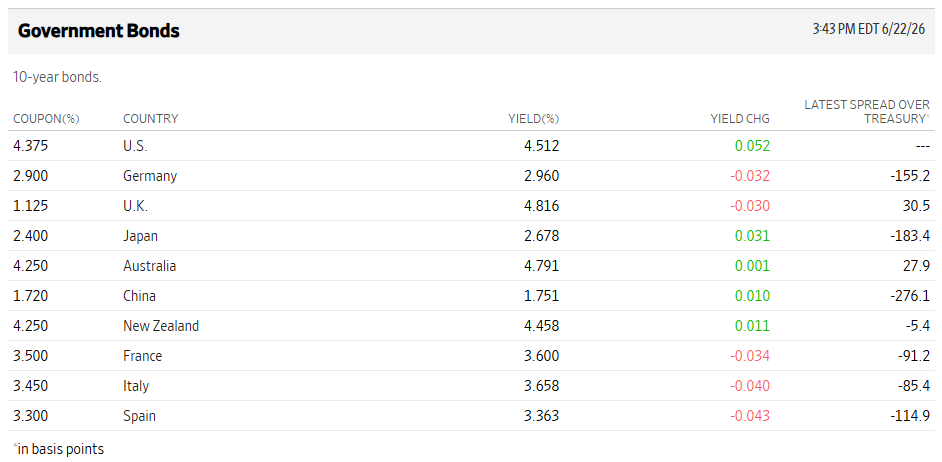
British governments have failed to level with the British people. The punchbowl is gone. The money is simply not there. The debt vigilantes are at the door, with the British benchmark 10-year rate among the highest in the developed world (Figure 3).
Is the US faring any better? Not much. At least the US has had some real deregulation, but the fantasy of debt-fueled free lunches still reigns supreme in the minds of politicians and many voters.
Still, Britain stands out as a country where politicians have waved away tradeoffs and legislated feel-good rules that grab a few days of good press at the expense of long-term economic pain. Brexit was fantasy politics, to be sure, but that is something it shares with the politically correct Regime of Nice that has ruled the country for the past 20 years.