
 By
By A free society should be judged less by who becomes wealthy than by how easily people can improve their circumstances under impartial rules. Who gets wealthy matters less than how.
Income inequality is dominating a national news landscape primed for questions of affordability, contrasted with ever-growing private fortunes on the other. Socialists in the New York Mayor’s treat wealth concentration as one of America’s defining political problems. Debate erupted over Elon Musk’s growing fortune, accompanied by familiar declarations that America should never permit its first trillionaire. A $30 million wedding and a sweeping “housing affordability law.”
As another national campaign season begins, including some unapologetically redistributionist platforms, Americans should expect to hear still more about “income inequality.” Candidates will promise to narrow it, activists will measure it, and commentators will treat it as a proxy for economic justice.
But income inequality, while politically useful, is a poor measure of economic health. By itself, it tells us surprisingly little about whether an economy is flourishing or failing. More often than not, it distracts from the question that actually matters.
The Real Metric is Mobility
A free society does not merely permit unequal outcomes; it guarantees them. That is not principally because people differ in intelligence, industriousness, or luck, though they do. More fundamentally, they differ in what they want.
Some willingly exchange higher salaries for flexibility, especially balancing with care tasks. Others endure longer hours, greater stress, or years of additional education in pursuit of higher earnings. Some choose to relocate or remain in expensive metropolitan areas because the labor market rewards them accordingly. Others leave those same cities for lower costs of living, accepting slower wage growth in return for larger homes, shorter commutes, or proximity to family. Increasingly, adherents of the FIRE and Coast FIRE movements deliberately sacrifice their personal lives and some luxuries in their peak earning years in exchange for earlier financial independence or greater autonomy over their time. Of course, these people experience vastly different financial outcomes, largely as a result of those choices.
These decisions are not distortions of the market. They are among its principal expressions. Income is only one of many goods people seek to maximize. Leisure, stability, family, geographic preference, vocation, autonomy, and prestige all compete with wages. Once individuals are free to order those priorities differently, unequal outcomes become the predictable consequence of liberty itself.
Why France’s Labor Market Is Increasingly Concentrated Near the Minimum Wage
For all these reasons, the elimination of income inequality is not, in itself, a desirable policy objective. Stopping some people from moving up does not reallocate resources to the poor. It destroys them or fails to create them at all.
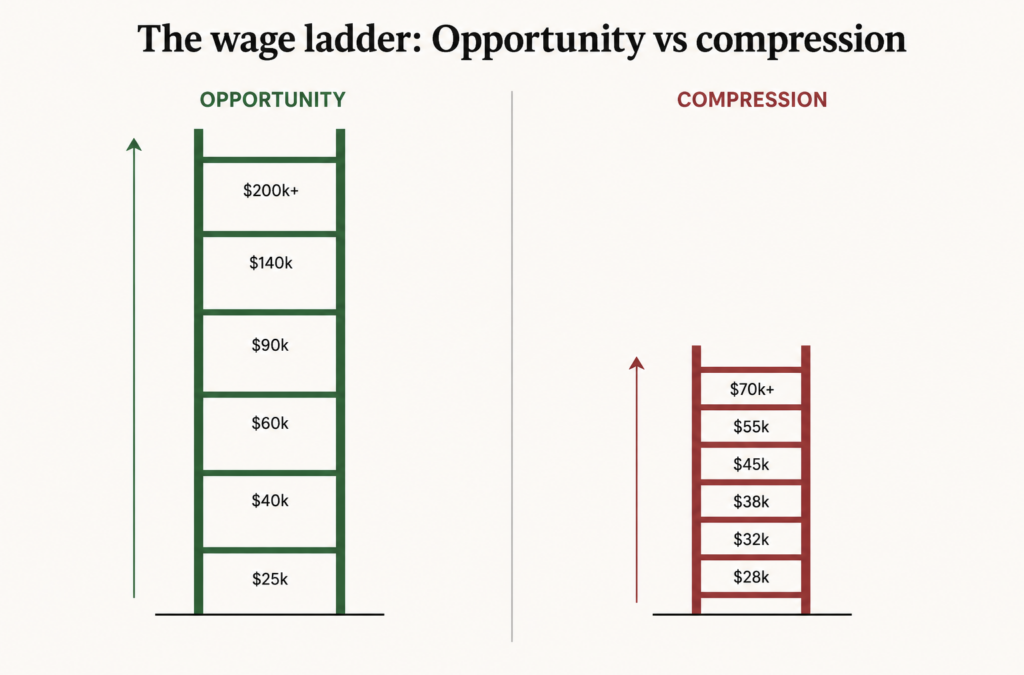
France offers a useful illustration. For years, economists have noted smicardisation — the concentration of wages at or near the statutory minimum. Wage compression has left fewer opportunities to advance beyond them. Promotions yield relatively modest gains, career progression slows, and fewer meaningful steps exist between the bottom and the top of the wage distribution.
The irony is difficult to miss. A society can reduce measured income inequality by reducing economic opportunity. Compressing wages may satisfy a political desire for “equity,” but it also flattens the incentive structure that encourages workers to acquire new skills, assume greater responsibility, or move into more productive occupations.
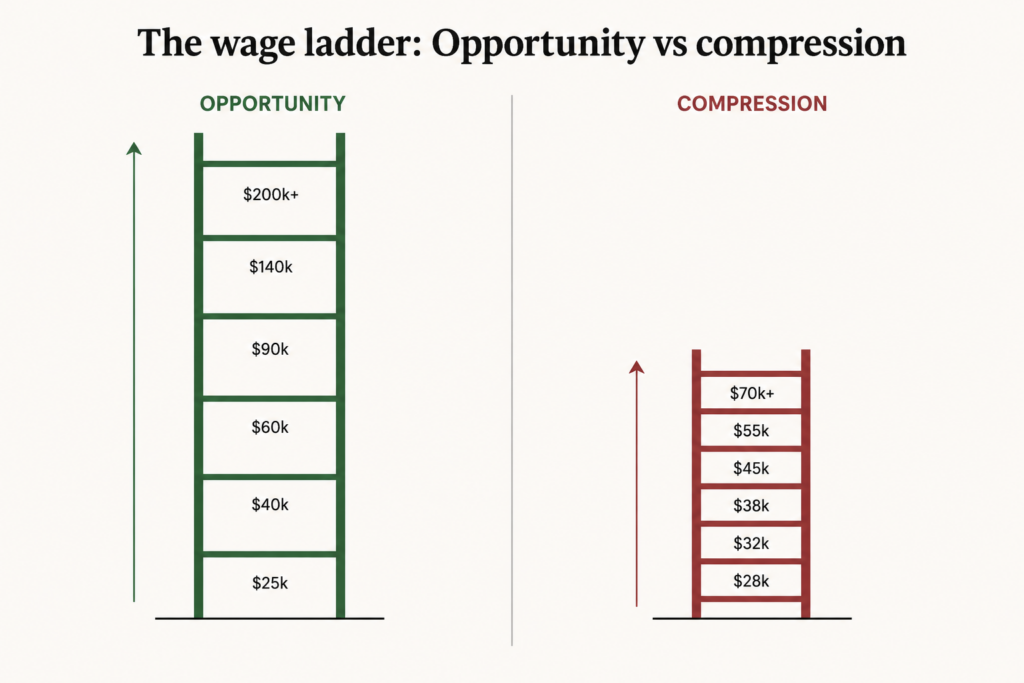
Markets are not valuable because they produce equal outcomes. They are valuable because they reward differences in productivity, specialization, innovation, and risk-taking. When those differences are compressed, the economy becomes less dynamic, not more just.
The relevant inquiry, then, is not whether incomes differ, but how freely people can move between economic strata.
Social mobility is a measure of opportunity rather than distribution. It asks whether individuals remain permanently confined to the economic circumstances into which they were born, or whether talent, effort, prudent decision-making, and changing life circumstances allow them to move upward — or downward — over time.
This distinction is frequently lost because public debate tends to treat income groups as though they were fixed populations. They are not.
Most People are Both Poor and Wealthy in Their Lifetimes
Individuals occupy different places in the income distribution at different stages of life. Earnings generally rise through middle age before declining in retirement. Total household wealth may spike when a house is sold or dip during a brief unemployment. Young workers who appear in the lowest quintiles often move substantially upward over their careers. Likewise, many who are born into affluent households fail to remain there as adults. The composition of each income quintile changes continuously, even if the statistical distribution appears relatively stable from year to year.
None of this is to suggest that mobility is perfect or that barriers to advancement do not exist. They plainly do. Housing costs, educational quality, occupational licensing, family instability, and regulatory barriers can all impede upward mobility and deserve serious attention. But those are questions about opportunity — not outcome.
Looking upward at those who have more, with blame, instead of inward asking how to achieve it, is a seductive impulse. Romans called it Invidia, envy, not simply an emotion but a destructive quasi-supernatural force capable of corroding both the individual and the Republic. Envy requires no self-examination, no acknowledgment of tradeoffs, no accounting for neglected opportunities or misjudgments. The belief that every disparity is evidence of injustice comforts the bruised psychology. Every success is an implicit accusation. To succeed becomes suspect.
A politics centered on mobility makes far greater demands. Asking how people rise obliges us to question institutions that either expand or restrict opportunity. It asks difficult questions of ourselves. Which ambitions did we pursue? Which sacrifices were we unwilling to make? Which opportunities, what profitable paths, did we decline in favor of other goods, or experiences, we valued more?
Joan Didion once observed that self-respect comes from accepting responsibility for oneself. That observation is no less applicable to economics than to character. A society committed to opportunity expects individuals to exercise agency within the freedoms they possess, even while recognizing that circumstances differ and misfortune is real.
Not everyone has the same combination of ability, appetite for risk, or singular ambition. We are not all born into homes with equal resources or offered the same educational and professional choices. But almost everyone possesses more agency than contemporary politics is willing to admit. The relevant question is seldom whether you could have become one of the wealthy elite. It is whether you might have become someone other than the person you are today.
Asking for personal accountability, for self-examination, is a far less politically convenient conversation than railing against “income inequality.” Campaigns built on redistribution require little more than resentment to move them along, but they only worsen the incentive problems they purport to solve. A society committed to expanding opportunity demands something more difficult: institutions that preserve mobility, not ‘equality,’ and citizens willing to bear responsibility for what they do — and fail to do — with their freedoms.