
 By
By The year is 1932. It has been almost three years since the stock market crashed. By the end of the year, the unemployment rate will hit almost 24 percent. There is a silver lining, though: baseball. Pick your city, pick your team. Forget about the current economic or personal crisis for a couple of hours.
When crises hit, governments (unfortunately) seldom sit still. They often introduce new policy measures, claiming they are necessary and neutral. To raise revenue for such programs, states must choose whether to borrow the money, print the money, or confiscate it from the people in taxes. Not by coincidence, the most visible and organized activities are easily targeted by a “necessary tax” narrative. But sometimes these activities are the last affordable parts of ordinary life.
In the summer of 1932, the federal government reinstituted an amusement tax that had originally been introduced under the Revenue Act of 1917 but repealed in the 1920s. It applied broadly to tickets for movies, theaters, and sporting events — like Major League Baseball games.
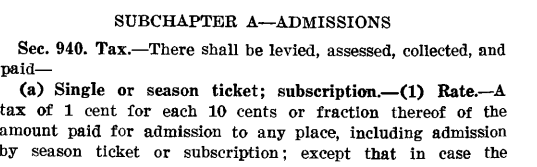
Upon first consideration, it appears modest — only 10 percent on admissions. This applied to most standard baseball tickets (all above forty cents) before exemptions were raised high enough to exclude them two years later.
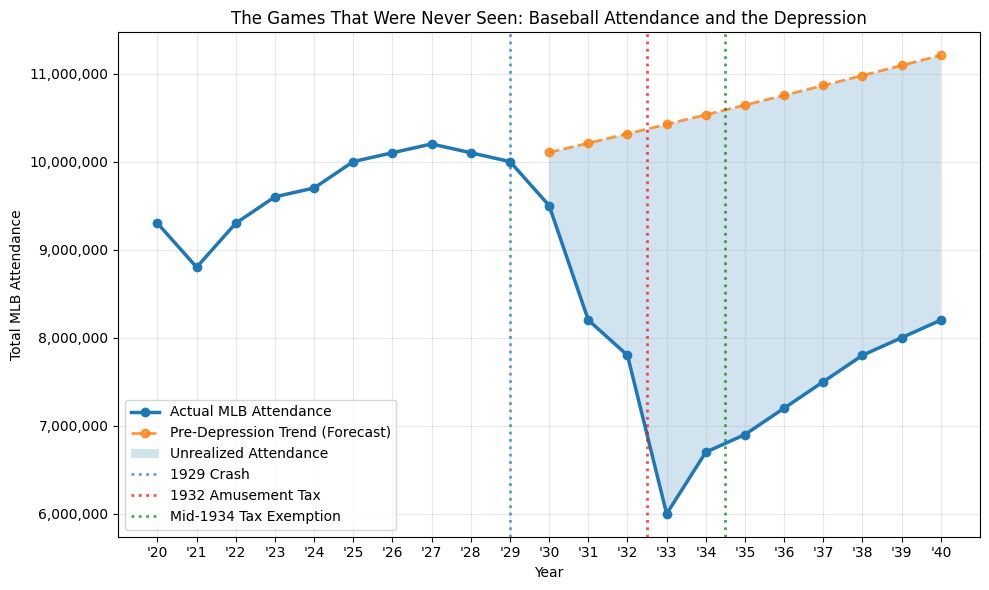
Perhaps in normal times, this would have gone by somewhat unnoticed. In 1932, however, unemployment was high, incomes were falling, and families were increasingly cutting discretionary spending as they entered the third year of the Great Depression. In fact, baseball attendance had already fallen from about ten million to about 7.8 million annually.
And then the tax arrived.
Mainstream economic analysis regarding taxation is centered around who pays it. Do consumers bear it through higher prices, or do producers eat it through lower revenue? Perhaps some combination. This framing is, at best, incomplete. Prices are not simply cost-plus formulas. They depend on what consumers are willing and able to pay. As Dan Sanchez puts it, “Prices are not determined by costs. Costs are determined by prices.” Producers are already charging the most they believe they can at any moment; they cannot change their price simply because the cost of production changes, without a corresponding rise in demand. If consumers’ willingness to pay collapses, firms cannot simply pass on the tax. What results, then, is fewer transactions at the stadium turnstiles.
Putting aside who absorbed the tax, a more interesting question is: what happened to demand? How many people stopped going to games?
The answer: quite a lot. By 1933, attendance had fallen by almost two million, forty percent.
This is crucial: the amusement tax did not just transfer money from fans to the state. It reduced the number of voluntary exchanges, pushing the marginal fan — who could justify paying one dollar for a ballgame but not a dollar ten — out of the market. And every time that happened, a small piece of economic and social life disappeared.
A typical baseball ticket in the early 1930s cost around one dollar, about $24 today — about one-quarter of a day’s wage. Even the “cheap seats” at fifty cents would consume more than ten percent of daily income. The increase from the tax was noticeable, and clearly enough to change fans’ behavior.
Baseball was not just entertainment for the elites but an affordable public activity for families. An outing to the park, the excitement of cheering on a local team, could provide some normalcy during hardship. This very accessibility, visibility, public appeal, made it vulnerable to the state. Large crowds, centralized ticket sales, and predictable revenue streams are easy targets for taxation.
Easy targets are also fragile, though.
Discretionary spending is quite sensitive to changes in income, with leisure often cut first. The psychological effect of even a small increase in leisure activities is significant, because it arrived at a time when people were already cutting back discretionary spending. Policymakers writing new taxes appeared more concerned with whether baseball was taxable than with whether attendance could withstand the tax.
It was taxable, but not that resilient.
The tax was short-lived, as the tax was adjusted to exclude purchases of less than three dollars ($70 today), subsuming most general admission baseball tickets. But the two seasons were met with a notable gap between expected and actual attendance, using a basic forecasting model. From 1930 to 1934, an estimated 13.4 million fewer Americans attended a baseball game than previous trends would have anticipated, absent the Crash of ‘29 and the Amusement Tax of 1932. Of that 13.4 million, 10.8 million, or 81 percent, happened between 1932 and 1934 — the tax years.
Major League Year-by-Year Averages, Baseball Reference
Baseball during the Great Depression is only one memorable example. Governments often prefer to tax that which is visible, convenient at scale, and politically feasible, making mass consumption easy to tax. But convenience does not mean economically harmless, and it usually means disruption to price-sensitive activities that can be sources of joy. These changes in behavior, social and cultural, at the margin have real impact. That should be criteria for judging a tax, as worthy of discussion as incidence or rates.
As Frederich Hayek articulated and others have explained, the unseen is not just what we fail to observe — it is also what never comes into existence. In this story, it was marginal, dollar-for-ticket exchanges not made: baseball games not attended, family memories never made, wholesome happiness never felt.
Collected tax revenue is visible and easily measured. The moments of ordinary joy they consume are not. But these unseen losses are no less real or important to the people who bear them.