
 By
By As recently as 1995, a child’s straight-A report card meant something specific. Still relatively rare, the feat indicated a child had worked hard and was learning and retaining information at the expected grade level. Parents would congratulate their little scholars over dinner, take them out for ice cream, and quietly calculate the damage of a college tuition bill.
If your child comes home with a straight-A report card in 2026, there may still be cause to celebrate. But grades have changed in ways a discerning parent should understand before they load up the car for a run to Baskin-Robbins.
When Every Child Is Above Average
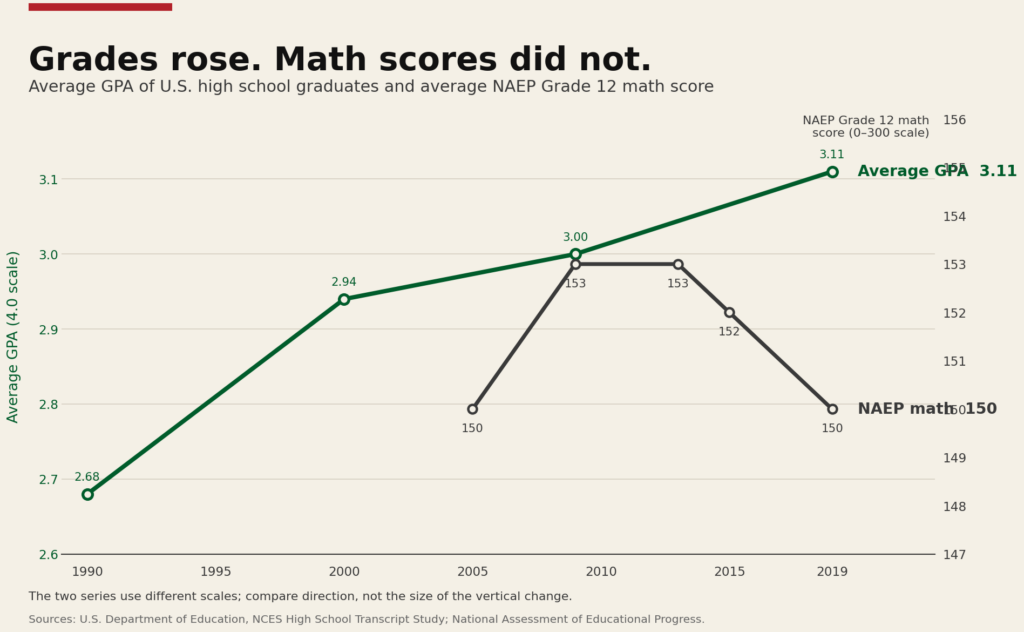
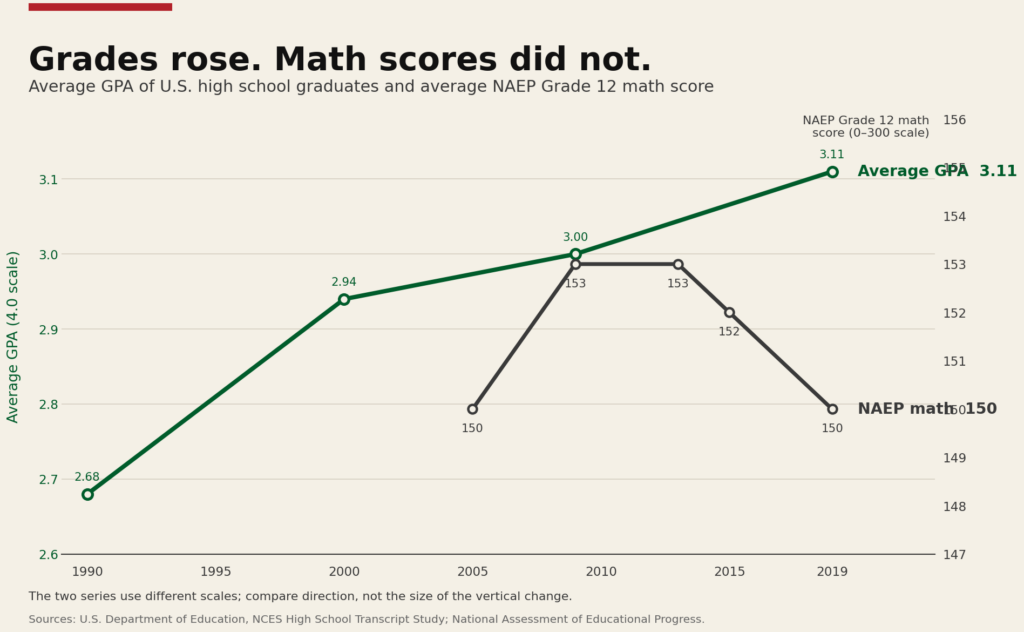
Half of all seniors graduate now with grades in the A range (up from 39 percent in 1990), making it by far the most commonly awarded grade. But state-administered proficiency test and SAT and ACT scores decline year after year..
Once upon a time, grades were at least a nominally objective measure of academic merit, in the sense that they equated roughly to a percentage: an A meant a student got 90–100 percent of the work correct, a B meant they got 80–89 percent correct, and mastering less than half meant a failing grade. And more importantly, there were far fewer incentives for a teacher to misrepresent them.
In the twenty-first century, grades are inflated as standard practice. Grades evolved from relatively standardized metrics of knowledge into heavily inflated, subjective signals between adults and institutions. This shift — driven by consumer-model schooling and faculty incentives — actually harms students.
For years, the headlines have been full of reports of students getting good grades but failing miserably at actual academics. Grade inflation may be even more common in wealthier schools, driven partly by demanding parents.
In 2025, a student in Connecticut graduated from high school with a 4.0 GPA, then turned around and sued her district because she couldn’t read. Later that same year, the story broke that UC San Diego, one of the most prestigious schools in California, had to put 11.8 percent of its incoming freshmen into remedial math classes. Even more shocking: while seventy percent of the remedial class tested below the middle school level, one in four had earned a perfect 4.0 GPA in high school math.
An increasing academic disconnect emerges: GPAs are rising while course rigor and more objective assessment scores are falling.
Who Is To Blame?
The students — and their parents — made it through all of high school getting signals that their work is adequate, with straight A’s on every report card. Often nobody, parent nor student, realizes those grades don’t reflect reality until a child ends up in a remedial math class in their first year of university. Students frequently get high grades in their classes, only to score horribly on the externally administered, standardized SAT (even while the SAT has become progressively easier to accommodate students’ declining academic abilities). A student might never have struggled in high school, even if they never actually mastered even middle school math.
Little Johnny (Jaxon? Braxton?) may very well be working as hard as he can, or at least as hard as he’s been asked to, and think he’s meeting the expectations of his teacher. He didn’t deserve those high scores — he needed academic support and the dignity of a high academic standard.
Teachers aren’t entirely to blame, either. They face pressures and perverse incentives to pass students even if they’re not ready. In June 2017, Ballou High School — one of Washington, DC’s poorest schools — announced that all 164 of its graduates had been accepted into college. Celebrations of the amazing turnaround story ensued. An investigation later found that only 57 of those graduating students had actually attended class and passed courses under district policy. At least half of students had missed three months or more of school their senior year, and roughly two-thirds shouldn’t have graduated. When DC high school teachers were surveyed, 60 percent said they’d felt pressured or coerced to give grades that didn’t reflect what students had actually learned, and more than one in five said that their submitted grades were changed by someone else.
The common thread is clear: the incentives inside American education have become warped, to the point grades no longer even approximate learning.
The institutional finger-pointing rivals a Spider-Man meme. Some people are quick to blame the teachers’ unions, yet in the Ballou story it was the union itself that conducted the survey on grading coercion and blew the whistle about administrative pressure. In that case, it was the administrative staff that resigned or got fired, but administrators aren’t the bad actors every time, either.
One easy scapegoat is the increasing federal control over curriculum and policy since the inception of No Child Left Behind in 2001 and Common Core a decade later. But the reality is that the bulk of policy rests with the states, and the federal government has less say in district-level policies than most believe.
The real problem is what schools are incentivized to prioritize. Their success is measured in funding, and judged primarily through test scores, grades, and graduation rates. Actual cognitive growth is difficult to measure, and so, it isn’t prioritized. Statistical proxies are manipulated, instead.
Schools are heavily pressured to show improvements and to meet minimum benchmarks for each of these metrics. Federal funding to each district can be contingent on student outcomes. Failing schools run the risk of closure, budget loss, and layoffs.
Districts can’t change test scores, which are considerably more objective and comprise one-third their success metrics. But they can change grades, which in turn influence passing and graduation rates (graduation is based on your GPA, not your test scores).
Sometimes the pressure to doctor the numbers is immense, as proven by the Ballou story and other scandals. It might even feel compassionate in individual cases: “Johnny doesn’t quite get the material yet, but he’s really trying, and he’ll just fall behind if we hold him back.” Data reveals he’ll continue to fall behind if he moves forward, too.
Colleges Perpetuate the Lie
Similar pressures exist in universities, where the incidence of A’s relative to other grades at universities has also been rising. Across all four-year colleges in the US, the most commonly awarded grade is now an A, causing the National Institutes of Health to declare, “College grades have become a charade.” Student evaluations contribute to grade inflation by tying student satisfaction to each professor’s promotion and tenure potential. Professors who maintain high standards and give out As sparingly are punished with low scores, low enrollments, and lower salaries. One professor told The Atlantic “We give them all As and they give us all fives.” This pattern routinely rewards teaching to ease, not excellence.
For any student from kindergarten all the way through university, an A on a report card could indicate either that the student did A-level work or that the teacher or school needed an A-level grade to keep their numbers up. For parents and students, the difference can be hard to discern.
The first line of defense for parents is to simply be aware of what your kids are actually retaining and how their skills grow — not arbitrary lettered signals that serve other people’s interests. Talk to your kids about what they’re learning. Ask them to read to you and do calculations for you and to show you their school essays. Assign growth-mindset challenges yourself. Observing them will give you far more clarity into their academic skills than a report card can.
If the government school system isn’t supporting your child’s full potential — and all available data indicate it is not — that’s one more reason to question whether public school is designed or properly incentivized to deliver an education at all.