
 By
By Wealthy professionals can be strident egalitarians or naive optimists about the benefits of government spending — or so it would seem after reading law professor Ray Madoff’s book The Second Estate: How the Tax Code Made an American Aristocracy.
Madoff clearly has an axe to grind against America’s wealthiest citizens, and she is deeply critical of the legal mechanisms they use to protect and transfer their assets. Her argument often seems to boil down to this: Why should wealthy Americans keep so much of their wealth for personal use rather than allow the public — or, more specifically, Congress — to decide how those resources should be spent?
Yet The Second Estate is no low-brow polemic. Professor Madoff knows federal tax policy well, and her explanations of the tax code and the ways wealthy individuals use it are often insightful. My disagreement is not with her description of the mechanics of taxation, but with her underlying assumption — at times explicit, at times implied — that concentrated wealth is inherently harmful because it deprives the federal government of resources.
The wealthiest Americans pay hundreds, thousands, or even millions of times more in taxes than the average taxpayer. More importantly, the companies they create and build make the country more prosperous and generate enormous tax revenues in the process.
This should be obvious upon reflection. The businesses created, owned, or led by members of the Forbes 400 employ millions of people and generate tens of billions of dollars in federal tax revenue each year.
Yet The Second Estate presents a very different picture: a special class of Americans who exist above the reach of the tax code and avoid contributing their fair share to government revenue. We can set aside the questionable assumption that more federal revenue is automatically beneficial for most Americans. The deeper flaws in Madoff’s argument stem less from what she says than from what she leaves out about the super-wealthy.
Myths About the Rich and Taxes
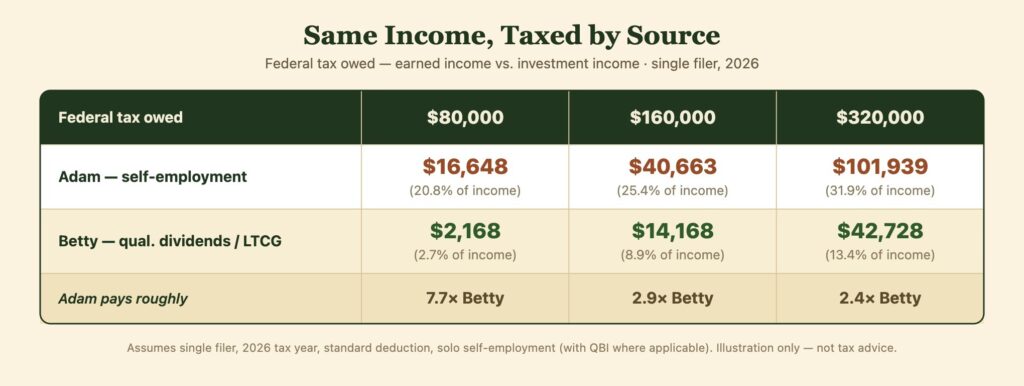
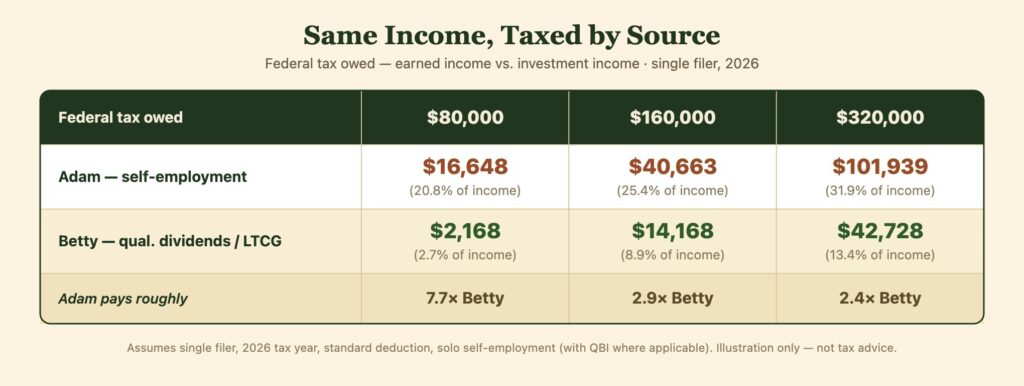
Professor Madoff is correct to distinguish between different types of federal taxes. Income from dividends, interest, and the sale of assets (capital gains) is generally taxed differently — and often at a lower rate — than income earned through wages.
Long-term capital gains and qualified dividends are typically taxed at rates of 0, 15, or 20 percent, depending on income level, while wages are subject to both income taxes and payroll taxes. Employees pay 7.65 percent in Social Security and Medicare taxes through FICA, and employers pay another 7.65 percent. Capital gains, by contrast, are not subject to payroll taxes.
As a result, a billionaire’s effective federal income tax rate can be lower than that of an employee earning a middle-class salary. Madoff correctly explains how these differences affect taxpayers who receive income through wages versus those who receive income through investments.
Suppose Adam is self-employed while Betty receives all of her income from dividends and long-term capital gains. The following table illustrates how their federal tax burdens would differ at income levels of $80,000, $160,000, and $320,000.
Madoff explains how wealthy individuals often borrow against their assets rather than sell them. They don’t pay taxes on those loans (though they do pay interest). This is true. Sometimes individuals with a net worth of tens or hundreds of billions of dollars will report little or no income in a year because their “salaries” or wages are very small and they didn’t realize any capital gains.
But the fact that the ultra-wealthy can avoid paying federal income taxes some years does not mean they avoid them altogether. They have to pay down their loans and lines of credit periodically. And if they want to make exceptionally large purchases or investments, loans from banks are not enough. Then they must sell shares, realize gains, and pay taxes. The super-wealthy undoubtedly pay far more dollars in taxes than any middle-class or upper-middle-class individual.
Elon Musk, for example, famously paid about $11 billion in income taxes in 2021. This particular tax bill was anomalous both for its size and because the IRS taxed much of it as ordinary income at a high tax rate. Musk had a huge block of his stock options that he had to exercise or lose. Yet even if those were the only income taxes he ever paid over the course of 50 years, that would still come out to ~$200 million in taxes annually — far more than any but the very wealthiest Americans earn over their lifetimes, let alone what they pay in income taxes.
Most of the super-wealthy find ways to pay lower rates on their income. Still, many wealthy individuals pay vast sums, in the tens or hundreds of millions of dollars, annually on dividend income (Steve Ballmer pays approximately $250 million every year). There are also large one-time tax payments from capital gains. Ken Griffin paid roughly $4 billion in 2021, Jeff Bezos paid about $2 billion in 2020 and 2021, Jensen Huang paid more than $100 million in 2024 and 2025, and Tim Cook paid roughly $300 million in 2021.
Even accounting for the payroll taxes paid by ordinary wage earners, these tax payments represent the equivalent of thousands upon thousands of “Adams” paying federal income taxes. And this is where the shortcomings of Professor Madoff’s argument become clear.
Her account gives the impression that the ultra-wealthy largely avoid taxes because their effective tax rates are often lower relative to their income or wealth. While wealthy individuals certainly have ways to reduce their tax liabilities and structure their assets efficiently, it is inaccurate to suggest that they simply avoid paying federal taxes.
It is also misleading to ignore the many other taxes the super-wealthy pay.
They pay property taxes on their land and houses every year. In places like Los Angeles and New York City, those tax bills can reach hundreds of thousands or even millions of dollars. They pay taxes when they shop, dine, or travel. They pay transfer taxes, building fees, development fees, and a host of other taxes and charges.
That is hardly “free-riding” on the tax system — especially when they pay many times (10, 100, or even 1,000 times more) than the average taxpayer while consuming nowhere near that proportion of government services.
The Wealth Creation the Tax Debate Ignores
Even this oversight, however, misses the most important contribution of the super-wealthy to society: wealth. Focusing on how much Elon Musk or Jeff Bezos or the Mars family pays in personal income or other federal taxes in a specific year is a red herring. It is a rounding error compared to how much wealth their companies have generated for shareholders and how much tax revenue they have generated. Focusing on the corporate income taxes paid (or not) by individual companies makes similar mistakes.
Consider Tesla. Over the past five years, the company has reported relatively little federal income tax liability (about $48 million in 2023) despite nearly $20 billion in net income. This is largely because Tesla has carried forward previous losses, invested heavily in new capital, and benefited from certain green energy and research-and-development tax credits. Yet Tesla employs roughly 134,000 people. If the average wage for those employees is $100,000, the company would pay more than $1 billion annually in employer-side FICA taxes alone. Employees would pay another $1 billion-plus through their share of payroll taxes — not including the income taxes they pay.
Those figures are small compared to what Amazon (1,100,000 employees), Apple (90,000 employees), Meta (45,000 employees), and Alphabet (115,000 employees) pay in FICA taxes — over $10 billion annually for the employer share alone.
Madoff’s quixotic crusade against dynastic or family wealth is just that — tilting at windmills. Only a quarter or so of people on the Forbes 400 list inherited the majority of their wealth. And that number gets smaller as you move to the top 100 and then the top 50. Inherited wealth can only last if it remains invested in companies rather than cashed out or spent. For every example of inherited wealth growing, there are more examples of inherited wealth becoming depleted.
Who Owns Wealth?
All of this raises a basic question: Why should we care that families such as the Mars, Walton, or Koch families possess wealth they can pass on to future generations?
Madoff argues that the wealthy “free-ride” on the tax system. But this assumes their money somehow already belongs to the government or the public.
It does not.
Madoff also suggests that the super-wealthy exercise undue political influence from the shadows. In this, she leaves the solid ground of analyzing existing tax rules and mechanisms to the ideological concerns and disapproval she has for large concentrations of wealth in general.
Could the tax code be fairer and better than it is? Certainly. Will her specific recommendations make it so? I’m not sure. But will politicians implement her “ideal” policies? Assuredly not.
Besides raising revenue, the tax code should distort and discourage economic activity as little as possible. While everyone benefits from clear rules of the game that promote competition and responsibility, it’s far from clear that they would all benefit from more “tweaks” to the tax code to close loopholes. Revenue with minimal distortion, not leveling the fortunes of the super-wealthy or making sure they pay their “fair share,” should guide tax policy.
Lobbyists, insiders, and wealthy individuals have certainly influenced the tax code for their own benefit. But so have middle-class homeowners through mortgage deductions, residents of high-tax states through state and local tax (SALT) deductions, and lower-income Americans through welfare programs and tax credits. This is how the political game is played.
Rather than criticizing the super-wealthy for minimizing their tax liabilities as best they can, policymakers should focus on reducing government spending so that everyone else’s taxes can be reduced too. Reducing political power, limiting the coercive reach of the state, and allowing individuals to keep more of what they earn would do far more to improve Americans’ lives than taking more money from the wealthy and giving it to politicians.
Such broad-based reforms would also be more just.