
 By
By One of the most familiar diagrams in introductory economics — perhaps second only to the famous supply and demand graph — is the classic “guns versus butter” tradeoff. Its ubiquity can make it seem almost too familiar to warrant much thought. Yet its deeper history carries a timeless lesson worth revisiting.
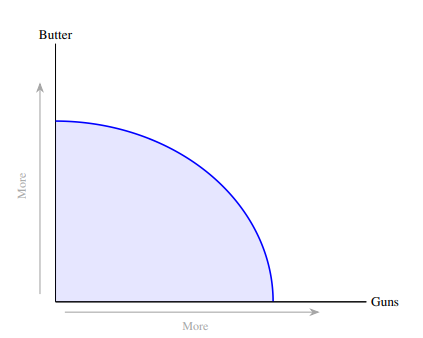
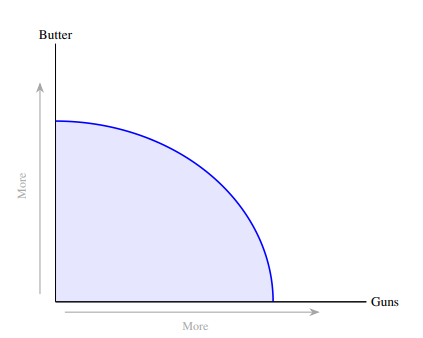
The guns versus butter graph illustrates a fundamental economic reality: in a world of scarce resources — land and raw materials, labor, and capital — devoting more resources to producing one good necessarily means producing less of another, all else equal. Because resources typically have multiple uses, the true cost of any choice is the value of the next-best alternative forgone, known as its opportunity cost. A production possibilities frontier, the broader category to which the guns versus butter graph belongs, neatly visualizes this constraint by showing the menu of feasible combinations available to an individual, firm, or entire society.
The specific example of a tradeoff between guns and butter depicts a societal decision made by governments, whether through democratic processes or dictatorship. While the classic example may feel somewhat dated today (a more contemporary version might be military drones versus smartphones), it still captures a timeless reality: producing more military goods necessarily means devoting fewer resources to consumer goods.
Consistent with this theory, a survey of the empirical literature on the economic effects of military spending by Dunne and Tian finds that the predominant conclusion is that “military expenditure has a negative effect on economic growth.” In times of war, military personnel and civilians bear the ultimate and most tragic costs. Beyond this human toll, however, the guns versus butter analogy reminds us that war also carries significant economic costs.
The trade-off represents a static snapshot where resources are fixed in the short run. But, in the long term, technological improvements, driven by investment, better institutions, access to markets, and innovation, expand the production possibilities frontier, allowing societies to produce more of both guns and butter. As the US experience during WWII demonstrates, it is the entrepreneurial dynamism, economic flexibility, and material abundance brought by open and competitive markets that ultimately provide the strongest foundation for national defense. Conversely, restrictions on technology, resource shocks, erosion of the rule of law, weakened property rights, and trade barriers can shrink the frontier, reducing the production of both military and civilian goods.
Paul Samuelson’s popular textbook Economics (1948) was the first apparent depiction of a guns versus butter graph, making it a permanent staple of introductory courses. Samuelson was introduced to the first production possibilities frontier graph, depicting the tradeoff between two goods, by his Harvard professor Gottfried von Harberler, a student of Friedrich von Wieser and Ludwig von Mises, who had introduced it in his book Theory of International Trade (1936).
Yet the underlying insight, arguably, reaches back much further. In Book IV of Wealth of Nations, Adam Smith meticulously documented the economic costs of Britain’s imperialism. Subduing, protecting, and administering far-flung territories had enormous costs and few benefits. Contrary to the prevailing wisdom of his day, he argued that empire, once all the tradeoffs were considered, diminished the wealth of nations rather than increasing it.
Modern scholars have built on Smith’s foundation, adding insights from public choice theory and Austrian economics to “understand state-provided defense in the actual world,” to better appreciate the incentive and knowledge problems and the erosion of domestic liberties that can come from militarism. International relations theory has also questioned the benefits of defensive buildups, given the inherent security dilemma where increasing allocation to “guns” leads other countries to do likewise, leaving all countries in the same relative position defensively, with consumers bearing the costs. James Monroe recognized this (in a letter to John Quincy Adams) following the Treaty of Ghent, observing “The increase of naval armaments on one side upon the lakes, during peace, will necessitate the like increase on the other, and besides causing an aggravation of useless expense to both parties…”
Wikipedia’s entry for the guns versus butter model claims the origin of the analogy traces back to the United States during World War I. That, however, does not appear to hold up. The cited references fail to support it, and extensive searches of variations of the term on Newspapers.com and Google Ngrams do not turn up results that can confirm those origins. Rather, the historical evidence suggests another, far more sinister, origin.
The phrase appears to have originated in Nazi Germany (referred to as “kanonen und butter” in German). As Adam Tooze demonstrates in Wages of Destruction, living standards in the Weimar Republic — and even more so under the Nazis — lagged behind those in Britain and the United States. Hitler’s drive for territorial expansion to secure land and resources ran headlong into the economic reality captured by the guns versus butter tradeoff: building a massive military required significant sacrifices from German consumers.
To encourage those sacrifices, the Third Reich launched a propaganda campaign — widely reported in US newspapers — urging Germans to patriotically accept lower living standards, including higher prices, fewer consumer goods, and rationing, in order to produce more Panzers and Messerschmitt Bf 109 fighters for the Fatherland. In 1936, Joseph Goebbels declared, “We can do without butter, but, despite all our love of peace, not without arms. One cannot shoot with butter, but with guns.” Hermann Göring put it even more bluntly: “Guns will make us powerful; butter will only make us fat.” Mussolini soon appropriated the same rhetoric as a patriotic slogan.
The British diplomat and journalist R. H. Bruce Lockhart published a 1938 memoir of his travels through Europe, Guns or Butter, in which he classified countries as either “butter” or “gun” countries. Butter countries enjoyed peaceful societies and higher standards of living, while gun countries sacrificed living standards to pursue military buildups. Even in 1938, Lockhart recognized from his travels that “Germany put guns before butter.”
Adam Tooze notes that estimates of German economic growth between 1935 and 1938 indicate that direct and indirect military expenditures accounted for two-thirds of the increase in national output, compared with just 25 percent for private consumption. Japan, too, pursued resource-driven territorial expansion and chose guns over butter. As Michael Barnhart writes in Japan Prepares for Total War, “One route did exist which avoided reliance on foreign nations or occupied areas, was politically possible, and was especially attractive to the Planning Board. Still harsher controls could be imposed on consumption within the Japanese Empire.”
And the sacrifice made by consumers wasn’t limited to the Axis powers. The Allies were also required to make drastic wartime sacrifices in response. In The Journal of Economic History, economic historian Robert Higgs writes that “during the war the economy was a huge arsenal in which the well-being of consumers deteriorated…” Economists Steve Horwitz and Michael McPhillips supplement this with archival evidence from newspapers and diaries, finding that “the wartime economy actually amounted to a retrogression for many families because they had to supply additional labor, accept inferior goods, and do without many goods altogether as resources were diverted to the war effort and wartime controls constrained the market process.”
The tradeoff for the Soviet Union was even more devastating, Tooze notes. “…the production [of military equipment] came at the expense of enormous sacrifice on the Soviet home front,” he writes, “where hundreds of thousands if not millions of people starved to death for the sake of the war effort.”
It is this bitter experience that led President Eisenhower to observe:
Every gun that is made, every warship launched, every rocket fired signifies, in the final sense, a theft from those who hunger and are not fed, those who are cold and are not clothed. This world in arms is not spending money alone. It is spending the sweat of its laborers, the genius of its scientists, the hopes of its children. The cost of one modern heavy bomber is this: a modern brick school in more than 30 cities. It is two electric power plants, each serving a town of 60,000 population. It is two fine, fully equipped hospitals. It is some 50 miles of concrete highway. We pay for a single fighter plane with a half million bushels of wheat. We pay for a single destroyer with new homes that could have housed more than 8,000 people.
The guns versus butter tradeoff remains one of the most powerful analytical tools in economics precisely because it forces us to confront an uncomfortable truth: resources are finite, and every choice carries a cost.
The phrase’s apparent origins in Nazi Germany — and its grim application during the 1930s and 1940s — remind us that when governments prioritize guns over butter, the burden falls heaviest on ordinary citizens through lower living standards. Adam Smith recognized this principle in the eighteenth century, famously distilling the ingredients of prosperity to “peace, easy taxes, and a tolerable administration of justice.” The ultimate lesson of the guns versus butter graph is straightforward: military buildups and war come with real tradeoffs, often at the expense of civilian prosperity and living standards.