
 By
By Walk through almost any beloved old Manhattan neighborhood and you quickly run into a strange fact: much of the city people love would be illegal to build today.
In 2016, The New York Times published an analysis titled “Forty Percent of the Buildings in Manhattan Could Not Be Built Today.” Using data from Quantierra, the article found that, out of Manhattan’s roughly 43,000 buildings, 40 percent — about 17,000 — violate at least one current zoning rule. Many were too tall or covered too much of their lots. Some had too many apartments; others had too many retail stores. In other words, much of Manhattan’s built environment survives only because it was grandfathered in before today’s rules could prohibit it.
The forbidden builds include iconic buildings like the Empire State Building, the Chrysler Building, the original World Trade Center Twin Towers, and scores of landmarks all over the city.
In an important sense, New York City is living in its past. It is hampered from creating a dynamic future, frozen in place by zoning laws that typically force buildings to be squat, “wedding cake” shaped, or simply indistinguishable from neighboring buildings. Under these rules, it would be impossible to build world-famous skyscrapers like the Empire State Building, or Art Deco masterpieces like the Chrysler Building, the Flatiron Building, The Dakota (famous home of John Lennon and Yoko Ono), and scores of others.
What future landmarks will never be built under today’s zoning rules?
Poke around on this interactive map to see how today’s zoning would have quashed buildings on nearly every city block.
The Twin Harms of Zoning: Scarcity and Loss of Dynamism
Two main harmful consequences result from zoning laws and their cousin, landmarks laws. (Landmarking in NYC essentially prevents any new construction in vast zones of the city. It is like a form of super-severe zoning. More on it below.)
First Harm: An Artificial Scarcity of Housing
The first harm is that zoning makes housing (and office rents – this analysis applies equally to office buildings) much more expensive by reducing the supply of new housing in the city. In order to preserve access to “light and air” for pedestrians and residents, zoning restricts the size and density of buildings. It does this by limiting heights, square footage, and imposing a variety of other rules, such as requiring empty backyards and street setbacks.
The first comprehensive zoning law in the United States was passed in New York City in 1916. Its purpose was to preserve “light and air” by reducing the size of new buildings. It divided the city into zones, each with a different limit on building size. The law further separated the city into use-zones. Parts of the city could only be used for their designated purpose: residential, commercial, manufacturing, and many more narrowly prescribed uses. Using a building in a zone for a different purpose (say, converting a warehouse or defunct office space into apartments) was expressly forbidden.
As time went by, the power to restrict building sizes and uses became a tool for residents who wanted to preserve their views or who simply didn’t want more neighbors. These concerns expressed themselves in the major 1961 revision to the zoning laws, which effectively “downzoned” much of NYC’s potential density. Before 1961, forecasters had predicted that NYC could eventually reach 20 or 25 million residents. (Note that such populations have already been attained in similar physical space by Tokyo, Jakarta, and Mexico City, among others.)
After 1961, NYC effectively froze in place. The total population of all five boroughs in 1960 was 7.8 million. Today it is 8.5 million, representing an anemic annual growth rate of 0.13 percent. In 66 years, it has barely grown, and zoning (and the resulting cost) is the major reason why. In the prior 60 years, from 1900 to 1960, NYC’s population grew at a much faster rate, more than doubling from 3.4 million people in 1900. (Rent control was also a major factor in thwarting New York City’s growth, as I’ve written before.)
Strict zoning largely locks in place existing uses and densities. It may allow for some growth, but usually in areas (zones) that are already high-density, such as Midtown Manhattan (which is why Billionaire’s Row is located there.)
Landmarking does the same thing, but it is far more severe. It imposes a near-complete ban on new construction in designated “landmarked” historical zones. Essentially, landmark preservation is a form of severely restrictive zoning; only a very small amount of replacement construction will be permitted, and only where building heights and sizes are strictly at or below neighboring buildings.
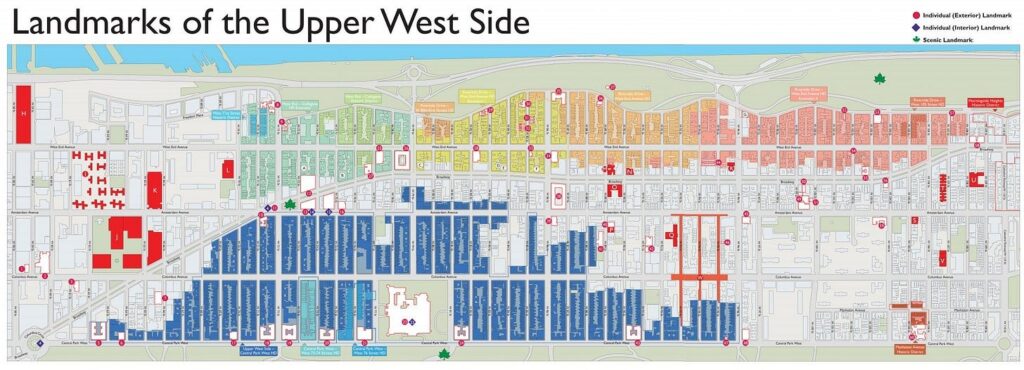
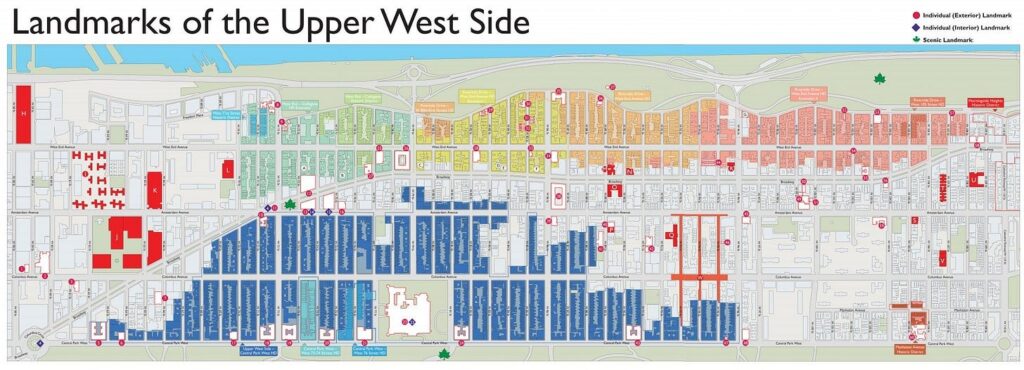
Landmarking was enacted in 1965 in response to the demolition of the original Penn Station. Originally intended to protect specific buildings, it has been expanded into vast landmarked zones, where new construction has essentially been foreclosed. Today, 27 percent of Manhattan’s building lots fall within landmark districts, largely off-limits to development. In much of Manhattan, including the Upper West Side, Upper East Side, Greenwich Village, SoHo, and Tribeca, this percentage is much higher. The map below shows Manhattan’s Upper West Side neighborhood. Nearly the entire region is landmarked, and essentially off-limits to new construction. Each colored area shows a different landmark district.
The Story of 19 Jones Street
The story of one building illustrates how zoning curtails new development. The photo below shows 19 Jones Street in the Greenwich Village neighborhood of Manhattan.
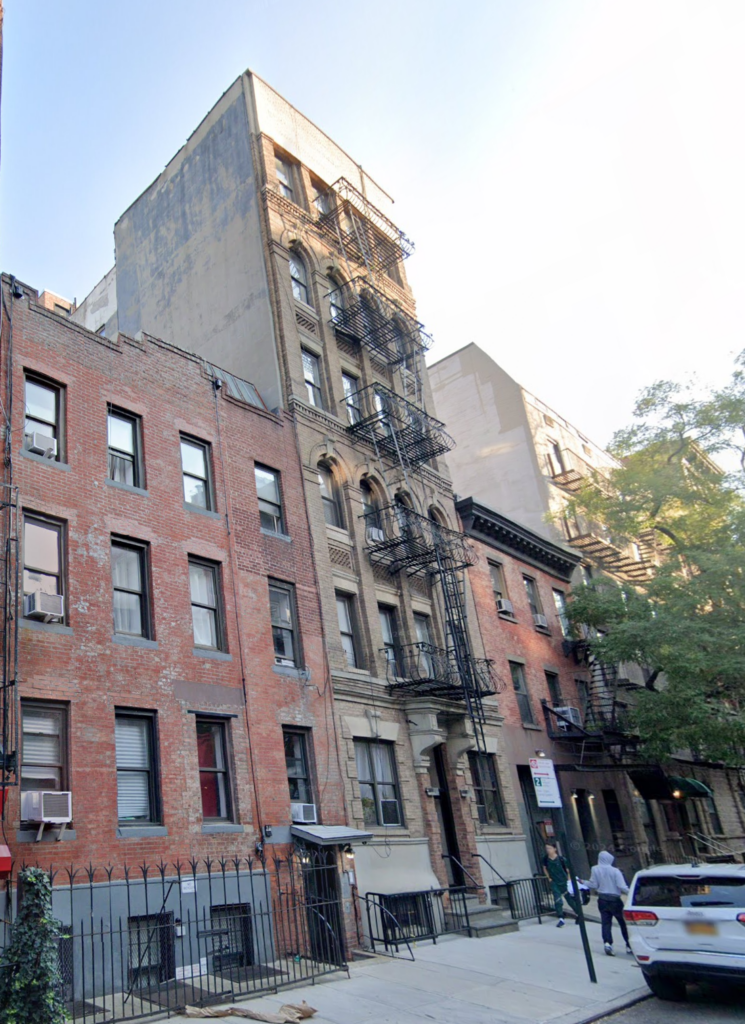
19 Jones Street was built in 1910, before NYC’s first zoning law. As the New York Times reports:
Were 19 Jones built today, it would have to be significantly smaller. The number of apartments would fall sharply, to just eight from 24. The building’s total dimensions would be nearly halved, and a story or two would have to be chopped off.
In other words, if built under today’s zoning rules, two-thirds of the existing apartments would be gone. Extrapolate this to the whole city, and it is as if a bomb has destroyed the future growth of the city. Artificial scarcity makes fewer apartments available, making housing unaffordable.
Second Harm: Ossifying the City
The second effect of zoning is that it freezes existing uses of property in a way that stifles creativity and growth. The best examples of this are two once completely illegal neighborhoods that are now beloved by New Yorkers and millions of tourists: SoHo and DUMBO. The only reason these neighborhoods could become something new and wonderful was that artists and others violated the obsolete zoning law that had prohibited the new uses. If the obsolete zoning laws had been rigidly enforced, these neighborhoods would have languished as semi-abandoned wastelands. As it was, zoning stood in the way of the conversion to new uses, making it take decades longer to happen, and at much greater cost.
SoHo: Illegally Re-Used, Now Beloved
Today, the SoHo (South of Houston) neighborhood in Manhattan is treated as one of New York’s great urban success stories: cast-iron buildings, lofts, galleries, restaurants, retail, and a streetscape that tourists and New Yorkers both recognize instantly. But SoHo’s revival began with activity that zoning did not permit. Its famous cast-iron buildings had been created and zoned for commercial and industrial uses. As manufacturing began leaving the city after World War II, artists moved into former factory spaces because the spaces were large, cheap, and full of light. But living there was illegal; zoning meant these spaces could only be used for manufacturing. Because of this illegality, early tenants had to hide their presence by blacking out windows so police could not see lights at night.
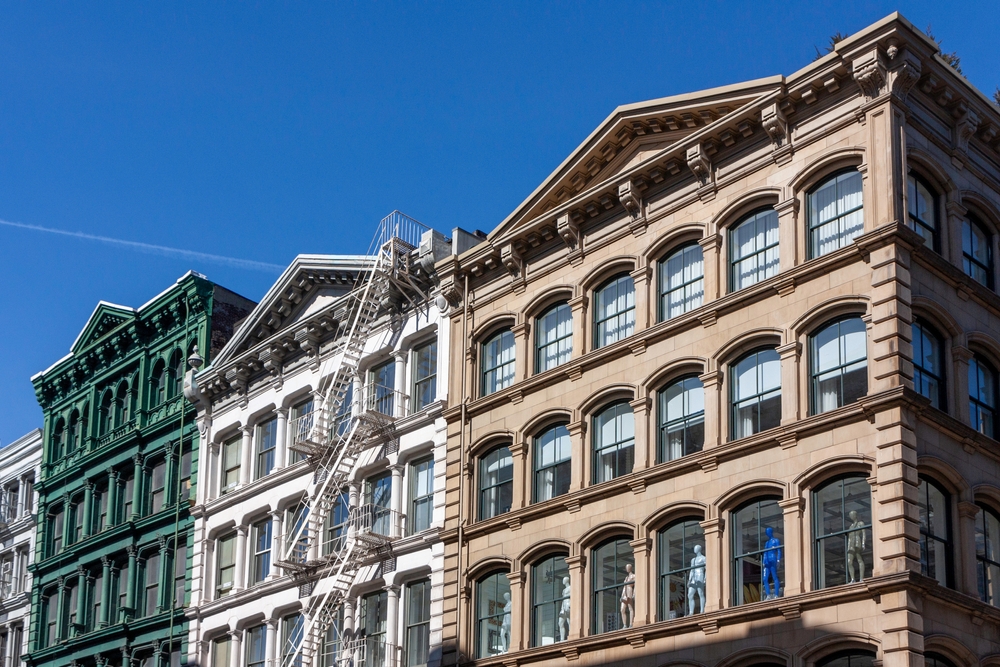
The illegality came first. The neighborhood’s cultural success came next, only after significant delay. Legalization came only decades after the fact, after the artists and others had already transformed the neighborhood. In 1971, New York created a special path only for “certified artists” to live in joint living-work quarters in SoHo, but even that was a narrow legalization rather than a broad recognition that the neighborhood had evolved beyond its old manufacturing-only logic. Full legalization of SoHo’s residential and retail spaces did not occur until just a few years ago, on December 15, 2021, when the City created the Special SoHo-NoHo Mixed Use District. One of the most famous mixed-use neighborhoods in the world existed for decades under a legal cloud before zoning rules finally legalized what the neighborhood had already become.
DUMBO: Down Under the Manhattan Bridge Overpass
DUMBO tells a similar story in Brooklyn. Today, DUMBO is an urbanist’s dream: historic warehouse buildings, cobblestone streets, tech firms, design companies, galleries, apartments, restaurants, and the gorgeous waterfront Brooklyn Bridge Park. But its transition also began as a mismatch between old land-use rules and new economic reality. The Department of City Planning’s own DUMBO rezoning materials describe the area’s evolution from an industrial hub into a mixed-use neighborhood through adaptive reuse of loft and warehouse buildings, noting that artists illegally began moving into large loft buildings in the late 1970s. Residential occupancy increased through both illegal conversions and costly ad hoc zoning variances.
Again, the market discovered the neighborhood before the zoning code did.
The official story often reverses the causation. We talk as if planners create livable neighborhoods by assigning the correct uses in advance, but as in SoHo and DUMBO, the actual order was different. Entrepreneurs, artists, tenants, small businesses, and property owners discovered new uses for old buildings. They took declining industrial districts and made them valuable again. Then the city slowly and expensively changed its rules after the fact to accommodate and legalize what private action had already produced.
Zoning continues to hold back more valuable new uses today. After COVID-19 shutdowns and with the rise of remote work, the demand for office space has waned, yet many attractive buildings that could be converted to much-needd residential units must languish for years as special zoning exemptions and variances — costly in time and money — are obtained. Other new uses, such as co-living and “ghost kitchens,” are also hampered by current zoning rules.
The Apartments That Never Get Built
The question is not whether some apartments built without zoning would be less desirable, dimmer, less well-ventilated. Of course they would. Would abolishing zoning would reduce the total supply of apartments with light and air, or merely add another category of apartments: sub-optimal, but cheaper and still valuable to people who cannot afford today’s expensive, regulated ideal. The likely answer is the latter. Zoning might preserve sunlight on paper, but at street level, it rations that legally preferred kind of apartment to those rich enough to afford it, preventing the construction of cheaper alternatives for everyone else.
The visible benefit of restrictive zoning is easy to imagine: more light on a particular block, a lower building next door, less change in a familiar neighborhood. The unseen cost is harder to picture because it consists of things that never happen: the cheaper apartments never built, the family never housed, the student priced out, the worker forced into a longer commute, and the young person who decides New York is no longer a place where he or she can afford to start a life.
A zoning rule does not announce, “I just raised your rent.” It simply says the next building must be smaller, less flexible, more expensive… or impossible. The rent increase arrives later, when the restricted supply of new buildings fails to meet demand. That is the lesson of the research by Edward Glaeser, Joseph Gyourko, and Raven Saks on Manhattan housing prices, and of Jason Barr’s work on New York’s “FAR Dome”: much of the city’s inherited density remains legal only because it was grandfathered, while comparable new density is forbidden. The result is higher prices for fewer available apartments. (Note: “FAR” stands for “Floor Area Ratio.” Zoning restricts density by specifying maximum FAR limits in each zone.)
New York’s housing problem is not mysterious. People want to live here. Firms want to hire here. Students, immigrants, families, and young professionals want access to the jobs, schools, culture, and transit that make the city valuable. Zoning prices these newcomers out. Instead of an unaffordable “light-and-air-filled” apartment, they are denied the option to live more cheaply in a less-luxurious apartment in the city center.
New York forces housing through FAR limits, use restrictions, discretionary approvals, historic reviews, parking rules, community opposition, and political bargaining. Supply is never allowed to meet demand. But everyone acts surprised when rents rise.
A First Step, Then Repeal
The first step in reform should be simple: stop making it illegal to rebuild the city that already exists. End the 1961 downzoning. If an old building is torn down, it should be legal to replace it with a new building of equal density. New, modern construction should not have to mean fewer apartments, fewer offices, and greater scarcity.
But that first step should not be mistaken for the final goal. The deeper solution is not to make zoning slightly more flexible. The deeper solution is to end zoning completely.
Building densities and uses should be determined by market demand, not political maps and political pull. If people want apartments near transit, ground-floor retail under housing, offices in old industrial buildings, or studios and restaurants in former warehouses, owners should be free to provide them without a rezoning, variance, or years of political negotiation. They should be able to build as of right, without permission.
This does not mean every use must be permitted regardless of harm. The law should and would still prevent real injuries to neighbors: smoke, fumes, toxic discharges, excessive noise, dangerous vibrations, fire hazards, and other nuisances. A chemical plant next to apartments is not the same thing as a coffee shop, bookstore, studio, office, restaurant, or small manufacturer operating peacefully nearby. Zoning is the wrong solution for these problems, which are already covered under tort and nuisance law.
The proper principle is not “planners decide the use.” It is “owners are free unless they harm others.” That principle would have allowed SoHo, DUMBO, and countless other neighborhoods to adapt sooner, legally, and more affordably. Cities are discovery processes. Nobody in 1916 or 1961 could have planned the SoHo of the 1970s, the DUMBO of the 2000s, or the New York economy of today. The knowledge of what a building can become is discovered by owners, tenants, builders, businesses, and residents experimenting with space.
Legalize the Once and Future City
New York should begin by legalizing the city New Yorkers already love. But the ultimate reform is more fundamental: abolish zoning and its political allocation of densities and uses, and rely instead on property rights, market prices, contracts, building safety standards, and nuisance law. Markets are not perfect, but they are far better than zoning boards at discovering where people want to live, what buildings should become, and which uses can productively coexist.
The promise of zoning was light and air, but the cost has been scarcity, rigidity, and exclusion. New York protected theoretical open space while sacrificing real living space. It preserved sunlight on paper while pricing people out in reality. A city is not made livable by forbidding change. It is made livable by allowing people to live there.