

 By
By 
Omdia forecasts cellular IoT connections will reach 5.9 billion by 2035, with NB-IoT, 5G Massive IoT and eRedCap shaping the next phase of module and connection growth.
The cellular IoT market is no longer moving along a single upgrade path. For device makers and connectivity providers, the next decade is likely to be defined less by a wholesale migration to 5G than by a more segmented technology mix, where cost, power consumption, network availability and application requirements determine which radio access technology wins in each use case.
That is the key message from new research by Omdia, which forecasts that cellular IoT connections will grow to 5.9 billion by 2035. The analyst firm identifies three technology areas as central to that expansion: 5G RedCap and eRedCap, 5G Massive IoT, and 4G LTE Cat-1bis modules.
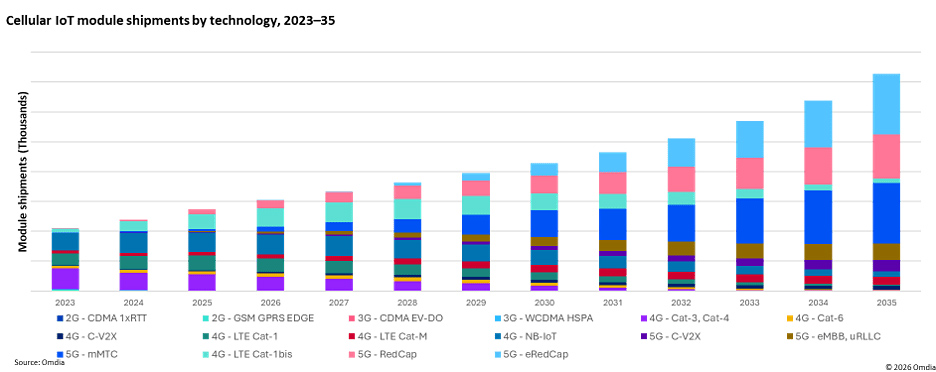
What makes the forecast notable is not simply the headline growth figure. Omdia is pointing to a cellular IoT market that remains highly plural, rather than one in which 5G replaces earlier technologies in a linear fashion. By 2035, NB-IoT, mMTC and eRedCap are expected to account for 65% of cellular IoT connections, underlining the continued importance of low-power and lower-complexity connectivity alongside more capable 5G options.
eRedCap changes the RedCap narrative
One of the more specific conclusions in Omdia’s analysis is that eRedCap is expected to be more successful than RedCap. That distinction matters. RedCap was designed to serve applications that sit between high-end 5G broadband devices and low-power IoT endpoints, but Omdia notes that adoption has been limited by high module prices and slower rollouts of 5G Standalone networks.
By contrast, eRedCap enters the market in a different context. According to Omdia, the first eRedCap module launches have already taken place in 2026, while the technology is expected to benefit from growing 5G SA network availability. The practical implication is that eRedCap may face fewer of the timing and infrastructure constraints that affected early RedCap deployments.
This is the announcement’s main point of differentiation from many cellular IoT forecasts: it does not treat 5G IoT as a single category. Instead, it separates RedCap, eRedCap, Massive IoT, NB-IoT, LTE-M and Cat-1bis into distinct roles. For OEMs, that distinction is operationally important because module selection affects product cost, certification work, power budgets, roaming strategy and device lifecycle planning.
Omdia also notes that RedCap has shown some momentum over the past 12 months following the launch of the latest Apple Watch range incorporating RedCap technology. While wearables are not the same market as industrial sensors or utility devices, the inclusion of RedCap in a high-volume consumer product can help validate the technology ecosystem around chipsets, modules and network support.
Regional dynamics remain uneven
NB-IoT continues to be heavily weighted toward Asia and Oceania, which accounted for 86% of global NB-IoT module shipments in 2025, according to Omdia. LTE-M, meanwhile, is expanding globally, with Asia and Oceania projected to capture a 58% module market share by 2035.
For global device vendors, this regional asymmetry is a concrete integration issue. A product intended for multiple markets may need different module variants, fallback technologies or connectivity profiles depending on where it will be deployed. The forecast therefore reinforces a familiar but often underestimated point: cellular IoT scale is not just about network coverage, but about matching technology portfolios to regional operator realities.
Regulation is another factor shaping the market. Omdia highlights Europe’s Cyber Resilience Act, which mandates secure-by-design products with five-year vulnerability patching, as a driver of structural change in the region. The firm says this is accelerating adoption of eSIM, eUICC and resilient SIM architectures. For manufacturers, that links connectivity choices more directly to long-term security maintenance and device management, rather than treating the SIM purely as a provisioning component.
In North America, Omdia points to the US Infrastructure Investment and Jobs Act and the Inflation Reduction Act as supporting deployments in smart grids, utilities and EV charging infrastructure. These are markets where ruggedized 4G and 5G modules are expected to see immediate demand, according to the research.
Automotive moves toward cellular dominance
The automotive sector is forecast to exceed 1 billion cellular IoT connections by 2035. Omdia expects 89% of automotive modules to use 5G technologies by that date, driven by connected vehicle adoption among both Chinese and international automakers and by vehicle-to-everything communications requirements.
For system integrators and enterprises, the broader message is that cellular IoT procurement is becoming more application-specific. Utilities, EV charging operators, fleet platforms, automakers and industrial equipment vendors will not be choosing between “4G” and “5G” in the abstract. They will be weighing NB-IoT, LTE-M, Cat-1bis, RedCap and eRedCap against deployment geography, expected device lifetime, security obligations and available network infrastructure.
Omdia’s forecast therefore points to a larger ecosystem shift: cellular IoT growth through 2035 will depend on a wider set of optimized radio technologies, not a single dominant standard. That creates more flexibility for the market, but also more complexity for OEMs and connectivity providers that must support products over long lifecycles in uneven regional conditions.
The post Omdia Sees Cellular IoT Reaching 5.9 Billion Connections by 2035 as eRedCap Gains Weight appeared first on IoT Business News.