
 By
With another election season behind us, we should revisit some of the great economic and political debates about the merits of voting and electoral politics. While majorities successfully elected candidates and passed referenda across the country on Tuesday, they will likely not be happy with all the effects of their choices on society. Or, to put it another way, the majority got what it wanted, but it is not going to like it.
At least, that’s the argument a prominent economist (and my former professor), Bryan Caplan, made in his book The Myth of the Rational Voter. The problems and shortcomings of democratic politics discussed in this essay should not be construed as an implicit or backhanded endorsement of more authoritarian or more restricted decision-making by government. As Churchill told the House of Commons, “democracy is the worst form of Government… except for all those other forms that have been tried from time to time.”
But given that we live in a country with elections, and having just had one, a closer look at how they work is in order. Caplan argues that, contrary to the “save our democracy” folks, society’s major problem is not getting the will of the majority into law and policy. The problem is that what the majority wants will not lead to good outcomes.
Caplan is not simply saying that he will not like the outcomes or that he doesn’t consider the outcomes good even though a majority of voters do. He is saying that the same voters who got their preferred candidate elected or referendum passed will not call the future outcomes of their electoral success “good.” The question is whether voters’ beliefs about policy are accurate enough on average to deliver good outcomes democratically.
Caplan is not as concerned about the common economic objection that voting is not worth your time. After all, your individual vote has a vanishingly small chance of changing the outcome of the election. The expected value of your vote is essentially zero. Yet people still vote in droves because they feel it is their duty as citizens.
A better explanation may be that people vote because they enjoy participating in elections the way they enjoy watching sports events. People will cheer for their team even when cheering has no expected influence on the outcome of the game. And people will vote, and literally cheer at election parties, for similar reasons. This is why, for example, we see much higher voter turnout and participation in high-profile national elections (like NFL football games) than we do in local city or county elections (similar to the WNBA), even though individual votes are orders of magnitude more important in local elections than in national ones.
But whether voting is worth your time is a separate question. The focus here is Caplan’s arguments about the likely outcomes of democratic elections, as well as some objections. Caplan wrote The Myth of the Rational Voter largely in response to the work of economist Donald Wittman.
Wittman’s 1989 Journal of Political Economy article, “Why Democracies Produce Efficient Results,” and his 1995 book The Myth of Democratic Failure argue that standard public choice pessimism about the outcomes of electoral politics and government policy is bad economics. Wittman claims that standard public choice arguments depend on doubtful assumptions: extreme voter stupidity, a serious lack of competition, and excessively high negotiation or transfer costs. Wittman chided public choice economists for downplaying voter knowledge and for ignoring institutions that create efficiencies in the political process similar to the market process.
Wittman argues, for example, that politics offers many informational “shortcuts” and “proxies,” much as prices serve as “shortcuts” for conveying information about relative scarcity. Consumers don’t need to know what is happening at the local chicken farm or to the national chicken population, nor do they even have to know that eggs have become relatively more scarce, to modify their behavior when egg prices rise and act like they knew eggs had become relatively more scarce.
Similarly, you don’t have to know what bills have been proposed in Congress restricting gun ownership to vote for a pro-gun or an anti-gun candidate. Organizations like the National Rifle Association make it even easier by doing research and putting their stamp on some candidates or ballot initiatives while opposing others. The same can be said for dozens upon dozens of issues and advocacy groups.
And political party affiliation can serve as a kind of brand. You may not know anything about some or all the candidates on a ballot, but having an R, D, or L next to their names tells you something about them. Are they on your team? Furthermore, because these political parties are a kind of brand, they have an incentive to protect that brand by disciplining those who violate it and screening those who want to use it.
As an aside, having dipped my toes into party politics over the past couple of years, I have found that the information barrier is significant and the “policing” within parties is often extremely limited, because parties have no owner or residual claimant of the “company” who ultimately gets to decide things.
Wittman also argues that voters don’t have to get their positions “exactly” right. Being directionally correct is enough. When votes are aggregated, candidates and policies should move toward or be at the median voter’s position. This is similar to how millions of people buying and selling shares of stock move its price to an efficient point. Millions of voters move politicians and political decisions to an efficient point in terms of what voters want.
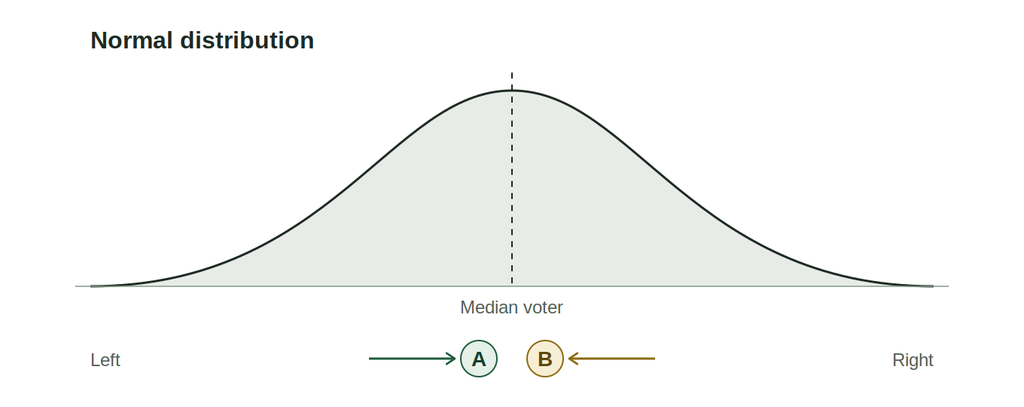
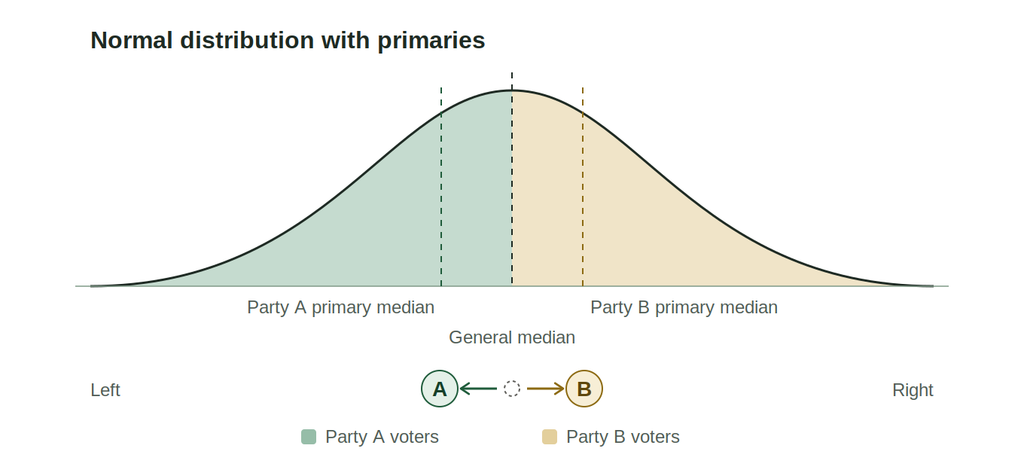
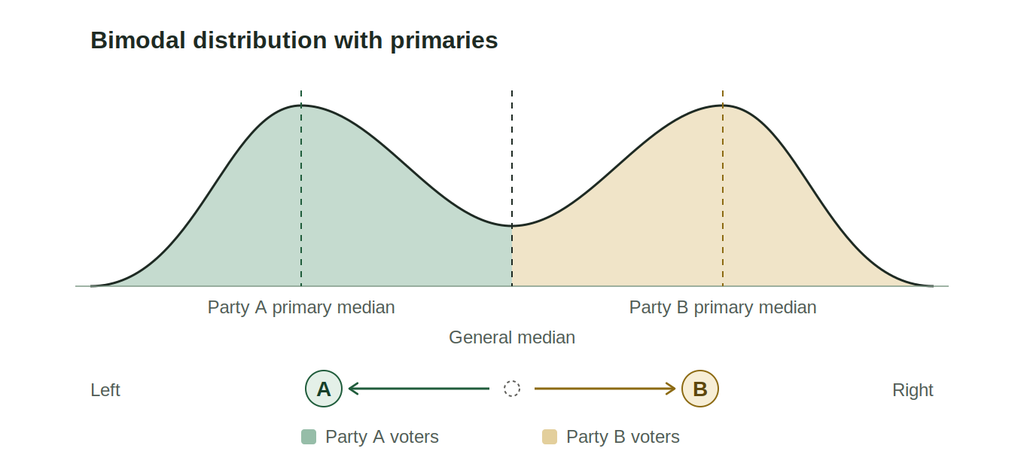
This claim invites doubts too. For one thing, it assumes that voters are relatively evenly distributed on either side of a “median” or moderate position. That’s not too hard to swallow. But primaries reduce the odds of more moderate candidates being nominated. And if voters cluster on the far right and the far left of the political spectrum, you get even more extreme results that do not reflect the preferences of the median voter.
But leaving these objections aside, Caplan asks whether what voters want actually makes sense. People get the policies they want (more protectionism, less immigration, and more regulation) but not the outcomes that would make their lives better.
He argues that voters don’t support efficient or optimal policies (and candidates who would implement them) because they have irrational biases. Voting “irrationally” means people vote for policies and politicians that are more likely to reduce their well-being than to improve it.
So why might voters hold irrational rather than merely uninformed views? People tend to have emotionally satisfying policy beliefs for which they bear few direct costs. When people think they can stay out late, drink heavily, and feel fine first thing in the morning, they experience disappointment and direct feedback. Reality delivers the costs of such beliefs quickly and directly.
But a person may wrongly believe his whole life that immigrants or free trade reduce economic growth, with no direct negative consequences. Politics is a popularity contest, so successful politicians tell people what they want to hear. And people vote in ways that make them feel good, even where they are biased, because their individual vote will almost never be the deciding factor in an election outcome. Or to put it another way, voters bear a low cost for exercising irrational preferences that make them feel good.
This compounds the collective action problem in Congress. Most people know that Congress has an abysmal approval rating. In April, Gallup found just 10 percent of Americans approve of Congress while 86 percent disapprove, tying the all-time record. What fewer people know is that voters view their own member of Congress far more favorably. When Gallup last asked, 43 percent said their own representative deserved reelection, while only 15 percent said the same of most members.
And voters act on it. In 2024, 96.6 percent of House incumbents seeking reelection won. People get the candidate they want, but not the government they want. Then they elect politicians who implement policies whose effects most people won’t like.
Ultimately, the disconnect between cheering on Election Day and lamenting the state of the country months later isn’t a glitch in our democratic system — it is the direct result of our own unexamined biases.
It doesn’t much matter which individual candidates or parties won on Tuesday, at least when it comes to whether voters will see their expectations fulfilled. The majority of Americans will continue getting policy outcomes that they won’t like, though many will find comfort in the emotionally satisfying belief that their side is making progress even if it doesn’t correspond to reality.
As Caplan wrote of the average voter, “Even when his views are completely wrong, he gets the psychological benefit of emotionally appealing political beliefs at a bargain price. No wonder he buys in bulk.” Recognizing how easily voters indulge poor policy beliefs, we should focus on limiting the scope of government power in a system that often leads to collective buyers’ remorse.