

 By

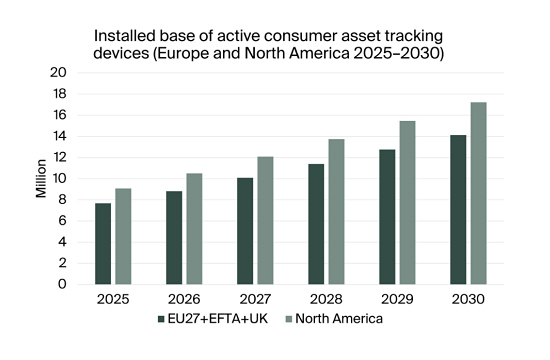
Consumer asset tracking is gaining traction across Europe and North America, with 16.8 million active devices at the end of 2025. New research from Berg Insight points to continued growth, supported by low-power connectivity, satellite networks and increasingly sophisticated tracking services.
Despite the widespread availability of GPS technology and connected devices, consumer asset tracking remains a relatively underpenetrated segment of the Internet of Things. From monitoring pets and children to protecting motorcycles and electric bicycles, dedicated tracking solutions are finding new applications as connectivity technologies become more accessible.
According to the latest research from Berg Insight, the installed base of active consumer asset tracking devices in Europe and North America reached 16.8 million units at the end of 2025. The analyst firm forecasts a compound annual growth rate (CAGR) of 13.4%, bringing the installed base to 31.4 million devices by 2030.
The corresponding market value is expected to increase from €2.3 billion in 2025 to €4.2 billion in 2030, reflecting sustained demand for connected tracking products and associated services.
A large addressable market with limited penetration
One of the most significant findings in Berg Insight’s fourth edition of its Consumer Asset Tracking Solutions report is the considerable gap between potential applications and actual adoption.
Europe and North America together account for more than 380 million dogs and cats, approximately 620 million passenger cars, 160 million other consumer vehicles and nearly 70 million children aged 4–10, a primary target group for GPS-enabled watches.
Yet the overall penetration rate of GPS tracking products stands at approximately 1.2%, according to Berg Insight. Pet trackers, children’s GPS watches and passenger car tracking solutions currently represent the largest segments by active device numbers.
Importantly, the study focuses on tracking systems using wide-area connectivity, including cellular, satellite, LoRa and Sigfox networks. Bluetooth-only and Wi-Fi-only devices, such as conventional proximity-based item trackers, are excluded. This distinction provides a more specific picture of the market for independently connected IoT tracking devices rather than the broader consumer location-tracking ecosystem.
Pet tracking and connected vehicles shape the competitive landscape
The market remains fragmented, with specialized providers competing across different applications. In pet tracking, Austria-based Tractive has established a substantial position, with approximately 1.8 million subscribers, while Fi and Halo are prominent players in North America.
Family and child tracking involves a different mix of technology providers and mobile operators. Smartcom Mobility Solutions and Smith Micro Software supply platforms and white-label services, while Xplora Technologies and US mobile operators address the children’s smartwatch market.
Vehicle tracking encompasses another diverse set of applications. Passtime GPS, Tail Light’s Bouncie and Agnik are among the established consumer telematics providers in North America, while European suppliers include Net4Things, Air and CarLock. Specialized solutions from companies such as Monimoto and GeoRide target motorcycles, while Bosch eBike Systems, PowUnity and IoT Venture operate in the bicycle tracking ecosystem.
These specialized markets also create opportunities for consolidation. Recent transactions include Tractive’s acquisition of Whistle Labs in 2025 and the subsequent acquisition of Tractive by Bending Spoons in 2026. Such developments illustrate how companies are seeking greater scale and broader service portfolios.
LPWA, satellite connectivity and AI expand tracking capabilities
For IoT technology suppliers, the market’s evolution presents opportunities beyond conventional GPS positioning. Power consumption remains a critical design consideration, particularly for small, battery-operated trackers attached to pets, bicycles or personal belongings.
Low-Power Wide-Area networking technologies are therefore relevant to applications where long operating life must be balanced against connectivity requirements. Satellite connectivity is also emerging as a complement to cellular networks, extending tracking possibilities into locations where terrestrial coverage is limited.
Meanwhile, artificial intelligence is adding functionality beyond location reporting. In pet tracking, AI-supported health and activity monitoring creates opportunities to differentiate services through additional insights into animal behaviour and wellbeing.
The implication for device manufacturers and connectivity providers is that tracking solutions increasingly need to be designed around specific use cases rather than positioning accuracy alone. Battery autonomy, network availability, device size and the value of associated software services all influence the suitability of a solution.
For system integrators and platform providers, this also highlights the importance of supporting different connectivity architectures and service models across consumer tracking categories.
With adoption still limited relative to the addressable market, Berg Insight’s forecast suggests considerable room for expansion. However, capturing that opportunity will depend not simply on connecting more objects, but on delivering tracking services that solve clearly defined consumer needs.
The post Consumer IoT Tracking Devices Set to Reach 31.4 Million by 2030 as Adoption Expands appeared first on IoT Business News.