
 By
By Discussions about the cost of living for food, fuel, and fun dominate many political debates today. If there’s one service that’s ripe for cutting costs, it’s broadband — and states and other policymakers should take notice.
Broadband affordability is uneven in the United States. Household broadband subscription rates ranged from 89 percent in Mississippi to 96 percent in New Hampshire in 2024. The federal Affordable Connectivity Program (ACP)’s expiration that same year left 23 million homes without discounted internet service. Providers like Spectrum saw an immediate, massive decline in customers, “largely driven” by the end of the ACP.
Less government intervention, however, presents a golden opportunity for states to create their own free-market solutions and deregulate their existing broadband regimes to benefit consumers.
Competition is central to lowering service costs. Internet prices are no exception. A recent study of select urban markets in California found households in zones with overlapping gigabit networks spent up to $40 less per month than households served by only one gigabit provider. If this bottom-up competition extended statewide, California consumer savings could eclipse $1 billion per year. Local conditions drive markets. Consumer choice lets households generate surpluses they can save or spend elsewhere.
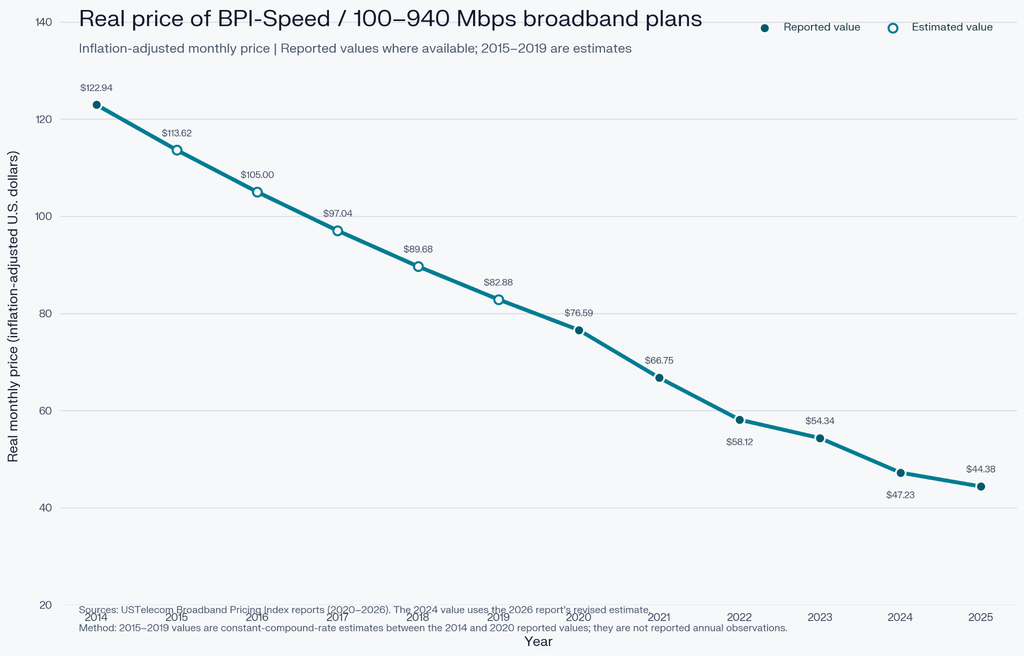
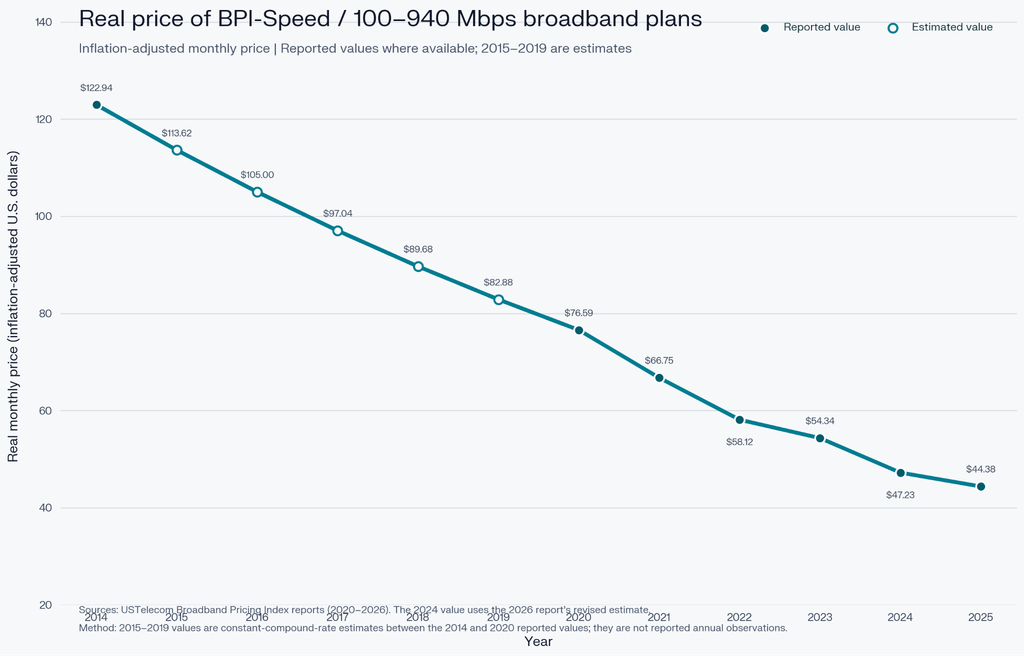
Auctions also help address these needs by allowing internet providers to fill local spectrum gaps. The Federal Communications Commission (FCC) has historically auctioned former military-grade broadband wavelengths off to industry giants like Verizon and newer entrants like Cherry Wireless. AT&T deployed this spectrum at 23,000 cell sites by mid-2026, with customers experiencing 80 percent faster mobile 5G download speeds and 55 percent faster wireless internet. As service improved, auctions helped America’s most popular internet plans fall 6 percent in price from last year. They’re down almost 64 percent over the past decade.
True competition isn’t just about the number of providers. It’s about the comparable speeds they offer. A 2025 event-study of K-12 broadband purchasing found that comparable internet services reduced prices by $917 a month. Schools in this experiment also increased their purchased bandwidth by 136 percent. Options and pooled purchasing make high-quality services more appealing, affordable, and widespread. As the FCC considers cutting internet discount programs for schools, non-government entities are primed to lead the affordable broadband charge.
Critics, like Senator Ed Markey (D-MA), argue the FCC’s potential move disconnects “low-income, rural and marginalized communities.” Shifting responsibility to states, local governments, and private actors, however, empowers the groups and consumers who need reliable service most.
Recent political developments affirm the possibility of bipartisan action on this issue. Last November, the House Communications and Technology Subcommittee held a markup session to consider 28 bills to streamline federal, state, and local broadband permitting processes. Seven of the bills passed with bipartisan support. Congress has recognized that reducing red tape, lowering deployment costs, and accelerating high-speed internet rollouts are vital to expanding broadband access.
In June 2026, with the input of tribal governments, the National Telecommunications and Information Administration released $790 million for tribal broadband funding. These initiatives highlight the collaborative aspects of internet reform, all with the same goal: putting Americans’ technological needs first.
Sound on-the-ground policy can make broadband issues an overarching win for towns. Municipalities can invest in their fiber infrastructure, as Chattanooga, Tennessee, did with its Electric Power Board. By offering another gigabit service alongside cable providers, the town generated over $5 billion in net community benefits in 13 years. That also produced over 10,000 jobs, with the surplus creating a low-cost access option for 28,000 eligible families with school-age children.
Streamlining local processes, including broadband permitting, is another measure worth pursuing. Flagstaff, Arizona, partnered with private companies and retooled its permits to expand citywide fiber. A March 2026 white paper estimates the project will save the city $18 million in capital expenses, invest $50 million in the Flagstaff region, and spur $100 million in economic impact over five years. Local governments can reduce the cost of private deployment without owning and operating the retail network, opening the door for additional network entry and investment.
Taken together, these proposals can deliver tangible results for Americans. In May, FCC Space Bureau Chief Jay Schwarz said that ingenuity, competition, and deregulation led to a 51 percent increase in download speeds and a 4.1 percent drop in prices for wireless subscribers.
In a world that demands connection, our communities can’t afford red tape and mismanagement. Comparable-speed competition, deregulation, and innovative community efforts can help make broadband affordable for citizens and provide reliable access for years to come.