
 By
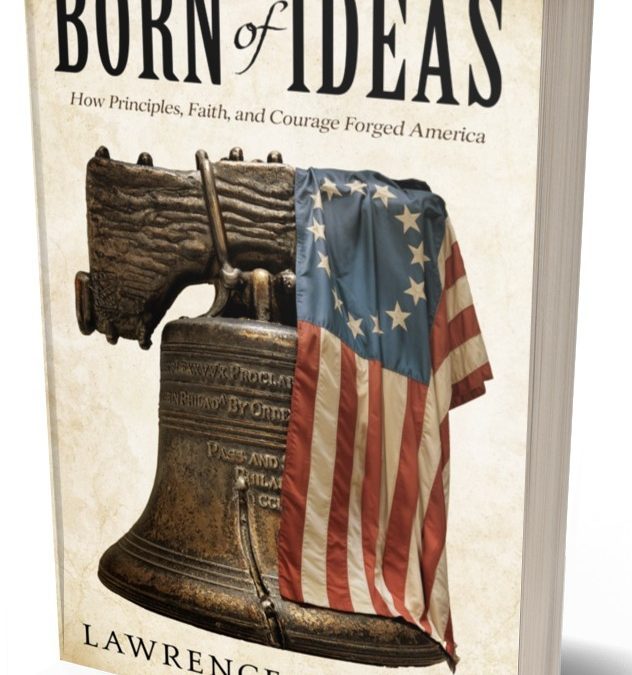
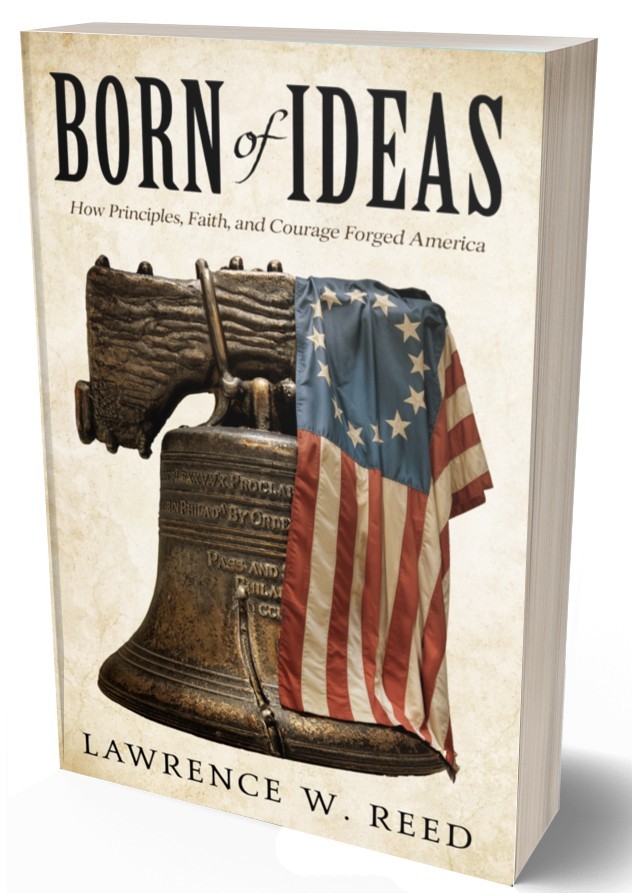
By Most histories of the American founding celebrate its courage. Lawrence Reed’s new book Born of Ideas does that too, but it does something more useful: it makes the curriculum visible.
His argument is stated plainly in the introduction. The Revolution “did not start with shots fired at Lexington.” What happened there was the result of “a revolution that had been percolating in the hearts and minds of Americans for a generation.” The book is a catalogue of what those minds had been reading, and who had been passing the reading list forward.
The chapter on Rome is the most direct evidence. Jefferson at William & Mary, Madison at Princeton, Adams at Harvard, Washington in his private studies: all working through the same canon: Cicero, Tacitus, Virgil, Plutarch. When Hamilton, Madison, and Jay signed The Federalist Papers as “Publius,” they were not reaching for a clever pseudonym. They were invoking Publius Valerius, one of the men who expelled Rome’s last king and founded the Republic, and signaling to readers who would recognize the name exactly what kind of argument they were making. The Anti-Federalists wrote back as “Brutus” and “Cato.” Both sides were conducting an argument in a shared language drawn from a shared library. From Cicero specifically, the founders took a design specification: that a primary duty of the state is to protect private property. That principle did not remain abstract. It showed up in the Constitution’s Contracts Clause and its prohibition on the taking of private property without just compensation. From Tacitus and the Roman historians more broadly, they took the corollary: that concentrated, unchecked power is freedom’s mortal enemy. These were not general inspirations. They were building instructions.
The monetary chapters of Reed’s book add a different kind of evidence. The founders didn’t only read about inflation. They printed their way into catastrophe and wrote the hard-money provisions of the Constitution from that scar. Pelatiah Webster deserves more attention than he usually receives. He was publishing economic essays the same year The Wealth of Nations appeared in Scotland, arriving at strikingly similar conclusions from the ground up. As a merchant, not a theorist, Webster warned legislators about paper money depreciation years before they lived through its full consequences. Webster’s first essay appeared in October 1776, under the title “An Essay on the Danger of too much circulating Cash in a State, the ill Consequences thence arising, and the Necessary Remedies.” The Second Continental Congress regularly sought his advice. The Constitutional Convention’s delegates arrived in Philadelphia already holding a lived curriculum in monetary failure, and Webster had been narrating that curriculum in real time for a decade. He was making the monetary argument before the Convention settled it in constitutional language.
Chapter by chapter, Reed, an economist and President Emeritus at the Foundation for Economic Education, shows the same pattern: precedent accumulates, someone reads it carefully, and an institution gets built.
The Mayflower Compact opens the book for good reason. Covenant theology crossed the Atlantic not as abstraction but as practice: 30 men signing a document in a harbor, resolving a mutiny by constituting themselves as a self-governing body. Reed traces a line from that document to the Declaration, and the line holds because the ideas were carried consciously. The Pilgrims knew what they were doing. So did the founders who remembered them.
Reed’s thesis extends into uncomfortable territory in the Phillis Wheatley chapter. Wheatley arrived in Boston on a slave ship in 1761 at roughly eight years old. Within a few years, she was reading Latin and Greek, writing poetry, and corresponding with figures like George Washington. Her 1772 poem addressed to the Earl of Dartmouth invoked liberty in terms the founders would have recognized immediately, because she had read the same tradition they had. Reed’s point, made quietly, is that the mechanism doesn’t discriminate. Ideas move through whoever picks up the book. Wheatley had absorbed the natural rights argument from the same sources the founders were citing, and she turned it back on a society that had not yet applied it to her. That is not a footnote to the founding. It is the founding argument at its most unsparing.
Roger Williams was arguing for a wall of separation between church and state long before Jefferson made the phrase famous. The citizens of Flushing defied their governor in 1657 to protect Quakers — few of them were — on the principle that freedom is indivisible: allow the state to breach one wall and it will work to bring down the rest. What makes the Flushing Remonstrance remarkable is precisely that the signers had no personal stake in the outcome. They were not defending their own faith. They were defending the principle that the state has no business deciding which faiths deserve protection. Reed traces this tradition forward through figures like Anne Hutchinson and the citizens of Flushing to the First Amendment, and the argument holds for the same reason the monetary argument holds. The founders were not improvising. They were drawing on a record that dissenters had been building for a hundred years before Revolutionary-era Philadelphia.
Reed closes his introduction with a detail that, for this readership, carries particular weight. His own formation as a thinker ran through Hans Sennholz at Grove City College, and Sennholz had studied under Mises. Reed doesn’t make the connection explicit. He doesn’t need to. What he learned from Sennholz was precisely this: that ideas have genealogies, and that the chain of transmission matters as much as the ideas themselves. The Austrian tradition he absorbed was itself a lesson in how ideas survive hostile conditions by moving through committed individuals rather than institutions. Mises to Sennholz to Reed to the students of Grove City College is three generations of the same mechanism Reed is documenting in the founders. He recognizes the dynamic in the founding generation because he lived a version of it. The biographical note earns its place not as sentiment but as confirmation of the book’s central argument.
Readers who come expecting synthesis will need to supply some of it themselves. These are stand-alone essays gathered into a volume, and the seams show. Chapters on individual figures, the Reeds of Pennsylvania, Nathan Hale, are vivid and well-sourced, but don’t always advance the intellectual argument. Reed is honest about this in the introduction: he promises particular stories, not a unified thesis.
What the book does supply is harder to find than synthesis: a reliable guide to who read what, and what they did with it. Popular history tends to treat the founding as an act of will. Reed treats it as an act of applied reading, which is the more interesting claim, and the more useful one for anyone trying to understand how the experiment might be sustained.
Reed dedicates the book to the students of Grove City College, noting that the school “has not bowed to political winds or ephemeral fads.” The dedication is also a charge: someone has to keep reading. The founders couldn’t have built what they built without the accumulated reading of prior generations. Neither can we.