
 By
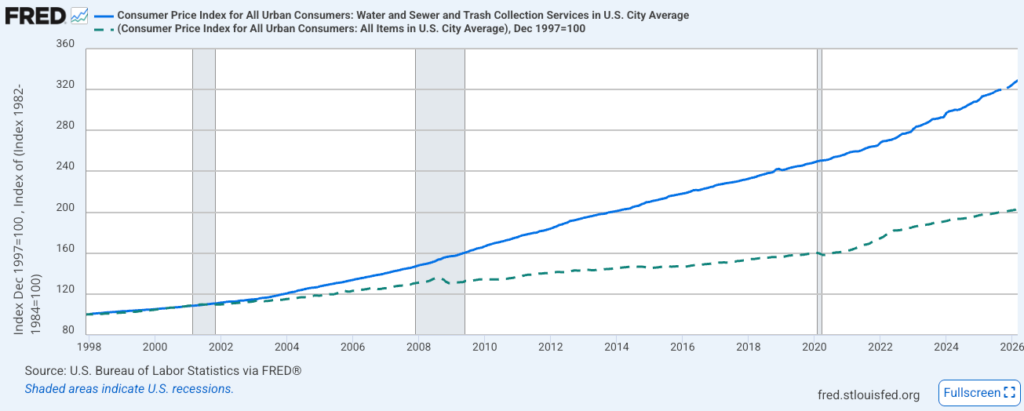
By America is good at solving problems, but less good at recognizing when the “solutions” become the problem. Nowhere is this more evident than on your water bill, which has risen more than 27 percent over the past five years and is increasing at roughly twice the rate of inflation. Politicians and journalists point to aging infrastructure, climate change, and per- and polyfluoroalkyl substances (PFAS) contamination. They are not entirely wrong. What they often omit is how decades of well-intentioned government intervention have systematically weakened the market mechanisms that might otherwise help keep costs in check.
Consider gasoline. Drivers may not like what they pay at the pump, but the price is determined in global markets where no single regulator sets it. The market aggregates information from millions of producers and consumers and generates a price that, whatever its imperfections, reflects underlying conditions of scarcity and demand. Water operates very differently. Its price is shaped by a maze of legal doctrines, regulatory mandates, utility commissions, and interstate compacts accumulated over more than a century. Each layer places additional distance between the resource and the consumer, making prices less transparent and less reflective of underlying realities.
This is what makes the situation so puzzling. Markets are remarkably effective at directing resources to where they are most needed. Hong Kong, Singapore, and Japan are three of the world’s most prosperous economies, yet they share one notable characteristic: a scarcity of natural resources. They possess little oil, coal, or rare earth minerals, and yet they thrive because markets reveal prices, coordinate investment, and allocate resources to their highest-valued uses. Scarcity, it turns out, is not an obstacle markets cannot overcome. It is often the very incentive that drives innovation and efficiency.
Water, by comparison, is an unusually ordinary resource. It is more abundant than oil, easier to treat than rare earth minerals, and across much of the United States, it literally falls from the sky. So why is America facing a slow-motion water crisis while Singapore can recycle wastewater to semiconductor-grade purity? The answer is not geology or climate. It is governance.
Some will argue that water is fundamentally different—a natural monopoly with relatively inelastic demand and pervasive externalities, where actions upstream affect everyone downstream. Those characteristics are real. Yet similar challenges exist in markets for oil, coal, and rare earth minerals, and markets have still found ways to move those resources across oceans to countries that possess little or none of them. To understand America’s water challenges, we must go back to a series of legal and political decisions that began before the Civil War and have compounded ever since. Let’s dive in (pun intended).
The first distortion predates federal regulation entirely. American water law split into two doctrines before the country was even fully defined. In Eastern and Midwestern states, riparian rights gave water access to whoever owned adjacent land; geography, not prices, determined access. In most Western states, prior appropriation, “first in time, first in right,” meant whoever diverted water first held the senior claim, regardless of the proximity of future landowners. Neither doctrine consistently allowed water to flow to its most productive use, as both locked allocation in place by accident of history. This was not a free market distorted by regulation, but one that was never permitted to form.
On top of that foundation, Congress layered environmental mandates over many years. The Clean Water Act (1972) and the Safe Drinking Water Act (1974) set uniform standards every utility must meet, regardless of local conditions or costs. Each new regulated contaminant means a new compliance cost passed directly to ratepayers with no competitive check. PFAS regulations (2024) alone now add an estimated $1.5 billion annually in system-wide costs.
Meanwhile, most Americans cannot choose their water provider. One pipe, one utility, no exit.
Investor-owned utilities have learned to leverage that captivity through mechanisms that pass capital costs to ratepayers, combining the pricing power of a monopoly with limited cost discipline.
This dynamic, where customers have nowhere else to turn, creates a system ripe for upward price pressure with little accountability. And the Colorado River Compact (1922) illustrates just how deep this dysfunction runs: negotiated by political compromise, it divided water among states by seniority of claim, locking in agriculture’s consumption of 80 percent of the river’s flow simply because those rights are oldest. Meanwhile, cities that would generate far greater economic value per gallon are legally prevented from buying that water at any price. The result is a river stretched to its limits, serving yesterday’s economy by law, while growing urban centers go thirsty by design.
Decades of regulations that distorted water prices also resulted in them being too low in some
municipalities. These layered laws subsidized the construction of entire cities in places that markets never would have chosen: dry desert cities like Las Vegas, Phoenix, and Tucson. The logic was circular: keep prices low enough that growth looks cheap, and the growth generates political constituencies that demand prices stay low. It is precisely the logic of subsidizing flood insurance for beachfront homes, except the moral hazard here is measured in millions of people and entire metropolitan economies that now require ongoing federal intervention just to stay hydrated.
The solution is to move water more fully into the market, allowing prices to reflect scarcity and capital to flow toward conservation and innovation. In practice, that means a managed transition in which rates gradually move toward market levels, whether higher or lower. Most importantly, it means eliminating the policies that created the problem: below-cost agricultural water contracts, federal development subsidies that ignore water costs, and interstate compacts that lock 1922 decisions in place indefinitely. It also means stopping policies that make it artificially cheap to build the next Phoenix in the desert.
Your water bill isn’t rising because water has become more expensive. It’s rising because we’ve built a system specifically designed to ensure that price has little to do with it.