
 By
By 
The Hang Seng Index remained in a correction this week after falling by 10% from its highest point this year as technology companies slipped. It dropped to H$25,400, down from the year-to-date high of H$28,052.
Hang Seng Index drops amid the Alibaba, Tencent, Xiaomi sell-off
The Hang Seng Index, which tracks some of the biggest companies in China, is continuing its sell-off today, a trend that may continue as technology stocks drop.
Alibaba stock dropped to $121 in New York, its lowest level since August 2025 and nearly 40% from its highest level in October last year.
Similarly, Tencent stock fell to $506 in Hong Kong, down by 25% from its highest point in 2025. Also, Xiaomi dropped to $34, also down by 45% from last year. Also, JD.com has remained in a bear market this year.
Alibaba and Tencent stocks have plunged leading to a $66 billion wipeout as the two biggest tech names published their earnings this week. The two juggernauts fell as the two companies failed to demonstrate how they will capitalize on artificial intelligence (AI) growth.
Analysts worry that, while AI spending is growing, investors are worried about how they will monetize it in the near term.
Alibaba plans to spend $53 billion in capital expenditure and hinted that it hoped to make $100 billion in AI revenue in the next five years.In a note, a Bloomberg analyst said:
“The key inflection will be when companies can show that AI is driving measurable revenue uplift, whether through cloud, advertising, or transaction conversion. Until then, markets will likely stay cautious.”
Xiaomi stock price has also crashed in the past few months, erasing billions of dollars in value in the past few months as the memory chip shortage continues, leading to higher costs. There are also concerns about its electric vehicle (EV) business as competition from top companies like XPeng and Nio remains.
Other technology companies in the Hang Seng Index like Meituan and Semiconductor Manufacturing International (SMIC) have also retreated in the past few months.
Meanwhile, some notable Chinese companies have done well despite the ongoing Hang Seng Index weakness. Li Ning jumped by 11% in the last 24 hours, while Geely, Xinyi Solar, Li Auto, AIA, and BYD jumped by over 1.67% on Friday.
Hang Seng technical analysis
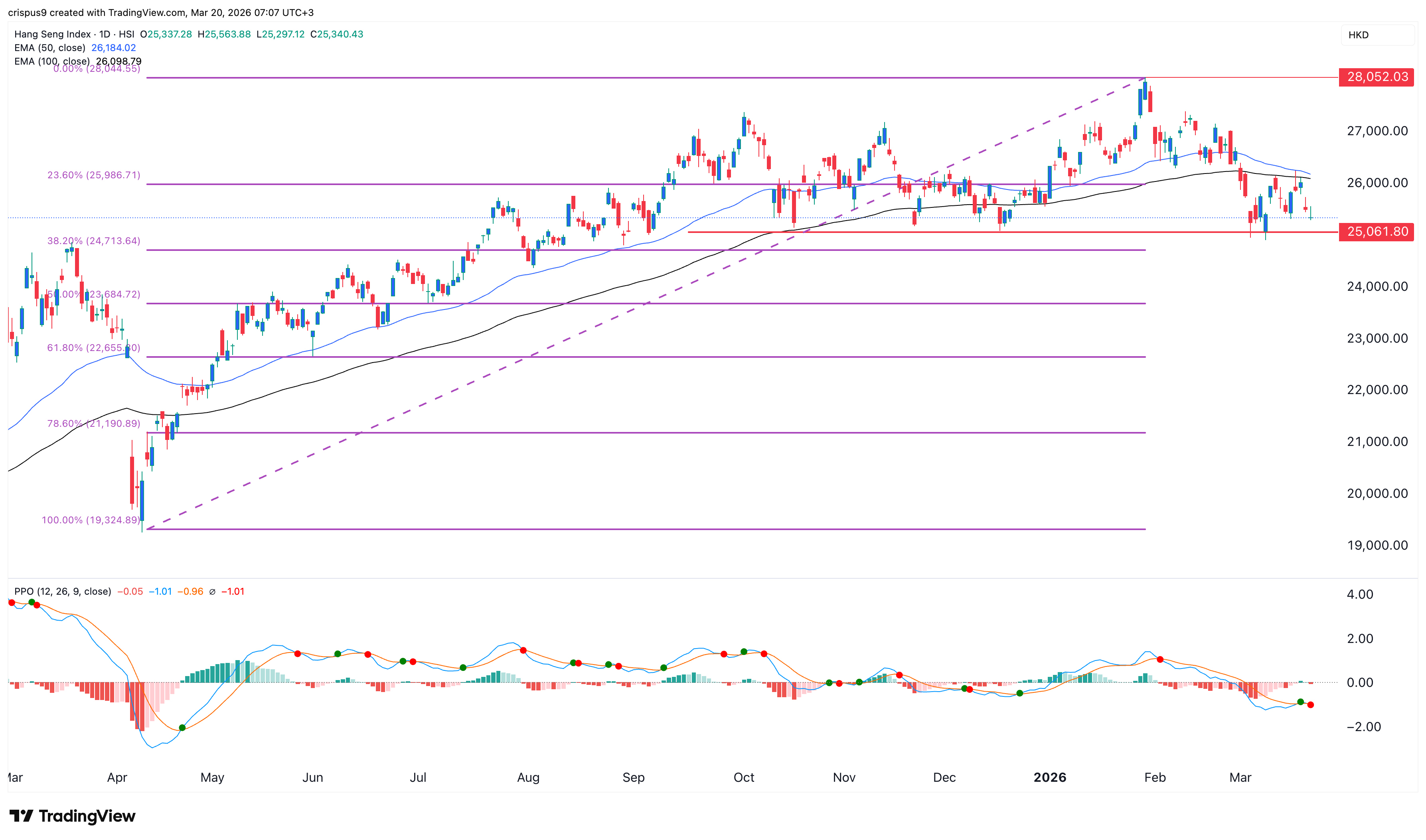
Hang Seng Index chart | Source: TradingView
The daily timeframe chart shows that the Hang Seng Index has slumped since February this year when it peaked at $28,052 to the current $25,330.
It has now moved below the 23.6% Fibonacci Retracement level, confirming the ongoing bearish trend.
The 50-day and 100-day Exponential Moving Averages (EMA) are about to form a bearish crossover pattern, a mini death cross pattern.
It has moved below the Ichimoku cloud indicator, while the Supertrend indicator has flipped from green to red.
The index has also formed a head-and-shoulders-like chart pattern, while the Percentage Price Oscillator (PPO) has continued falling.
Therefore, the index will likely continue falling in the near term. This crash will be confirmed if it drops below the key support level at $25,060. A move below that level will point to more downside, potentially to the 50% retracement level at $23,700.
The post Hang Seng Index at risk of a crash amid Alibaba, Tencent, Xiaomi woes appeared first on Invezz