
 By
By At the end of January, President Trump penned a triumphant op-ed declaring “Mission Accomplished” for the signature economic policy of his second term: tariffs.
Unfortunately, his entire victory lap revolved around phony numbers, cherry-picked facts, and a strawman caricature of his critics’ arguments.
Trump began by claiming all the “so-called experts” predicted his tariffs would trigger “a global economic meltdown.” Instead, he boasts, they’ve ushered in “an American economic miracle.”
He’s wrong on both counts.
It’s true that some economists did fear a recession right after his “Liberation Day” extravaganza. But that was before the president “chickened out” less than a week later. Why, pray tell, did the self-styled “Tariff Man” get cold feet? Lest we fall prey to his attempt to retcon that episode: GDP growth did decline, the stock market did crash, and bond markets did signal a five-alarm fire.
Once Trump retreated, economists recalibrated. As John Maynard Keynes supposedly quipped, “When the facts change, I change my mind. What do you do, sir?” No credible economists predicted that his revised, milder slate of tariffs would plunge us into depression.
Why not? There are many reasons. Most notably, the US is a massive economy, so trade, while vital, accounts for a fairly small share of our GDP. Tariffs are thus unlikely to cause a recession.
Tariffs disrupt economic activity mainly by diverting resources away from their most productive uses. They also limit people’s choices and lower the quality of products we can buy. All this inhibits growth, just not in ways that sharply reduce GDP (at least not in the short run). The damage that tariffs inflict is more akin to a slow-moving cancer than a sudden heart attack.
Trump loves to tout that 4.3 percent annualized growth estimate for Q3 2025. Yet he neglects to mention his -0.6 percent growth rate during his tariff spree in Q1 2025. Experts project that actual growth for 2025 will fall somewhere between 2.2 percent and 2.5 percent — well below Sleepy Joe’s nothing-to-write-home-about 2.8 percent mark in 2024.
Incidentally, this 0.2-0.5 percent decline in real GDP is exactly in line with what economists predicted. Is 2.5 percent growth catastrophic? No. But it’s hardly an “economic miracle.” And it’s a far cry from the 5 percent growth we’ve been promised.
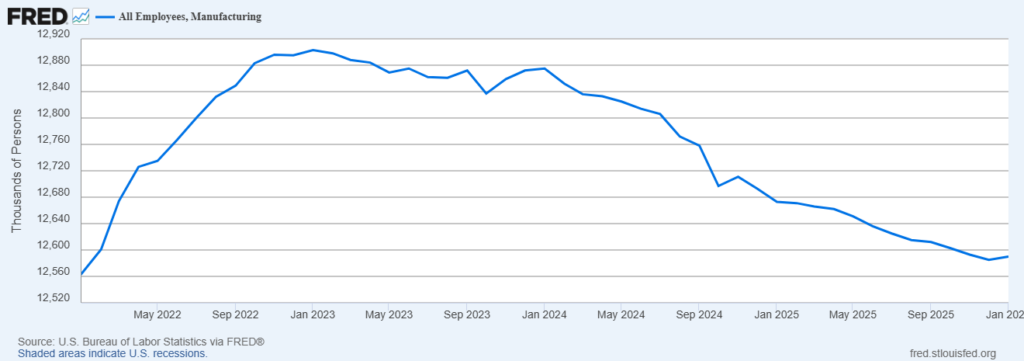
Another stat he conveniently omits: manufacturing employment has declined for nine straight months since Liberation Day. On that day, the White House predicted tariffs would add 2.8 million manufacturing jobs. Instead, we’ve lost 70,000.
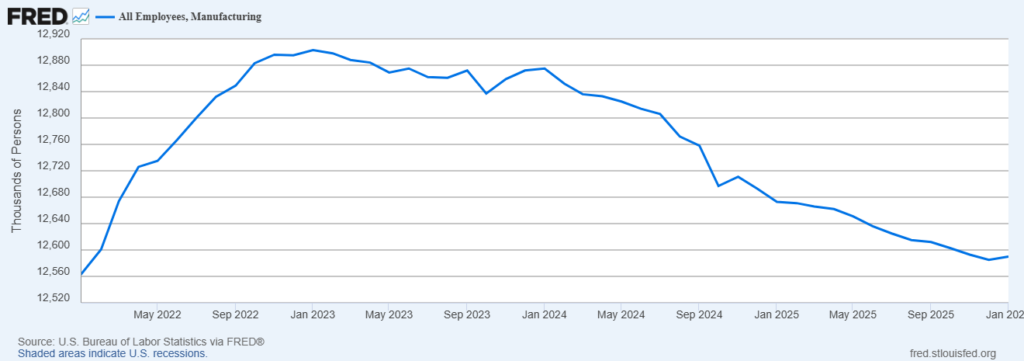
So much for Trump’s claim that tariffs would usher in a “golden age” in which manufacturing factories and jobs come “roaring back.”
But what about inflation? According to Trump, all the experts predicted skyrocketing inflation.
Here again, Trump’s quarrel is with a strawman, not economists.
Economists never said that tariffs immediately or inevitably spark “massive inflation.” If we did, we’d have a devil of a time explaining the massive deflation that followed the infamous Smoot-Hawley tariffs of 1930. (Evidently, Trump skipped this class with his buddy Ferris.)
Our claim has always been more nuanced: Tariffs inflict their harm mostly by distorting relative prices — not setting off ever-accelerating inflation. It’s unlikely, then, that tariffs will show up much in the overall inflation rate. What’s certain, however, is that restricting trade will slow growth by reducing efficiency, leaving consumers with “less bang for their buck.”
Now ask yourself: doesn’t that resonate with your lived experience over the past year?
Trump correctly notes that: “Economic growth does not cause inflation — in fact, often it does the exact opposite.” Hear, hear! Economists agree: higher growth should lower prices, not raise them. So why, then, Mr. President, has inflation risen from 2.3 percent to three percent since April? (Contrary to the administration’s claim that there’s “virtually no inflation.”) Might slower growth and higher import costs be partly to blame? With all the hullabaloo the president has caused over at the BLS, we may never know.
But at least those freeloading foreigners are being forced to “eat the tariffs,” right? Well, about that…
Trump loves to point out that billions in tariff revenue are “pouring in” to the Treasury each month. Economists yearn to snap back: “But who is paying it?!”
In his article, Trump cites a Harvard study that “found” foreigners are paying “at least 80%” of the tariffs. One minor problem: the study found the exact opposite: import prices are rising twice as fast as domestic goods prices, and virtually all of that burden has been borne by US firms and consumers. A different study found that Americans pay 96 percent of the tariffs. Evidently, Trump didn’t do his homework (or perhaps his ghostwriter put too much faith in ChatGPT).
Trump also takes credit for our declining monthly trade deficits. A reporter should follow up by asking: If trade deficits are so bad, Mr. President, then why don’t you cut your own hair to eliminate your trade deficit with your barber? Trade deficits sound scary, but they’re not. They don’t make us poorer. They aren’t akin to budget deficits. They entail no debt and impose zero obligation. They simply reflect net trade flows between nations. Truth be told, economists don’t think there’s any point in tallying trade “deficits.” What matters for our economic wellbeing isn’t net trade flows — it’s the total volume of trade and how easy it is to trade with foreigners. Trade, by definition, makes both sides richer. The more we trade, the better off we are — regardless of which direction that trade flows.
Trump claims he’s used tariff threats to “secure colossal investments in America.” According to the Dealmaker-in-Chief, he’s raised about $20 trillion in foreign direct investment. If that gaudy figure sounds too good to be true, it’s because it is. Turns out, it’s easy for foreigners to pledge big-ticket investments when the numbers are exaggerated, made up, or include projects already in motion. But none of those pesky details matters to the marketing guru in the Oval. Cosmetics trump substance. What matters is that it sounds good and makes for eye-popping headlines.
Trump’s strongest case for restricting trade is national security. Contrary to popular opinion, we economists aren’t dogmatists on this issue. We agree that it’d be defensible to, for instance, cut off trade with Nazi Germany in, say, 1939. A similar logic may apply to restricting sensitive aspects of trade with China today. Contra Trump, the argument here isn’t that restricting trade makes us richer; it’s that it makes us safer. That security may be worth a minor dent in our GDP.
Alas, Trump has turned what should be his strongest case for tariffs into his weakest.
Restricting trade for national security requires tact and the surgical precision of a scalpel. Trump instead went with a sledgehammer. Instead of deftly wielding tariffs to shield strategically-vital industries from bad actors, he slapped them on virtually everyone — friend and foe alike.
Trump’s pugnacious tactics have transformed the US from a reliable trade partner to an economic pariah. Far from using trade as a magnet to bring our friends close and our enemies closer, he’s used it as a wedge to drive everyone away. Latin America and the EU are pivoting east towards China. Even the Canucks are angry with us, for Pete’s sake.
Sure, other nations don’t always play “fair.” Many impose tariffs on American products. But that’s mostly their loss, not ours. Remember: Tariffs are primarily borne by domestic consumers. The fact that some nations slap dumb tariffs on our exports doesn’t mean that we should retaliate by slapping dumb tariffs on theirs. To borrow a nugget of classical parental wisdom: just because your friends jump off the Brooklyn Bridge doesn’t mean you should, too.
Trump should be commended for making his case directly to the public. After four years of a Weekend at Bernie’s presidency, it’s refreshing to see a leader who’s not afraid to speak directly to critics. It’s also nice to see Trump lay out his case so thoughtfully in written form. Aside from his erratic Truths and the occasional birthday letter, Trump rarely expresses himself so revealingly in print. Our Supreme Court Justices no doubt appreciate his candor.
Trump concludes: “Perhaps it’s time for the tariff skeptics” to don one of his signature red caps that reads: “TRUMP WAS RIGHT ABOUT EVERYTHING.”
He’d be wise to heed a proverb from King Solomon: Pride goeth before the fall. Or to put it in non-Biblical terms he’s familiar with: the power of positive thinking ends where reality begins.
Perhaps he’ll get lucky, and the damage wrought by his tariffs will remain hard to trace. Or maybe their unseen costs will eventually become impossible to deny.
If so, his op-ed won’t be remembered as a triumphant victory lap. It’ll be remembered as his embarrassing “Mission Accomplished” moment.